-(1).png)
A PET CT scan (Positron Emission Tomography–Computed Tomography) is the most advanced diagnostic imaging technique for cancer detection, staging, and treatment monitoring. If your oncologist has recommended a PET CT, the two questions that matter most are: how much does it cost in Delhi, and which centre can actually perform the specific scan your doctor has requested?
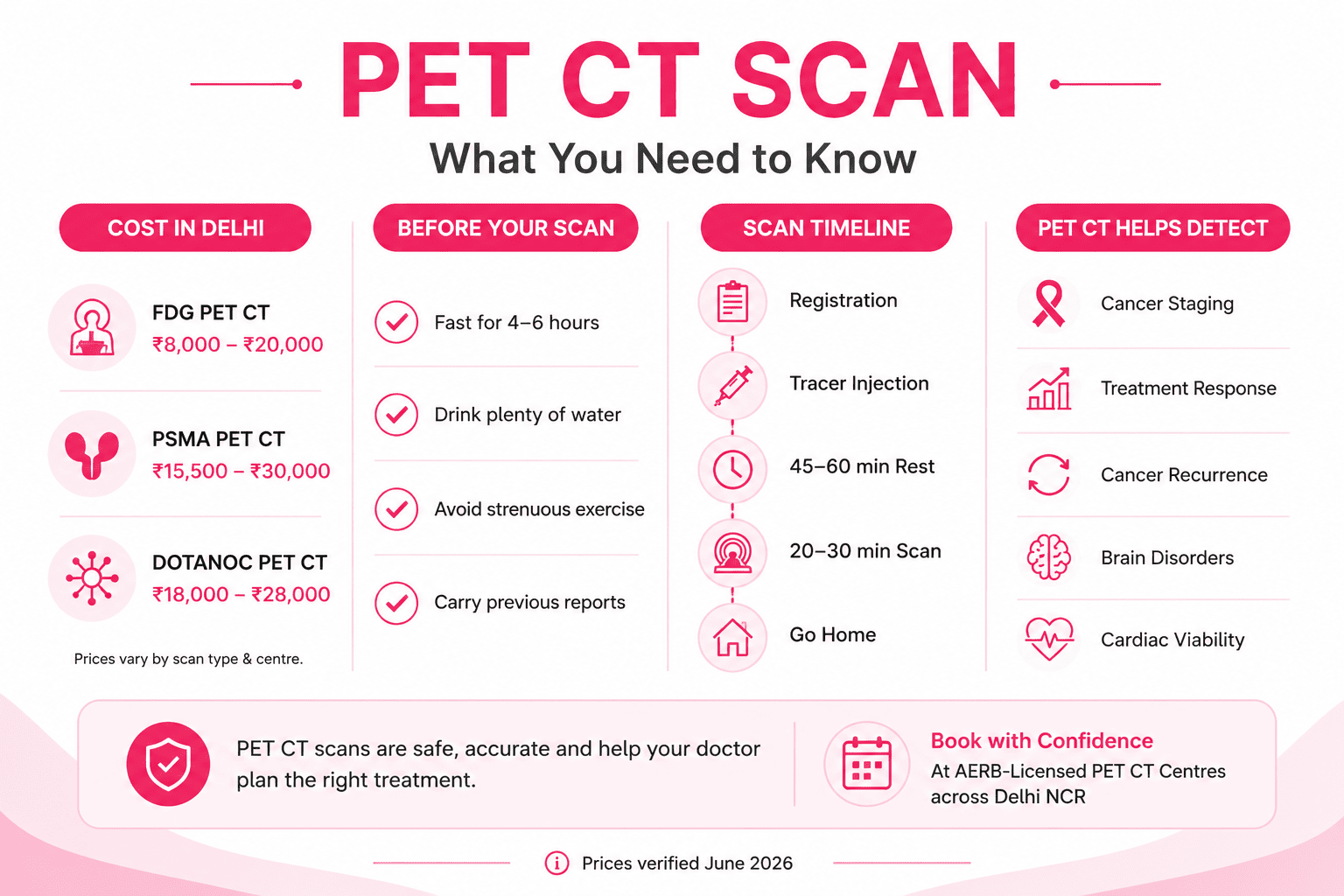
PET CT scan cost in Delhi ranges from ₹10,000 to ₹30,000 in 2026 — depending on the scan type, radiotracer used, and the nuclear medicine facility. Not all diagnostic centres can perform PET CT. EVE Healthcare partner centres for PET CT are exclusively AERB-licensed nuclear medicine facilities with trained nuclear medicine physicians.
PET CT Scan Cost Delhi 2026 — At a Glance
Whole Body FDG PET CT: ₹10,000 – ₹20,000 Brain PET CT: ₹10,000 – ₹18,000 Cardiac PET CT: ₹12,000 – ₹20,000 PSMA PET CT (prostate cancer): ₹17,500 – ₹30,000 Dotanoc / DOTA PET CT (neuroendocrine): ₹18,000 – ₹28,000 F-DOPA PET CT (Parkinson's): ₹18,000 – ₹28,000 Bone Scan / SPECT: ₹6,000 – ₹10,000
Prices verified June 2026. All prices reflect EVE Healthcare partner network — AERB-licensed standalone nuclear medicine centres. Hospital rates excluded.
PET CT Scan Cost Delhi 2026 — Quick Answers
|
Scan Type |
Price Range |
|
Whole Body FDG PET CT Delhi |
₹10,000 – ₹20,000 |
|
Brain PET CT Delhi |
₹10,000 – ₹18,000 |
|
Cardiac PET CT Delhi |
₹12,000 – ₹20,000 |
|
PSMA PET CT Delhi (prostate cancer) |
₹17,500 – ₹30,000 |
|
Dotanoc / DOTA PET CT Delhi (neuroendocrine) |
₹18,000 – ₹28,000 |
|
F-DOPA PET CT Delhi (Parkinson's) |
₹18,000 – ₹28,000 |
|
Paediatric FDG PET CT Delhi |
₹14,000 – ₹22,000 |
|
Bone Scan / SPECT Delhi |
₹6,000 – ₹10,000 |
PET CT Scan Price List Delhi 2026 — By Scan Type
|
PET CT Scan Type |
Lowest (₹) |
Average (₹) |
Premium (₹) |
Radiotracer |
Primary Use |
|
Whole Body FDG PET CT |
10,000 |
14,000 |
20,000 |
18F-FDG |
Cancer staging, treatment response, lymphoma, lung, breast, PUO |
|
Brain FDG PET CT |
10,000 |
13,000 |
18,000 |
18F-FDG |
Alzheimer's, epilepsy, brain tumour, dementia workup |
|
Cardiac FDG PET CT |
12,000 |
15,000 |
20,000 |
18F-FDG |
Myocardial viability, cardiac sarcoidosis |
|
PSMA PET CT |
17,500 |
22,000 |
30,000 |
68Ga-PSMA |
Prostate cancer staging, recurrence detection |
|
Dotanoc / DOTA PET CT |
18,000 |
22,000 |
28,000 |
68Ga-DOTA |
Neuroendocrine tumours (NETs) |
|
F-DOPA PET CT |
18,000 |
22,000 |
28,000 |
18F-DOPA |
Parkinson's disease, neuroendocrine, dopamine imaging |
|
Paediatric FDG PET CT |
14,000 |
17,000 |
22,000 |
18F-FDG (paed. dose) |
Paediatric oncology, rare tumours |
|
Bone Scan / SPECT |
6,000 |
7,500 |
10,000 |
Tc-99m MDP |
Bone metastases, transthyretin amyloidosis |
Prices verified June 2026 from EVE Healthcare partner network. "Lowest" = AERB-licensed standalone nuclear medicine labs. "Average" = accredited nuclear medicine centres. "Premium" = large multi-speciality nuclear medicine facilities. PSMA, Dotanoc, and F-DOPA require cyclotron facilities and are not available at every centre — confirm tracer availability before booking.
Where These Prices Come From
The price ranges on this page are compiled from EVE Healthcare's active partner network of AERB-licensed nuclear medicine centres across Delhi NCR. Our team contacts partner centres directly each quarter to verify current pricing and tracer availability — we do not pull prices from third-party aggregators or hospital websites.
Methodology: Prices reflect rates available for direct booking through EVE Healthcare. Hospital nuclear medicine department rates are excluded — they typically charge 30–50% above standalone nuclear medicine centre rates for equivalent scan quality. The "Lowest" reflects the floor price at EVE partner centres. The "Average" reflects the median across our active network. The "Premium" reflects the upper range at large private nuclear medicine facilities in South Delhi and Gurgaon.
Prices reviewed quarterly. Last verified: June 2026. Next review: September 2026.
What is a PET CT Scan and How is it Different?
Unlike MRI and CT — which show anatomy (what structures look like) — PET CT shows metabolic activity, what cells are actually doing at a molecular level. Cancer cells consume glucose at a much higher rate than normal tissue. By injecting a radioactive glucose tracer (FDG — fluorodeoxyglucose), areas of abnormal metabolic activity light up on the scan — allowing detection of cancer at the cellular level, often before any structural changes appear on CT or MRI.
A PET CT combines two scans in a single session: the PET component maps metabolic activity across the whole body, and the CT component provides the anatomical reference map. Together, they give your oncologist a precise picture of disease location, spread, and treatment response — in one visit.
|
Feature |
PET CT |
MRI |
CT Scan |
|
What it shows |
Metabolic activity + anatomy |
Soft tissue anatomy |
Structural anatomy |
|
Best for |
Cancer staging, treatment monitoring, neuro |
Soft tissue, brain, joints, spine |
Bone, chest, emergency, vascular |
|
Radiation |
Low (radiotracer + CT component) |
None |
Low-moderate |
|
Duration |
2–3 hours including uptake |
30–60 min |
5–15 min |
|
Cost Delhi 2026 |
₹10,000 – ₹30,000 |
₹4,000 – ₹25,000 |
₹1,500 – ₹14,000 |
|
Special prep |
Yes — fasting, glucose control, no exercise |
Varies |
Varies |
PSMA PET CT in Delhi — Prostate Cancer Scan
PSMA (Prostate-Specific Membrane Antigen) PET CT is the most sensitive imaging technique currently available for prostate cancer — far more accurate than conventional CT and bone scan for detecting small lymph node metastases and bone lesions, even at very low PSA levels.
When PSMA PET CT is ordered:
- Initial staging of high or intermediate-risk prostate cancer
- Detection of biochemical recurrence after surgery or radiotherapy — even at PSA as low as 0.2 ng/mL
- Patient selection and response monitoring for PSMA-targeted therapy (177Lu-PSMA)
- Equivocal findings on conventional imaging
Cost in Delhi 2026: ₹17,500 – ₹30,000. Requires 68Ga-PSMA tracer produced at cyclotron facilities. Not available at all nuclear medicine centres — confirm tracer availability on your specific appointment date before travelling.
What to bring: Recent KFT (kidney function test) and serum creatinine report — most centres require this before the scan. Fast for 4–6 hours. Water allowed freely. No carbohydrate restriction required (unlike FDG PET CT).
See our dedicated PSMA PET CT Cost Delhi .
Dotanoc / DOTA PET CT in Delhi — Neuroendocrine Tumour Scan
Dotanoc (68Ga-DOTATOC or DOTATATE) PET CT is the gold-standard investigation for neuroendocrine tumours (NETs) — a diverse group of tumours arising from hormone-secreting cells found throughout the body. It detects somatostatin receptor-expressing tumours with far greater sensitivity than conventional CT or octreotide scintigraphy.
When Dotanoc PET CT is ordered:
- Staging of confirmed NETs (carcinoid, gastrinoma, insulinoma, phaeochromocytoma, paraganglioma)
- Localising an unknown primary tumour with suspected neuroendocrine origin
- Before Peptide Receptor Radionuclide Therapy (PRRT / 177Lu-DOTATATE)
- Post-treatment follow-up
Cost in Delhi 2026: ₹18,000 – ₹28,000. Cyclotron facility required. Preparation is less stringent than FDG PET CT — no carbohydrate restriction, fast for 4–6 hours, water allowed freely.
See our dedicated Dotanoc PET CT Cost Delhi .
PET CT Scan Radiation — Is It Safe?
|
Scan Type |
Approx Radiation Dose |
Equivalent Background Radiation |
|
Whole Body FDG PET CT |
7 – 8 mSv |
~3 years |
|
Brain / Cardiac FDG PET CT |
5 – 7 mSv |
2 – 3 years |
|
PSMA PET CT (68Ga) |
5 – 6 mSv |
~2 years |
|
Dotanoc PET CT (68Ga) |
5 – 6 mSv |
~2 years |
|
CT component alone within PET CT |
4 – 6 mSv |
~2 years |
The radiation from a standard PET CT scan is low in absolute terms and considered safe for diagnostic use. For patients undergoing cancer staging or treatment monitoring, the clinical benefit far outweighs the radiation exposure. The FDG radiotracer has a very short half-life — 110 minutes for F-18 — and is largely eliminated through urination within hours.
PET CT is not recommended in pregnancy except in life-threatening situations. If you are pregnant or may be pregnant, inform your nuclear medicine physician before any injection is given.
Scan Anxiety — What PET CT Patients Actually Experience
PET CT is almost exclusively ordered for patients dealing with a cancer diagnosis or serious neurological condition. The wait between scan and results is one of the most stressful periods patients describe. This is normal, expected, and acknowledged by every experienced nuclear medicine team.
What to expect on the day — honestly:
The appointment is long — plan for 2.5 to 3 hours at the centre. The first 15 minutes are a blood glucose check and registration. The FDG injection itself takes seconds and is no more uncomfortable than a standard blood draw. You then rest in a recliner in a quiet, dimly lit room for 45–60 minutes while the tracer distributes — this is the uptake period. Most patients find this the hardest part, simply because there is nothing to do but wait and think.
The scan itself is very similar to a CT scan — you lie on a flat bed that moves through a large ring. It takes 20–30 minutes. The machine makes no loud sounds unlike an MRI. You will be asked to keep your arms above your head for part of the scan.
A few things that genuinely help:
- Bring headphones — centres typically allow music during the uptake period and some during the scan
- Wear warm, comfortable clothes — the uptake room is kept cool to reduce brown fat FDG uptake, and you will be sitting still for nearly an hour
- Bring someone with you — not for clinical reasons, but because waiting alone for 3 hours is harder than it needs to be
- The report is not available immediately — most centres provide it within 24 hours. Your oncologist reviews it with you in context of your full clinical picture, not in isolation
EVE Healthcare booking team will confirm your preparation instructions, arrival time, and KFT report requirements when you book — so nothing is a surprise on the day.
What to Bring to Your PET CT Appointment
|
Item |
Required / Recommended |
|
Doctor's referral / prescription |
Required — most AERB centres will not scan without one |
|
KFT / serum creatinine report (recent) |
Required for PSMA PET CT; recommended for all |
|
Fasting blood glucose report (diabetic patients) |
Required — glucose must be below 150–180 mg/dL |
|
Previous scan reports / CDs (CT, MRI, prior PET CT) |
Strongly recommended — helps nuclear medicine physician for comparison |
|
CGHS / ECHS card (if applicable) |
Required for CGHS rates |
|
Comfortable warm clothing |
Recommended — uptake room is cool |
|
Companion |
Recommended — 3-hour appointment, emotionally demanding |
|
Water bottle |
Recommended — drink freely before and after |
CGHS Rates for PET CT Scans in Delhi
|
PET CT Scan |
Non-NABH Rate (₹) |
NABH Rate (₹) |
|
Whole Body FDG PET CT |
10,413 |
12,250 |
|
Brain / Heart FDG PET CT |
12,219 |
14,375 |
|
Gallium-68 Peptide PET CT (Dotanoc — Neuroendocrine) |
12,219 |
14,375 |
|
PSMA PET CT |
12,750 |
15,000 |
|
F-DOPA PET CT |
12,750 |
15,000 |
Source: CGHS Rate Schedule 2025, Ministry of Health & Family Welfare, Government of India.
To avail CGHS rates: Bring your CGHS Smart Card and a valid referral letter from a CGHS-approved specialist — oncologist, nuclear medicine physician, or neurologist. A general OPD referral is insufficient at most empanelled centres. ECHS beneficiaries must confirm empanelment separately before visiting.
How to Prepare for a PET CT Scan — Complete Guide
PET CT preparation is more demanding than any other diagnostic imaging test. Deviating from these instructions can invalidate the scan and require a repeat visit.
24–48 hours before
- Avoid strenuous exercise — muscle activity increases FDG uptake in muscles and creates false positives that can be misread as disease
- Avoid high-carbohydrate foods, sugary drinks, fruit juices, and sweets for 24 hours — high blood glucose competes with FDG uptake in tumour cells and directly reduces scan sensitivity
- Avoid alcohol for 24 hours
Day of the scan
- Fast for 4–6 hours. Water is allowed freely and encouraged
- Avoid all caffeine on the day of the scan
- Take regular medications with a small amount of water — unless your nuclear medicine physician has specified otherwise
- Wear comfortable, loose, warm clothing
- Diabetic patients: Bring your fasting blood sugar report. Glucose must be below 150–180 mg/dL. Contact your nuclear medicine centre before the appointment to confirm insulin and medication adjustments — do not assume standard preparation applies
At the centre
- Blood glucose checked on arrival — if above threshold, scan may be rescheduled
- FDG (or other radiotracer) injected intravenously — small cannula placed in the arm
- Rest quietly for 45–60 minutes during uptake — avoid talking, walking, or jaw movement
- Scan takes 20–30 minutes in the machine
After the scan
- Drink 2–3 litres of water over the rest of the day to flush the radiotracer
- Normal activities resume immediately — radiation levels drop rapidly
- Breastfeeding mothers: Pause breastfeeding for 12–24 hours and discard expressed milk. Consult your nuclear medicine physician for specific guidance
Understanding Your PET CT Report
|
Term |
What It Means |
|
SUVmax |
Standardised Uptake Value maximum — how much FDG a lesion absorbed. Above 2.5 in a lung nodule is suspicious for malignancy; threshold varies by organ |
|
FDG-avid / avid lesion |
Area with increased metabolic activity — requires clinical interpretation by your oncologist |
|
Non-avid |
No significant FDG uptake — often reassuring, though context matters |
|
Metabolic complete response (MCR) |
No residual FDG-avid disease after treatment — a positive treatment outcome |
|
Partial metabolic response |
Reduction in FDG uptake vs previous scan — treatment is having effect |
|
Progressive metabolic disease |
Increase in FDG uptake or new lesions — treatment response is inadequate |
|
Deauville score |
5-point scale for lymphoma treatment response (1 = no uptake, 5 = marked new uptake) |
|
PSMA-avid |
Lesion expressing PSMA — relevant only in PSMA PET CT for prostate cancer |
|
Physiological uptake |
Normal FDG uptake in brain, heart, kidneys, bladder — not a disease finding |
|
SUVpeak / SUVmean |
Variations of SUV measurement used in some reporting protocols |
Always have your PET CT report reviewed by the oncologist who ordered it. Nuclear medicine reports contain quantitative technical language that only makes clinical sense in the context of your full treatment history, pathology results, and prior imaging.
PET CT Scan Centres in Delhi NCR
|
Area |
Available |
Scan Types |
Price Range |
|
South Delhi (Saket, Hauz Khas, GK) |
Yes — multiple |
FDG, PSMA, Dotanoc, F-DOPA |
₹14,000 – ₹28,000 |
|
Central Delhi (Green Park, Pusa Rd, AIIMS area) |
Yes — multiple |
FDG whole body + brain + cardiac |
₹10,000 – ₹20,000 |
|
North Delhi (Rohini, Karkardooma) |
Yes |
FDG whole body |
₹10,000 – ₹18,000 |
|
West Delhi (Rajouri Garden, Janakpuri) |
Yes |
FDG whole body |
₹10,000 – ₹18,000 |
|
Noida (Sec 18, 62) |
Yes |
FDG, PSMA |
₹12,000 – ₹22,000 |
|
Gurgaon (DLF, Sector 38) |
Yes — multiple |
FDG, PSMA, Dotanoc |
₹14,000 – ₹25,000 |
|
Faridabad |
Limited |
FDG whole body |
₹10,000 – ₹18,000 |
|
Ghaziabad / Indirapuram |
Limited |
FDG whole body |
₹10,000 – ₹17,000 |
PSMA, Dotanoc, and F-DOPA tracers are available at select centres only. Do not travel without confirming your tracer is available on your appointment date — call the centre directly when booking.
Book Your PET CT Scan in Delhi
EVE Healthcare partner centres for PET CT are AERB-licensed nuclear medicine facilities across Delhi, Noida, and Gurgaon. FDG whole-body, brain, and cardiac PET CT are available across the network. PSMA, Dotanoc, and F-DOPA are available at select centres.
Tap the WhatsApp button or use the search tool above. Our booking team confirms tracer availability, preparation instructions, KFT report requirements, and your exact appointment slot before you travel.
Also see: MRI Scan Cost Delhi → · CT Scan Cost Delhi → · Fibroscan Cost Delhi → · PSMA PET CT Cost Delhi → · Dotanoc PET CT Cost Delhi →· CGHS Diagnostic Centres Delhi
.png)
.png)