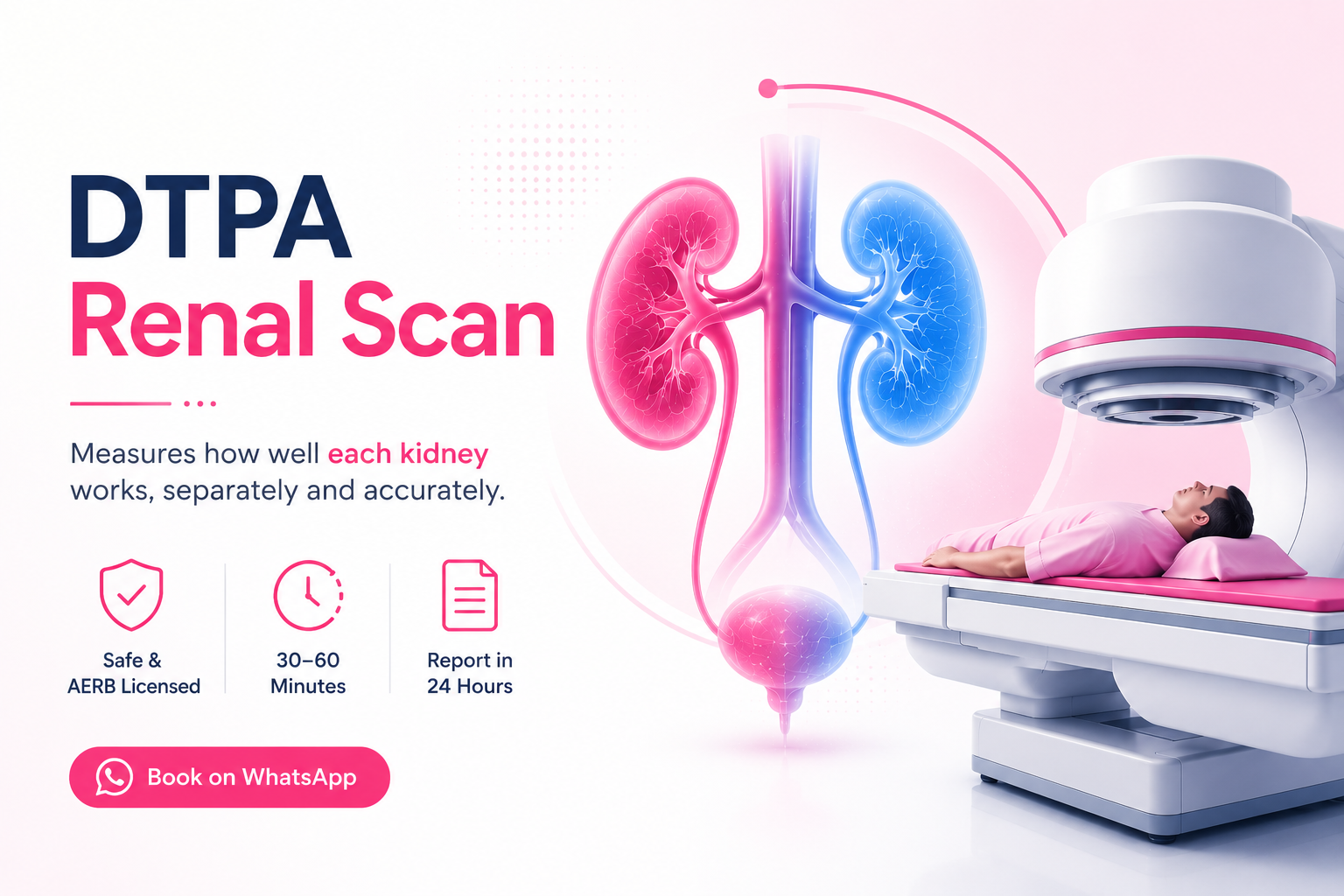
A DTPA renal scan is the only routine test that tells you how well each kidney works on its own. A blood creatinine test gives you one combined number for both. A DTPA scan separates them, showing the glomerular filtration rate of the left kidney and the right kidney individually, along with whether urine is draining freely or blocked.
EVE Healthcare offers DTPA renal scan across Delhi NCR at AERB-licensed nuclear medicine centres from ₹3,999, reported by a qualified nuclear medicine physician within 24 hours. The scan takes 30 to 60 minutes, requires no fasting, and reports are delivered on WhatsApp and email. Book on WhatsApp or call +91 9990032078.
What a DTPA Renal Scan Actually Measures
Tc-99m DTPA is cleared from the blood almost entirely by glomerular filtration. That single property is what makes the scan work. When the tracer is injected, the fraction each kidney takes up in the first two to three minutes is directly proportional to that kidney's filtration rate.
A gamma camera captures this in real time, and the software computes four things from it: the split renal function, meaning what percentage of total kidney function each side contributes; the GFR for each kidney separately, calculated by the Gates method; renal blood flow, or perfusion; and drainage, showing whether urine flows freely or is obstructed. The radionuclide GFR derived this way correlates closely with 24-hour creatinine clearance, and it requires no blood or urine collection at all.
Why a Blood Test Cannot Replace It
This is the part most pages skip. Serum creatinine, eGFR, and cystatin C give a single combined number for both kidneys together. They also lag, moving only once function is already significantly impaired, and they cannot tell you which kidney is failing.
If one kidney is quietly doing seventy percent of the work while the other manages thirty, your creatinine may still read as normal. Only a DTPA scan reveals that split. That is why nephrologists and urologists order it before nephrectomy, before transplant, and whenever hydronephrosis is suspected.
What Is a Diuretic DTPA Scan?
A diuretic DTPA scan adds an injection of furosemide (Lasix) during imaging. It answers one question that no other test answers cleanly: is a swollen kidney truly obstructed, or simply dilated?
If the kidney drains promptly after furosemide despite the dilation, true obstruction is ruled out. If drainage stays delayed or absent, obstruction is confirmed. This is the standard investigation for hydronephrosis before any surgical decision, because operating on a dilated but unobstructed collecting system helps nobody.
Who Needs a DTPA Renal Scan?
The most common reason is hydronephrosis, where the scan determines whether the swelling reflects true obstruction. It is also standard before nephrectomy, to confirm the remaining kidney has enough function to carry the load alone, and in living kidney donor workup, where most transplant centres require a total GFR of at least 80 mL/min for a donor to be accepted. Because DTPA gives both the total and the split, it answers both questions in one sitting.
Beyond that, it is used to monitor a transplanted kidney after surgery, to investigate renovascular hypertension when paired with a captopril challenge that can expose renal artery narrowing as the cause of high blood pressure, and to track each kidney's contribution over time in chronic kidney disease.
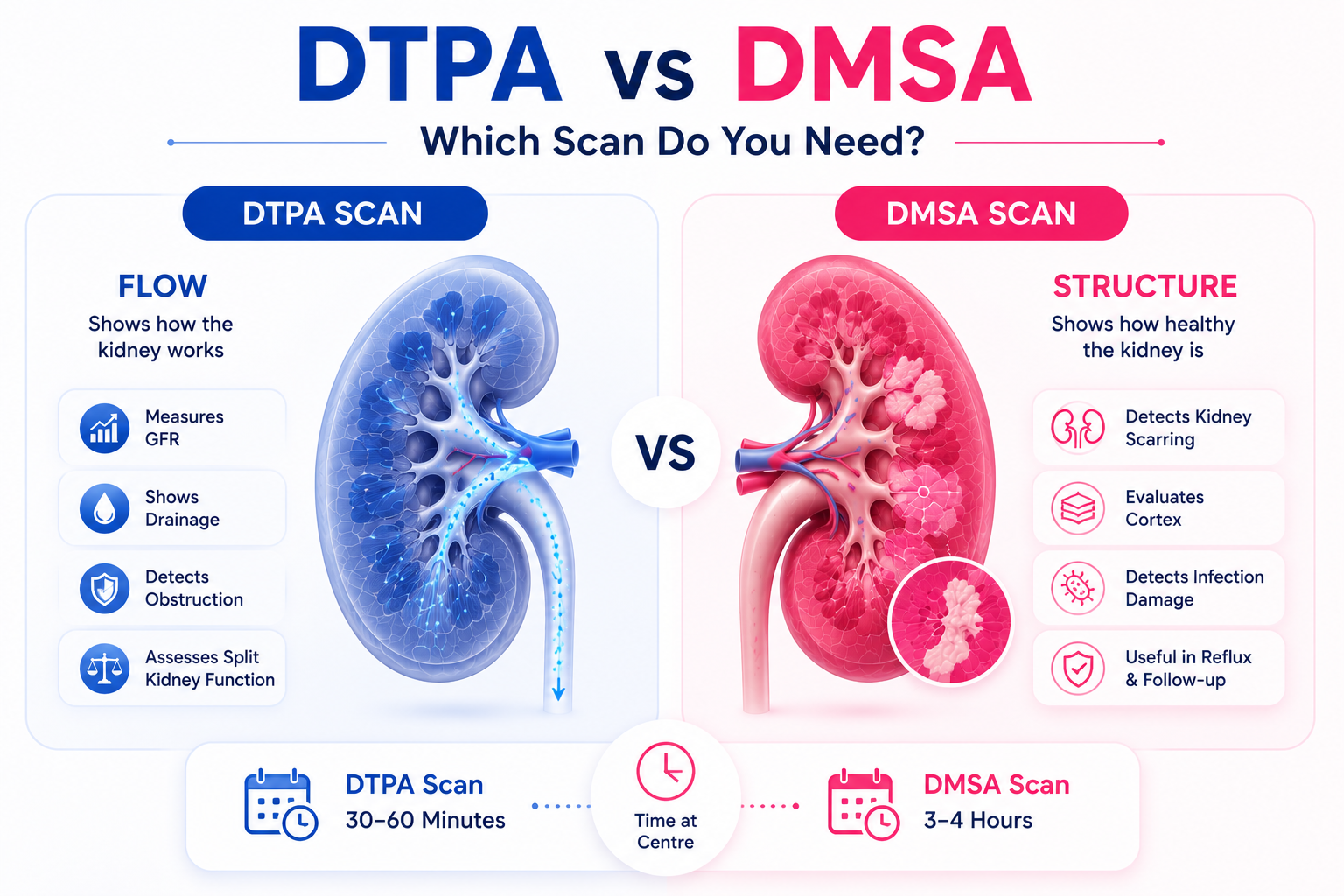
DTPA vs MAG3 vs DMSA
These three nuclear renal scans are not interchangeable, and choosing the wrong one means the scan cannot answer your doctor's question.
| DTPA | MAG3 | DMSA | |
|---|---|---|---|
| Cleared by | Glomerular filtration | Tubular secretion (90%) | Bound to cortical tubules |
| Type | Dynamic | Dynamic | Static |
| Measures GFR? | Yes, directly | No | No |
| Best for | GFR, split function, obstruction | Same, but when function is poor | Cortical scarring, pyelonephritis |
| Duration | 30 to 60 min | 30 to 60 min | 3 to 4 hours |
One clinically important nuance rarely explained: DTPA's variable binding to plasma proteins can underestimate GFR, and when kidney function is significantly reduced, DTPA images become faint. In poor renal function, in infants, or wherever image quality matters more than an exact GFR figure, many nuclear medicine physicians prefer MAG3, which the kidneys take up far more avidly. DTPA remains the standard where an actual GFR value is what the clinician needs.
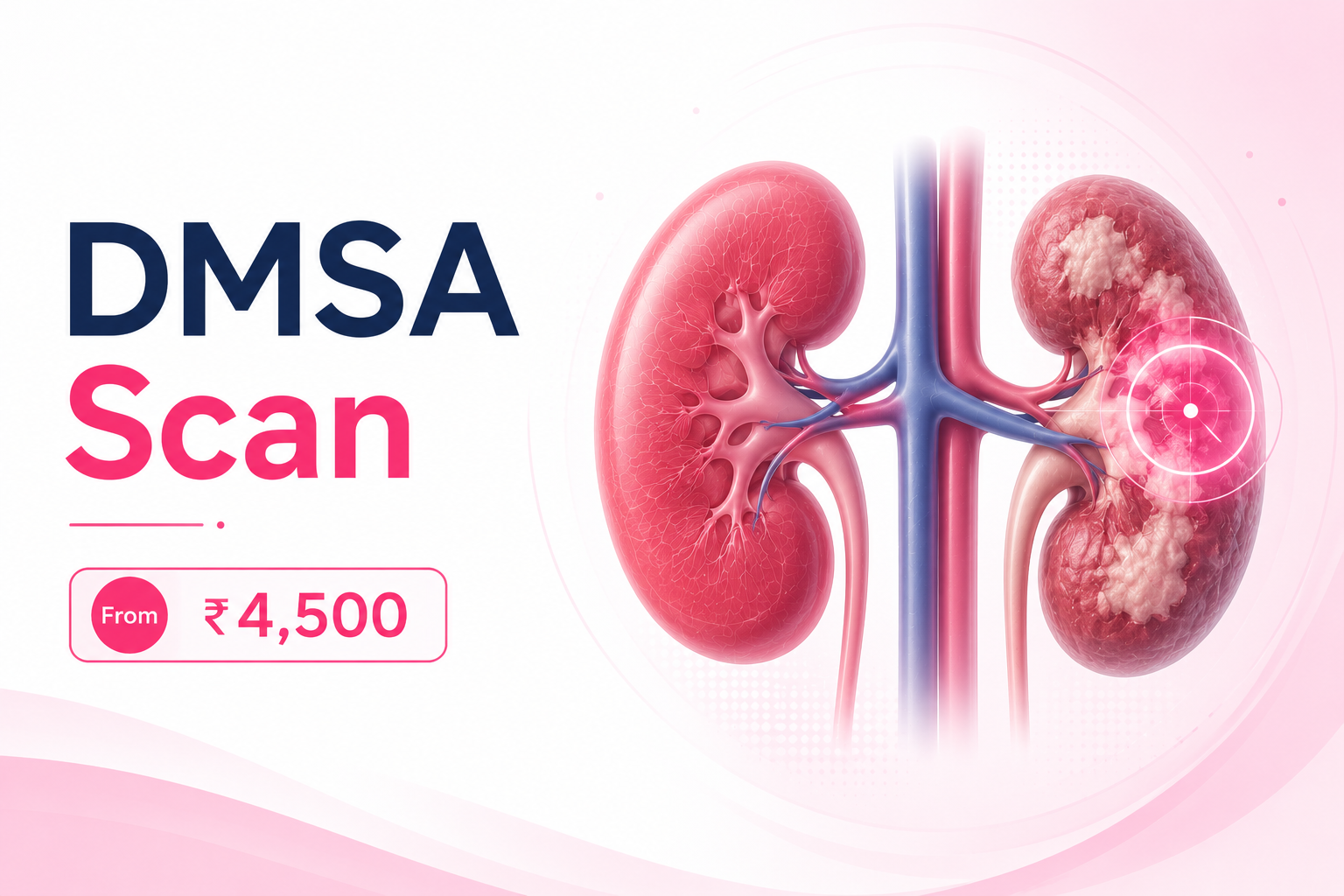
If your doctor has ordered a DMSA scan instead, that is a different question entirely, concerning cortical scarring rather than drainage. Always follow your specialist's prescription, and never substitute one scan for another to save cost.
DTPA Renal Scan Cost in Delhi NCR
| Scan | EVE Healthcare | Typical Delhi range | CGHS (NABH) |
|---|---|---|---|
| DTPA Renal Scan | from ₹3,999 | ₹3,500 – ₹19,500 | ₹3,500 – ₹4,500 |
| Diuretic DTPA (furosemide) | ₹4,500 – ₹8,000 | ₹4,000 – ₹12,000 | ₹4,000 – ₹5,000 |
The wide spread across Delhi is mostly hospital overheads rather than any difference in scan quality. What actually determines whether your report is usable is the AERB licence and whether a qualified nuclear medicine physician interprets it. EVE Healthcare partner centres are AERB-licensed, with CGHS and ECHS cashless available at empanelled centres and reports delivered within 24 hours.
How to Prepare
There is very little to it. Drink two to three glasses of water half an hour before you arrive, since hydration directly improves image quality. Eat normally, as no fasting is required, and continue your regular medications, including blood pressure tablets.
One exception matters. If you take ACE inhibitors or ARBs, tell the nuclear medicine physician in advance. These may need to be withheld for two to three days before a captopril DTPA scan for suspected renovascular hypertension, because they interfere with exactly what the test is trying to detect. Bring your specialist's prescription, as AERB-licensed centres cannot proceed without one, and tell the physician if you are or may be pregnant, or breastfeeding.
On the day, a small IV line is placed for the tracer injection and imaging begins immediately. You lie still while the gamma camera records, for thirty to sixty minutes. Afterwards you resume normal activity straight away, drinking plenty of water so the tracer clears naturally in urine.
Is a DTPA Renal Scan Safe?
Yes. The Tc-99m tracer dose is small, comparable to a few months of natural background radiation, and clears through the kidneys within hours. There is no iodinated contrast dye and therefore no risk of contrast nephropathy, which is one reason it is preferred over CT in patients whose kidney function is already reduced. Side effects are rare. It is avoided in pregnancy.
What to Confirm Before Booking
Confirm the centre holds a valid AERB licence, which is mandatory for every nuclear medicine scan performed in India, and that a qualified nuclear medicine physician reads and signs the report rather than a technician. Ask whether the gamma camera is operational on your appointment date and whether the tracer will be available, because Tc-99m has a half-life of roughly six hours and is prepared in batches, so centres schedule around it rather than keeping it in stock. Check the report turnaround, which should be within 24 hours, and if you are a CGHS or ECHS beneficiary, confirm empanelment for this specific scan rather than assuming general empanelment covers it.
Related Scans
Book your DTPA renal scan — WhatsApp +91 9990032078 or call. AERB-licensed nuclear medicine centres across Delhi NCR · From ₹3,999 · Reports in 24 hours.
.png)
-(1).png)
.png)