
-(1).png)
CT KUB cost in Delhi ranges from ₹1,500 to ₹4,500 at NABL-accredited standalone diagnostic labs in 2026. If you have been referred for a CT KUB — or you have flank pain and are searching for where to get this scan in Delhi — this page gives you the cost, the preparation, what the scan actually is, and the one clinical distinction that prevents the most common booking error.
Quick Answers — CT KUB Delhi 2026
NCCT KUB — standalone NABL lab: ₹1,500 – ₹4,500 NCCT KUB — private hospital: ₹4,000 – ₹8,000 CT Urogram (contrast) — standalone lab: ₹4,000 – ₹8,000 CGHS rate (NABH-accredited): ₹2,000 No fasting required: Eat normally before NCCT KUB No contrast injection: NCCT KUB is done without dye Same-day availability: Yes — across Delhi NCR Report time: 1–3 hours at EVE partner centres
The Most Important Thing to Know Before Booking
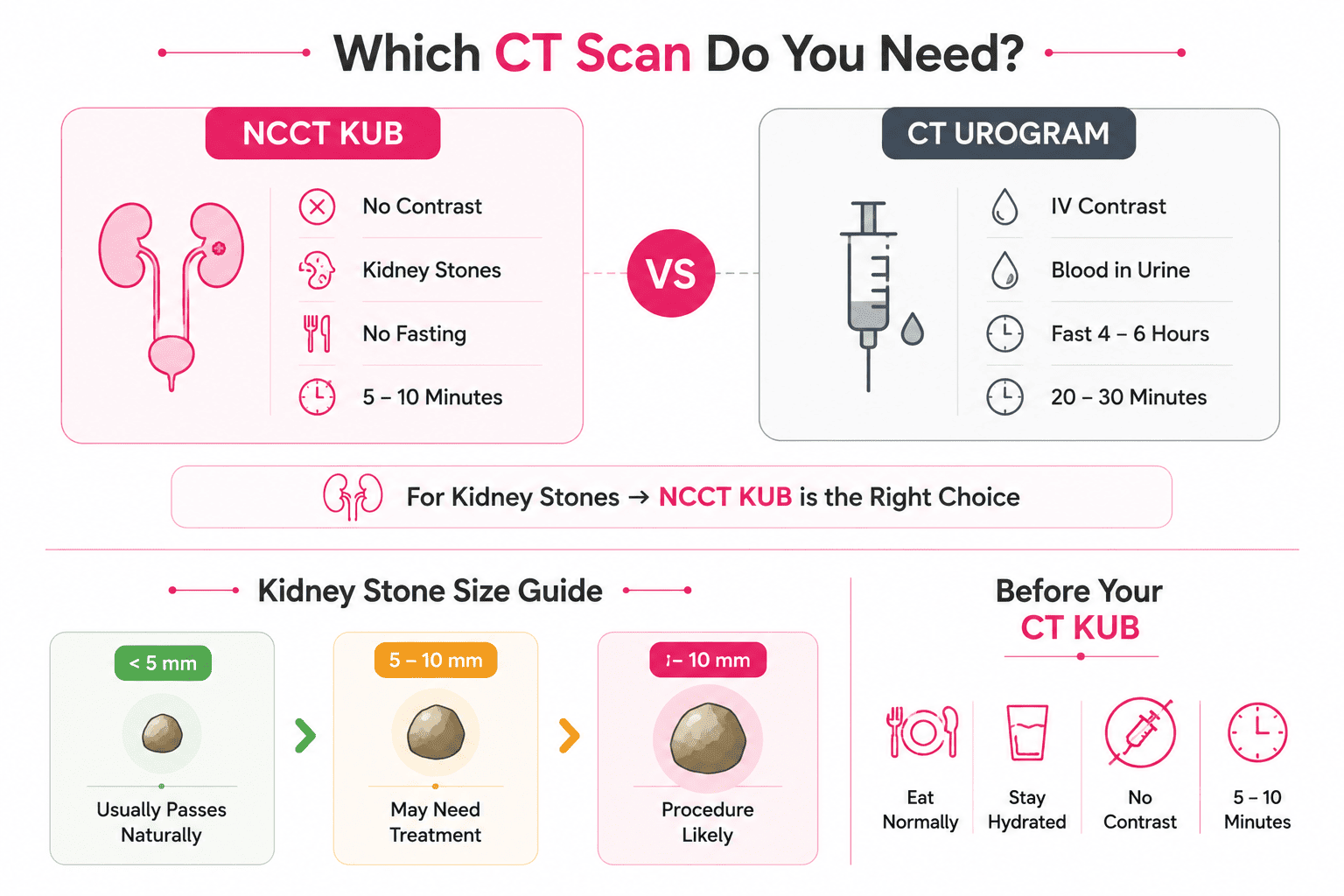
CT KUB for kidney stones is done WITHOUT contrast. Never WITH contrast.
CT KUB allows a rapid, contrast-free, anatomically accurate diagnosis of urolithiasis — kidney and ureteral stones — with a sensitivity of 97–98% and a specificity of 96–100%. AJR
Kidney stones are naturally hyperdense — they appear bright white on CT images without any contrast dye. Adding contrast does not improve stone detection. It adds cost, preparation time, an IV injection, and for diabetic patients on metformin — the requirement to pause metformin before and after the scan.
The most common CT KUB booking error in Delhi: Patients told "CT KUB" by their doctor call the centre and ask for "CT abdomen with contrast" — assuming any abdominal CT needs contrast dye. The centre books a contrast CT. The patient pays ₹2,000–₹4,000 more than necessary and gets an IV injection they did not need.
The correct investigation for kidney stones is NCCT KUB — Non-Contrast CT of the Kidneys, Ureters, and Bladder.
Tell the centre exactly this: "I need NCCT KUB — non-contrast — for kidney stones." Or share your prescription and EVE's team will confirm the correct investigation.
What Is CT KUB — In Plain Language
CT KUB stands for Computed Tomography of the Kidneys, Ureters, and Bladder. NCCT stands for Non-Contrast CT — meaning no dye injection.
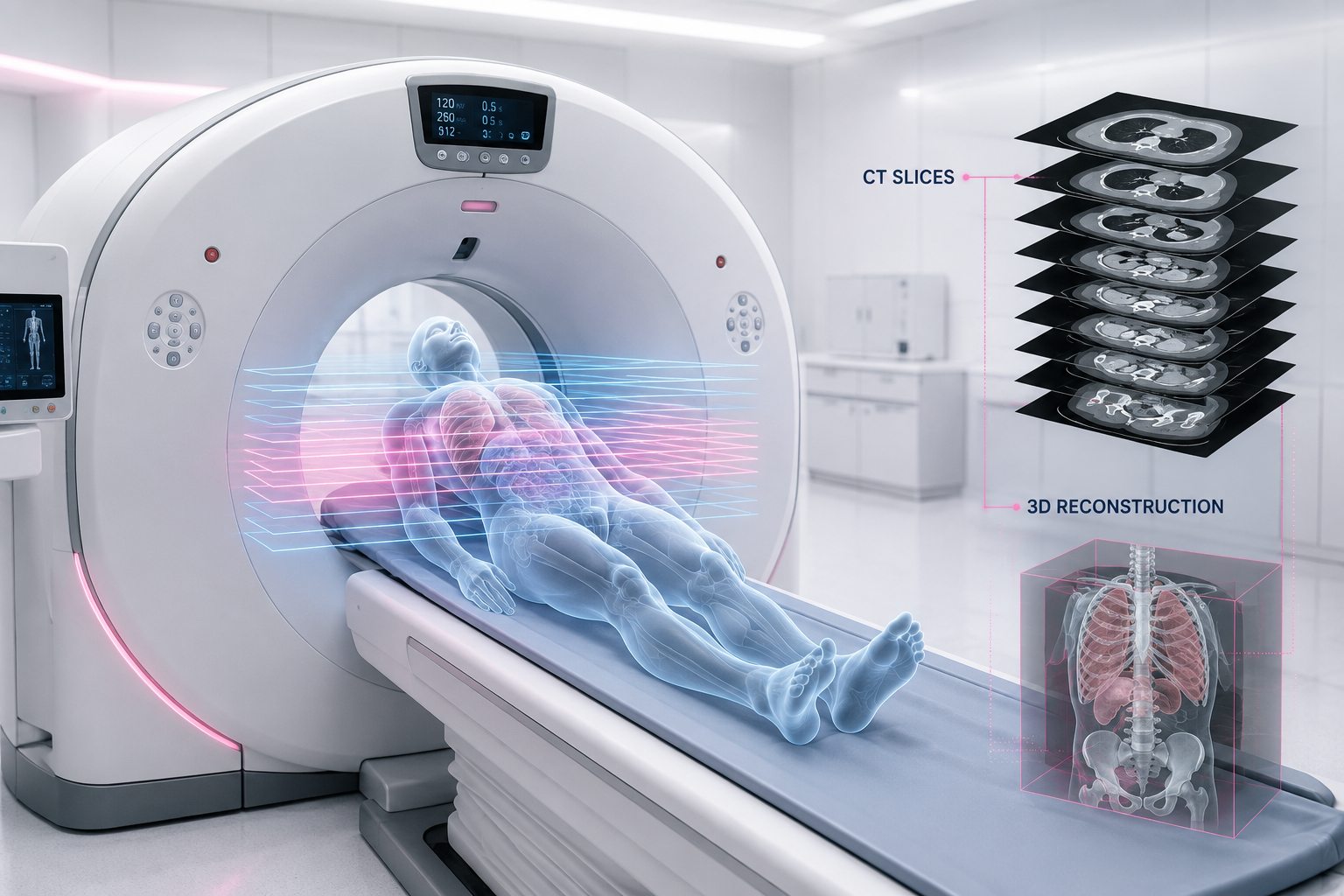
The scan creates detailed cross-sectional images of the entire urinary tract from the kidneys down to the bladder. It takes 5–10 minutes on the scanner. You lie on your back, the CT table moves through the scanner ring, and you are asked to hold your breath for a few seconds during the scan.
What CT KUB shows:
- Kidney stones (renal calculi) — size, location, density
- Ureteral stones — anywhere along the ureter from kidney to bladder
- Bladder stones
- Hydronephrosis — swelling of the kidney from blocked urine flow
- Ureteral obstruction — whether a stone is blocking urine flow
- Incidental findings — other kidney, liver, or abdominal abnormalities
Both the European Association of Urology and the American Urological Association recommend NCCT KUB as the standard of care for kidney stone detection and post-treatment confirmation of stone clearance.
Why not ultrasound instead? Ultrasonography has decreased sensitivity and specificity compared with NCCT for detection of both renal and ureteral calculi — especially ureteral stones, which ultrasound frequently misses. Ultrasound is appropriate as a first-line investigation in pregnant women and children where radiation reduction is a priority. For adults with suspected ureteral colic, NCCT KUB is the correct investigation. AuntMinnie
CT KUB vs CT Urogram — Which Does Your Doctor Mean?
Two different investigations. Frequently confused. Must clarify before booking.
|
Feature |
NCCT KUB |
CT Urogram (CECT KUB) |
|
Contrast injection |
No |
Yes — IV iodine dye |
|
Primary use |
Kidney and ureteral stones |
Haematuria (blood in urine), urinary tract tumours, obstruction assessment |
|
Fasting required |
No |
Yes — 4–6 hours |
|
Metformin pause (diabetics) |
No |
Yes — 48 hours before and after |
|
Cost in Delhi |
₹1,500 – ₹4,500 |
₹4,000 – ₹8,000 |
|
Duration on scanner |
5–10 minutes |
20–30 minutes (multiple phases) |
If your prescription says: "CT KUB" or "NCCT KUB" or "non-contrast CT kidney" — book NCCT KUB. No contrast.
If your prescription says: "CT urogram" or "CECT KUB" or "CT IVP" — book CT urogram with contrast. Confirm fasting and metformin pause if you are diabetic.
If unsure: Share your prescription with EVE Healthcare when booking. We confirm the correct investigation before your appointment.
CT KUB Cost Delhi 2026 — Complete Price Guide
|
Investigation |
Standalone NABL Lab (₹) |
Private Hospital (₹) |
CGHS Rate NABH (₹) |
|
NCCT KUB (kidney stones) |
1,500 – 4,500 |
4,000 – 8,000 |
2,000 |
|
CT Urogram (blood in urine, tumour) |
4,000 – 8,000 |
8,000 – 14,000 |
4,000 (approx.) |
|
CT Abdomen — for comparison |
2,000 – 5,500 |
5,000 – 10,000 |
2,000 |
All prices from EVE Healthcare partner centres — NABL-accredited standalone labs in Delhi NCR. Hospital rates for comparison. Prices verified June 2026.
Why Delhi NCR Has High Kidney Stone Prevalence
The incidence, prevalence, and recurrence of urolithiasis are very high — especially in the north-western part of India. AuntMinnie
Delhi NCR sits in what urologists call the Indian "stone belt" — the north-western region with the highest kidney stone prevalence in the country. Three converging factors drive this:
1. Climate and dehydration: Delhi's extreme summers — reaching 45°C+ — cause significant insensible fluid loss through sweat. Inadequate fluid replacement concentrates urine, increasing stone-forming mineral precipitation.
2. Diet: High dietary oxalate (spinach, tomatoes, nuts) combined with high salt intake and animal protein are established risk factors for calcium oxalate stones — the most common stone type in India.
3. Hard water: Delhi's municipal water supply has high calcium and magnesium mineral content — contributing to urinary supersaturation with stone-forming minerals.
The result: kidney stone disease in Delhi NCR is not just common — it is endemic. CT KUB is one of EVE's most booked CT investigations specifically because of this geographical reality.
What CT KUB Finds — Reading Your Report
Most patients receive their CT KUB report before their urology appointment and search for the terminology immediately. Here are the most common findings explained:
Stone — Size, Location, and Density Your report will describe each stone by its location (upper/mid/lower pole of kidney, proximal/mid/distal ureter, bladder), its size in millimetres, and its Hounsfield Unit (HU) density — which indicates the stone's composition and predicts treatment response.
|
Stone Size |
Clinical Significance |
|
Less than 5mm |
High chance of spontaneous passage — conservative management usual |
|
5mm – 10mm |
May pass spontaneously or may require intervention — urologist decides |
|
Greater than 10mm |
Unlikely to pass spontaneously — urological intervention usually needed |
|
Greater than 20mm |
Surgical planning required — PCNL or other intervention |
Hydronephrosis Swelling of the kidney caused by blocked urine drainage. Graded as mild, moderate, or severe. Severe hydronephrosis with an obstructing stone may require urgent urological intervention. If your report says "moderate or severe hydronephrosis" — contact your urologist the same day.
Perinephric Stranding Fat around the kidney appearing hazy or "stranded" — indicates inflammation from stone obstruction. Usually resolves when the stone passes or is treated. Does not indicate infection by itself.
Hydroureter Dilated ureter above the stone — confirms the stone is obstructing urine flow at that point.
HU (Hounsfield Units) The density measurement of the stone. High HU stones (above 1,000 HU) are typically calcium-based and harder to break with shock wave lithotripsy. Low HU stones (below 500 HU) are typically uric acid stones and may respond to medical dissolution therapy.
Incidental Findings CT KUB covers the entire abdomen from kidneys to bladder. Incidental findings — liver cysts, adrenal lesions, vertebral changes — are commonly reported. Your urologist will advise which incidental findings require further assessment.
Preparation for CT KUB — The Easiest Scan to Prepare For
CT KUB (NCCT) requires almost no preparation — which is why it is so practical in acute and emergency situations.
No fasting required — eat and drink normally. Staying well-hydrated actually helps the scan — good hydration keeps the kidneys actively filtering and makes the collecting system more visible.
No contrast injection — no IV dye, no needle, no metformin pause for diabetics.
What to do:
- Remove all metal — belt buckle, keys, coins, underwire bra
- Wear loose, comfortable clothing — or the centre will provide a gown
- Inform the CT technician if you have any previous abdominal surgery or metal implants near the scan area
- You may be asked to hold your breath for 5–8 seconds during the scan — practice this at home if you have breathing difficulties
The scan itself: You lie on your back on the CT table. The table moves through the scanner ring. The machine rotates around you — you may hear a humming sound. Total scan time: 5–10 minutes. Total time at the centre including registration: 20–30 minutes.
Report: Available within 1–3 hours digitally at most EVE partner centres. You do not need to return to collect a physical report.
CT KUB Near Me — Delhi NCR Area Guide
|
Area |
Price Range |
Same-Day |
CGHS |
Report Time |
Metro |
|
South Delhi (Saket, GK, Hauz Khas) |
₹1,800 – ₹4,500 |
Yes |
Yes (select) |
1–3 hours |
Yellow / Violet |
|
West Delhi (Dwarka, Janakpuri) |
₹1,500 – ₹4,000 |
Yes |
Yes |
1–3 hours |
Blue Line |
|
North Delhi (Rohini, Pitampura) |
₹1,500 – ₹4,000 |
Yes |
Yes |
1–3 hours |
Red Line |
|
Noida (Sector 18, 62) |
₹1,500 – ₹4,000 |
Yes |
Yes (select) |
1–3 hours |
Blue Line |
|
Gurgaon (DLF, Sector 56) |
₹1,800 – ₹4,500 |
Yes |
Yes (select) |
1–3 hours |
Yellow Line |
CGHS Rate for CT KUB in Delhi
CGHS rate for CT KUB (NCCT KUB) at NABH-accredited empanelled centres is ₹2,000. Source: CGHS Rate Schedule effective October 2025, Ministry of Health & Family Welfare.
For CGHS patients: Bring your CGHS Smart Card and a valid referral letter from your CGHS CMO or empanelled urologist. An empanelled centre cannot charge above the CGHS rate. Confirm empanelment before visiting.
Important: In acute kidney stone episodes, if you were not able to get a CGHS referral before visiting a non-empanelled centre, you can still submit a Medical Reimbursement Claim (MRC) at your CGHS Wellness Centre. Reimbursement is capped at the non-NABH rate (₹1,700) — not at the amount the non-empanelled centre charged. Keep all original bills.
When to Go to Emergency vs Book CT KUB Directly
|
Situation |
Action |
|
Severe, uncontrolled flank pain — unable to manage at home |
Emergency department immediately — CT KUB will be done there |
|
Pain with fever — temperature above 38.5°C |
Emergency — possible infected obstructed kidney (urological emergency) |
|
Pain with vomiting — unable to keep fluids down |
Emergency or urgent urology assessment today |
|
Moderate flank pain, manageable — referred by doctor |
Book CT KUB directly through EVE Healthcare |
|
No current pain — referred for stone follow-up or check |
Book CT KUB directly — same-day availability |
The fever + flank pain combination is a urological emergency. An infected kidney stone with obstruction (pyonephrosis) requires same-day hospital assessment and possibly emergency drainage. Do not book a routine CT KUB — go to an emergency department.
Clinical Note
From the reviewing urologist: In my Delhi practice, kidney stones are the most common acute urological presentation — driven by Delhi's heat, dietary habits, and hard water. The two clinical facts that matter most when a patient asks about CT KUB: first, it is non-contrast — no injection, no metformin pause, no fasting, no preparation. It is the most accessible acute investigation in urology. Second, the stone size on CT KUB directly determines treatment planning — a 4mm stone gets watchful waiting and hydration, a 7mm stone gets ureteroscopy consideration, a 15mm stone gets PCNL planning. The CT is not just a diagnosis — it is the treatment roadmap. For any patient in Delhi with acute flank pain and a clinical suspicion of ureteral colic — NCCT KUB at a NABL-accredited standalone lab within the same day, at ₹2,000–₹3,500, is the investigation that gives both the diagnosis and the treatment plan within 3 hours.
Book Your CT KUB in Delhi — Same Day Available
EVE Healthcare partner centres offer NCCT KUB across Delhi, Noida, and Gurgaon — NABL-accredited 16-slice or higher CT machines, same-day availability, and digital report delivery within 1–3 hours.
When booking: tell our team "NCCT KUB for kidney stones — non-contrast." If you have a prescription, share it via WhatsApp and our team will confirm the correct investigation before your appointment.
WhatsApp +91 9990032078 or use the search tool at eve-healthcare.com.
Also see: CT Scan Cost Delhi → · CT Scan Cost Noida → · HRCT Chest Cost Delhi → · CGHS CT Scan Rate Delhi → · MRI vs CT Scan
-(1).png)
-(1)-(1).png)
-(1)-(1).png)