
-(1)-(1).png)
A Dotanoc PET CT scan (also written as DOTA PET CT, Ga-68 DOTANOC, or 68Ga-DOTA-NOC) is the most advanced and sensitive imaging technique available for diagnosing neuroendocrine tumours (NETs). If your oncologist, gastroenterologist, or endocrinologist has recommended a Dotanoc PET CT, the key questions are: how much does it cost in Delhi, and which centre can actually perform it?
Dotanoc PET CT scan cost in Delhi ranges from ₹18,000 to ₹28,000 in 2026 depending on the nuclear medicine centre. This scan requires a specialised cyclotron facility and is not available at every diagnostic centre — EVE Healthcare partner centres offering Dotanoc PET CT are exclusively AERB-licensed nuclear medicine facilities.
Dotanoc PET CT Scan Cost Delhi 2026 — At a Glance
Dotanoc PET CT (Ga-68 DOTA-NOC): ₹18,000 – ₹28,000 CGHS rate (NABH-accredited centres): ₹12,219 – ₹14,375 Scan duration at centre: 2.5 – 3 hours total Report delivery: Within 24 hours at most centres Prescription required: Yes — specialist referral mandatory
All prices reflect EVE Healthcare partner network — AERB-licensed standalone nuclear medicine centres. Hospital rates excluded. Prices verified June 2026.
Dotanoc PET CT Scan Price List Delhi 2026
|
Centre Type |
Price Range (₹) |
Tracer Used |
Report Time |
Book via EVE |
|
AERB-licensed standalone nuclear medicine lab |
18,000 – 20,000 |
68Ga-DOTA-NOC |
24 hours |
Yes |
|
Accredited nuclear medicine centre |
20,000 – 24,000 |
68Ga-DOTA-NOC |
12–24 hours |
Yes |
|
Large private nuclear medicine facility |
24,000 – 28,000 |
68Ga-DOTA-NOC |
Same day |
Yes |
|
Super-speciality hospital nuclear medicine |
25,000 – 35,000 |
68Ga-DOTA-NOC |
24 hours |
No |
Prices verified June 2026. Dotanoc PET CT requires 68Ga-DOTA-NOC tracer produced at cyclotron facilities — not available at all nuclear medicine centres. Confirm tracer availability on your specific appointment date before travelling. All EVE partner centres for Dotanoc PET CT are AERB-licensed.
Where These Prices Come From
The price ranges on this page are compiled from EVE Healthcare's active partner network of AERB-licensed nuclear medicine centres across Delhi NCR. Our team contacts partner centres directly each quarter to verify current pricing and tracer availability — we do not pull prices from third-party aggregators or hospital websites.
Methodology: Prices reflect rates available for direct booking through EVE Healthcare at AERB-licensed standalone nuclear medicine centres. Hospital nuclear medicine department rates are excluded — they typically charge 30–50% above standalone centre rates for equivalent scan quality.
Prices reviewed quarterly. Last verified: June 2026. Next review: September 2026.
EVE Insight — Dotanoc PET CT Booking Data Delhi NCR
Based on Dotanoc PET CT bookings processed through EVE Healthcare between January 2025 and June 2026 across Delhi NCR partner centres:
|
Metric |
Data |
|
Most booked Dotanoc variant |
68Ga-DOTA-NOC (whole body) |
|
Average booked price |
₹20000 |
|
Most booked area |
Delhi |
|
Average report delivery time |
24 hours |
This data reflects actual booking patterns on the EVE Healthcare platform and is updated bi-annually. It is not sourced from published hospital rate cards or third-party aggregators.
What is a Dotanoc PET CT Scan?
Dotanoc PET CT (Positron Emission Tomography with DOTA-conjugated radiotracer) is an advanced imaging examination used to diagnose and investigate neuroendocrine tumours. It belongs to the same family as standard FDG PET CT — but uses a completely different radiotracer that targets a specific receptor found on neuroendocrine tumour cells rather than glucose metabolism.
In this scan, the patient is injected with a radioactive tracer Ga-68 DOTA-NOC and then a PET scan is performed. The tracer binds to somatostatin receptors (SSTRs) that are overexpressed on the surface of neuroendocrine tumour cells — making them light up on the scan with extremely high sensitivity and specificity. eve-healthcare
The binding affinity of DOTANOC to surface receptors (SSTR 2, 3 and 5) is 3 to 4 times higher than other available radiopharmaceuticals, giving this scan very high sensitivity and specificity for detecting neuroendocrine tumours and their metastases. Wikipedia
Why this matters clinically: Standard FDG PET CT — the most common PET CT scan — works by detecting high glucose metabolism in cancer cells. Neuroendocrine tumours are often slow-growing and have low glucose metabolism, which means they frequently appear negative or equivocal on FDG PET CT. Dotanoc PET CT uses an entirely different mechanism and detects NETs with far greater accuracy than FDG PET CT, conventional CT, or MRI.
Dotanoc PET CT vs FDG PET CT vs Conventional CT — Key Differences
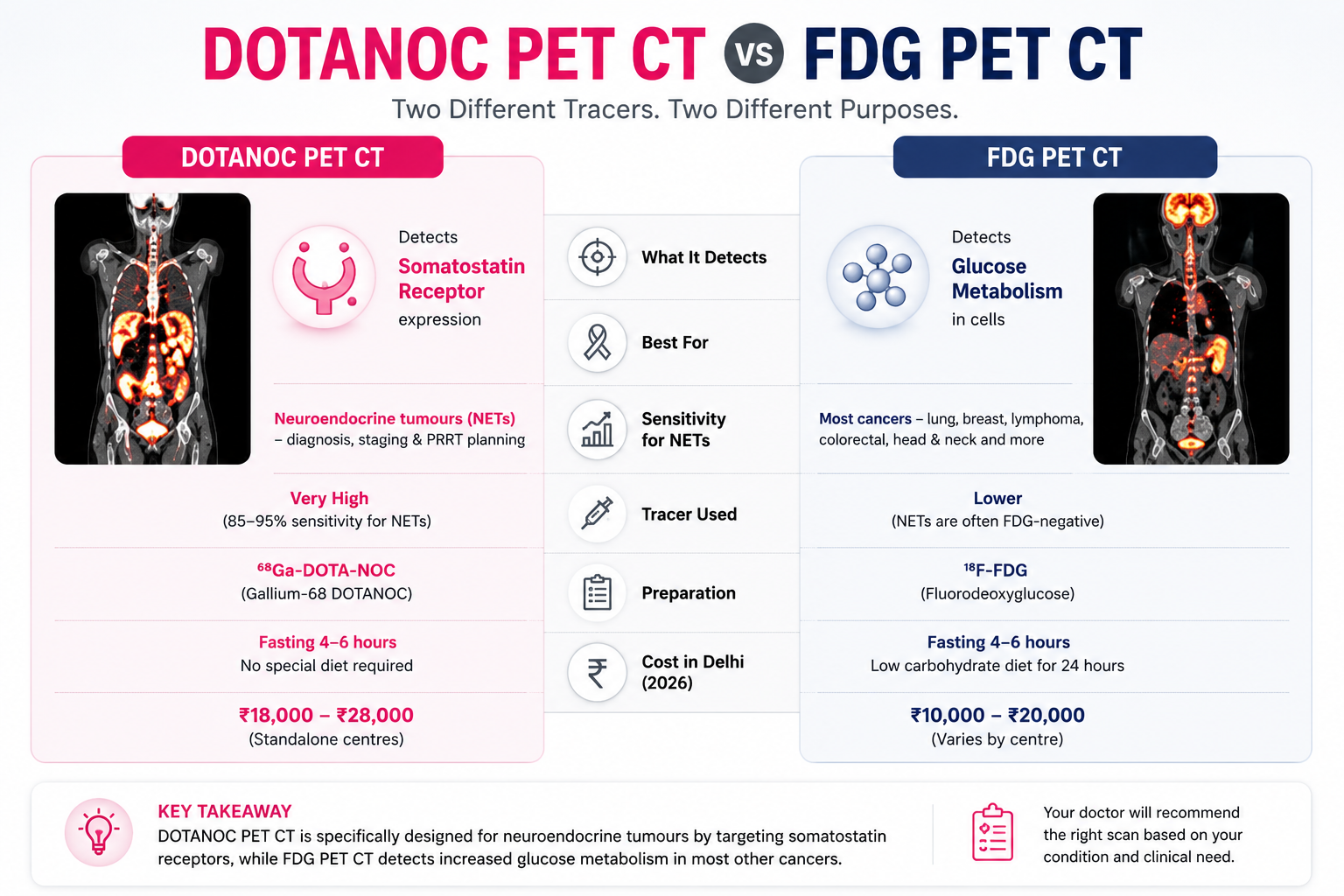
|
Feature |
Dotanoc PET CT |
FDG PET CT |
CT Scan |
|
What it detects |
Somatostatin receptor expression — NETs specifically |
Glucose metabolism — most cancers |
Structural anatomy |
|
Best for |
Neuroendocrine tumours — diagnosis, staging, PRRT selection |
Most solid tumours, lymphoma, lung, breast |
General cancer staging, anatomy |
|
NET detection rate |
Very high — 85–95% sensitivity |
Low — NETs often FDG-negative |
Moderate — misses small lesions |
|
Tracer used |
68Ga-DOTA-NOC |
18F-FDG |
None (uses X-rays) |
|
Carbohydrate restriction |
Not required |
Required — 24 hours before |
Not required |
|
Fasting |
4–6 hours |
4–6 hours |
Varies by scan type |
|
Cost in Delhi 2026 |
₹18,000 – ₹28,000 |
₹10,000 – ₹20,000 |
₹1,500 – ₹14,000 |
|
Available at |
Select cyclotron centres only |
Most nuclear medicine centres |
Most diagnostic labs |
See our full PET CT Scan Cost Delhi → page for complete FDG PET CT information.
What Are Neuroendocrine Tumours (NETs)?
Neuroendocrine tumours are a rare cancer type that occurs in the specialised cells of the neuroendocrine system. NETs are a rare, heterogeneous group of tumours which usually originate from small, occult primary sites and are characterised by over-expression of somatostatin receptors. Eve-healthcare
Neuroendocrine cells share characteristics with both nerve cells and hormone-producing cells. They are found throughout the body — in the pancreas, intestines, stomach, lungs, liver, and adrenal glands. This means NETs can develop almost anywhere, making them notoriously difficult to diagnose with conventional imaging.
Common types of neuroendocrine tumours that Dotanoc PET CT detects:
- Gastroenteropancreatic NETs (GEP-NETs) — the most common type, arising in the pancreas, small intestine, stomach, colon, and rectum
- Pancreatic NETs (pNETs) — including insulinoma, gastrinoma, glucagonoma, and non-functioning pNETs
- Carcinoid tumours — slow-growing NETs typically arising in the digestive tract or lungs
- Phaeochromocytoma — adrenal gland NET producing adrenaline
- Paraganglioma — similar to phaeochromocytoma but arising outside the adrenal gland
- Medullary thyroid carcinoma — thyroid NET arising from C cells
- Merkel cell carcinoma — rare skin NET
Why NETs are hard to diagnose without Dotanoc PET CT: Most NETs grow slowly and produce vague symptoms — abdominal pain, diarrhoea, flushing, weight loss — that can persist for years before a diagnosis is made. Conventional CT and MRI frequently miss small primary tumours and early metastases. Dotanoc PET CT can modify stage or modify treatment in up to 55% of neuroendocrine tumour cases — meaning in more than half of patients, the scan changes what the doctor does next. Wikipedia
Who Needs a Dotanoc PET CT Scan?
Your oncologist, gastroenterologist, or endocrinologist may recommend a Dotanoc PET CT in the following situations:
Diagnosis and staging:
- Suspected neuroendocrine tumour based on blood or urine markers (chromogranin A, 5-HIAA, gastrin, insulin, glucagon)
- Known NET with incomplete staging on conventional CT or MRI
- Unknown primary tumour with confirmed NET metastases — Dotanoc PET CT identifies the primary site in the majority of cases where CT and MRI have failed
Before treatment:
- Patient selection for Peptide Receptor Radionuclide Therapy (PRRT) — also called Lu-177 DOTATATE therapy. PRRT can only be used if the tumour is SSTR-positive, which Dotanoc PET CT confirms
- Surgical planning — identifies all disease sites before resection
- Determining eligibility for somatostatin analogue therapy (Octreotide, Lanreotide)
Monitoring and follow-up:
- Response assessment after PRRT treatment
- Surveillance after surgical resection
- Detection of recurrence in previously treated patients
Important: A positive Dotanoc PET CT (tracer-avid lesions) is required before PRRT can be initiated. If you have been referred for PRRT consideration, your nuclear medicine physician will specifically look at the degree of SSTR expression to determine if you are a suitable candidate.
How to Prepare for a Dotanoc PET CT Scan
Preparation for Dotanoc PET CT is significantly simpler than FDG PET CT. There is no carbohydrate restriction and no glucose level requirement.
Before the scan:
- Fast for 4–6 hours before your appointment. Water is allowed freely and encouraged — good hydration improves image quality and tracer clearance
- No high-carbohydrate diet restriction — unlike FDG PET CT, glucose levels do not affect Dotanoc scan quality
- Continue all regular medications including somatostatin analogues — unless specifically instructed otherwise by your nuclear medicine physician
Critical note on Sandostatin (Octreotide LAR): If you are on long-acting somatostatin analogue therapy (Sandostatin LAR, Somatuline depot / Lanreotide), timing your Dotanoc PET CT relative to your injection is important. You should make your Ga-68 Dotatate PET scan appointment one to two days before your next long-acting Sandostatin dose. Short-acting octreotide should be withheld for 12–24 hours before the scan. Confirm the exact timing with your nuclear medicine physician — do not guess. Eve-healthcare
At the centre:
- 68Ga-DOTA-NOC tracer is injected intravenously — small cannula placed in the arm
- Rest quietly for 45–60 minutes during the uptake period — avoid excessive movement
- The scan itself takes approximately 20–40 minutes depending on whether head-to-toe imaging is required
- Total time at the centre: approximately 2.5–3 hours
After the scan:
- Drink 2–3 litres of water over the rest of the day to flush the tracer through urination
- The 68Ga tracer has a short half-life (68 minutes) and is rapidly eliminated
- Normal activities can resume immediately
Understanding Your Dotanoc PET CT Report
|
Term |
What It Means |
|
SSTR-positive / tracer-avid |
Lesion has somatostatin receptor expression — confirms NET tissue and PRRT eligibility |
|
SSTR-negative / non-avid |
Lesion does not express somatostatin receptors — PRRT not suitable for this lesion |
|
SUVmax |
Standardised Uptake Value — measures tracer uptake. Higher SUVmax = stronger receptor expression |
|
Liver background SUV |
Used as a reference point — lesions with uptake greater than liver background are considered significant |
|
Physiological uptake |
Normal tracer uptake in spleen, kidneys, pituitary gland, and adrenal glands — not a disease finding |
|
Krenning score |
4-point scale rating tracer uptake in lesions relative to normal organs — used for PRRT patient selection |
|
Complete metabolic response |
No residual tracer-avid disease — positive treatment outcome |
|
Progression |
New tracer-avid lesions or increased uptake in existing lesions — disease has progressed |
|
Concordant / discordant |
Concordant means CT and Dotanoc findings agree. Discordant means CT shows a lesion that is not SSTR-positive — important for treatment planning |
Always have your Dotanoc PET CT report reviewed by the specialist who ordered it — typically a gastroenterologist, endocrinologist, or oncologist with NET expertise. Nuclear medicine reports contain highly quantitative language that requires clinical context. The Krenning score and SUVmax values directly inform treatment decisions.
CGHS Rates for Dotanoc PET CT in Delhi
Central Government employees, pensioners, and dependents covered under CGHS are entitled to Dotanoc PET CT at officially approved CGHS rates at empanelled nuclear medicine centres.
|
Scan |
Non-NABH Rate (₹) |
NABH Rate (₹) |
|
Gallium-68 Peptide PET CT (Dotanoc — Neuroendocrine) |
12,219 |
14,375 |
Source: CGHS Rate Schedule 2025, Ministry of Health & Family Welfare, Government of India.
To avail CGHS rates: Bring your CGHS Smart Card and a valid referral letter from a CGHS-approved specialist — oncologist, gastroenterologist, or nuclear medicine physician. A general OPD referral is insufficient at most empanelled centres. ECHS beneficiaries must confirm empanelment separately before visiting.
Dotanoc PET CT Scan Centres in Delhi NCR
|
Area |
Available |
Price Range |
Sandostatin Timing Advice Available |
|
South Delhi (Saket, Hauz Khas, GK) |
Yes — multiple |
₹18,000 – ₹28,000 |
Yes |
|
Central Delhi (Green Park, Pusa Rd) |
Yes |
₹18,000 – ₹24,000 |
Yes |
|
North Delhi (Rohini) |
Yes |
₹18,000 – ₹22,000 |
Yes |
|
West Delhi (Rajouri Garden) |
Yes |
₹18,000 – ₹22,000 |
Yes |
|
Noida (Sec 18, 62) |
Yes |
₹18,000 – ₹24,000 |
Yes |
|
Gurgaon (DLF, Sector 38) |
Yes — multiple |
₹20,000 – ₹28,000 |
Yes |
|
Faridabad |
Limited |
₹18,000 – ₹22,000 |
Confirm on booking |
|
Ghaziabad |
Limited |
₹18,000 – ₹20,000 |
Confirm on booking |
Dotanoc PET CT requires cyclotron facilities. Do not travel without confirming tracer availability on your specific appointment date — call the centre directly when booking.
What to Bring to Your Dotanoc PET CT Appointment
|
Item |
Required / Recommended |
|
Doctor's referral / prescription |
Required — AERB centres will not scan without one |
|
Previous scan reports and CDs (CT, MRI, FDG PET CT) |
Strongly recommended — allows direct comparison |
|
Sandostatin / Lanreotide injection record |
Required — nuclear medicine physician needs to know last injection date |
|
Chromogranin A and other NET marker blood tests |
Recommended — helps contextualise the scan findings |
|
CGHS / ECHS card (if applicable) |
Required for CGHS rates |
|
Water bottle |
Recommended — drink freely before and after |
|
Companion |
Recommended — 3-hour appointment |
Dotanoc PET CT vs PSMA PET CT — Which Scan Is for You?
Patients sometimes confuse these two specialised PET CT scans. They are completely different investigations for completely different conditions.
|
Feature |
Dotanoc PET CT |
PSMA PET CT |
|
Used for |
Neuroendocrine tumours (NETs) |
Prostate cancer |
|
Tracer |
68Ga-DOTA-NOC |
68Ga-PSMA |
|
What it targets |
Somatostatin receptors (SSTR 2, 3, 5) |
Prostate-specific membrane antigen |
|
Ordered by |
Gastroenterologist, endocrinologist, oncologist |
Urologist, oncologist |
|
Cost in Delhi 2026 |
₹18,000 – ₹28,000 |
₹17,500 – ₹30,000 |
If your doctor has prescribed a Dotanoc PET CT, do not book a PSMA PET CT — and vice versa. They are not interchangeable. Always confirm the exact tracer name on your prescription with the centre when booking.
See our full PSMA PET CT Cost Delhi → page.
Book Your Dotanoc PET CT Scan in Delhi
EVE Healthcare partner centres for Dotanoc PET CT are AERB-licensed nuclear medicine facilities across Delhi, Noida, and Gurgaon — the same centres that operate EVE's established DOTA PET CT Centre network. All centres have trained nuclear medicine physicians experienced in NET imaging.
Tap the WhatsApp button or use the search tool above. Our booking team confirms tracer availability, preparation instructions including Sandostatin timing, and your exact appointment slot before you travel.
Also see: PET CT Scan Cost Delhi → · PSMA PET CT Cost Delhi → · MRI Scan Cost Delhi → · CT Scan Cost Delhi → · CGHS Diagnostic Centres Delhi →
-(1).png)
-(1).png)
-(1)-(1).png)