In 2026, MRI scan cost in Delhi ranges from ₹3,500 to ₹25,000 — depending on the body part scanned, machine strength (1.5T vs 3T), whether contrast dye is required, and whether you book at a standalone lab or a hospital. This page gives you the complete Delhi NCR price list, broken down by scan type, so you can compare, choose, and book in minutes.
Quick Price Reference — MRI Scan Cost Delhi 2026
|
Scan |
Starting From |
Average |
With Contrast |
|
MRI Cost Delhi (any scan) |
₹3,500 |
₹6,000 |
₹6,500 onwards |
|
Brain MRI Cost Delhi |
₹4,500 |
₹6,500 |
₹7,000 – ₹14,000 |
|
Spine MRI Cost Delhi |
₹4,000 |
₹5,500 |
₹6,500 – ₹12,000 |
|
Knee MRI Cost Delhi |
₹4,000 |
₹5,500 |
₹6,000 – ₹11,000 |
|
3T MRI Cost Delhi |
₹6,000 |
₹10,000 |
₹9,000 – ₹18,000 |
|
Whole Body MRI Cost Delhi |
₹15,000 |
₹19,000 |
₹20,000 onwards |
|
Open MRI Cost Delhi |
₹5,000 |
₹8,500 |
₹8,000 – ₹14,000 |
|
MRI with Contrast Delhi |
₹6,500 |
₹9,000 |
— |
All prices reflect EVE Healthcare partner centre rates at NABL-accredited standalone labs and diagnostic chains. Hospital rates excluded. Prices verified June 2026.
MRI Scan Price List Delhi 2026 — By Body Part
|
MRI Scan Type |
Lowest (₹) |
Average (₹) |
Premium (₹) |
With Contrast (₹) |
Common Use |
|
MRI Brain |
4,500 |
6,500 |
9,000 |
7,000 – 14,000 |
Tumour, stroke, epilepsy, headaches, memory loss |
|
MRI Spine — Lumbar |
4,000 |
5,500 |
8,000 |
6,500 – 12,000 |
Back pain, disc prolapse, sciatica |
|
MRI Spine — Cervical |
4,000 |
5,500 |
8,000 |
6,500 – 12,000 |
Neck pain, spondylosis, nerve compression |
|
MRI Spine — Dorsal |
4,000 |
5,500 |
8,000 |
6,500 – 12,000 |
Mid-back pain, spinal cord conditions |
|
MRI Knee |
4,000 |
5,500 |
7,500 |
6,000 – 11,000 |
ACL/PCL tear, meniscus, cartilage, arthritis |
|
MRI Shoulder |
4,500 |
6,000 |
8,500 |
7,000 – 12,000 |
Rotator cuff tear, labral tear, impingement |
|
MRI Hip |
4,500 |
6,000 |
8,500 |
7,000 – 12,000 |
AVN, labral pathology, joint pain |
|
MRI Abdomen |
5,000 |
7,000 |
10,000 |
8,000 – 16,000 |
Liver, pancreas, kidneys, adrenal glands |
|
MRI Pelvis |
5,000 |
6,500 |
9,000 |
8,000 – 14,000 |
Gynaecological, prostate, rectum |
|
MRI Breast (bilateral) |
7,000 |
10,000 |
14,000 |
10,000 – 20,000 |
Cancer screening, dense tissue, implant check |
|
MRCP (bile ducts) |
6,000 |
8,500 |
12,000 |
9,000 – 16,000 |
Gallstones, biliary obstruction, pancreatic disease |
|
MRI Angiography (MRA) |
5,500 |
7,500 |
11,000 |
8,000 – 15,000 |
Blood vessels, aneurysm, carotid artery |
|
MRI Whole Body |
15,000 |
19,000 |
25,000 |
20,000 – 35,000 |
Cancer screening, comprehensive health check |
Prices verified June 2026 from EVE Healthcare partner centres across Delhi NCR. "Lowest" = standalone diagnostic labs. "Average" = NABL-accredited diagnostic chains. "Premium" = large private diagnostic centres. Contrast scans use gadolinium dye — your doctor's prescription will specify if contrast is required. All EVE partner centres are NABL-accredited.
Where These Prices Come From
The price ranges on this page are compiled from EVE Healthcare's active partner centre network across Delhi NCR. Our team contacts partner centres directly each quarter to verify current pricing — we do not pull prices from third-party aggregators or hospital websites.
Methodology: Prices reflect rates available for direct booking through EVE Healthcare at NABL-accredited standalone diagnostic labs and diagnostic chains. Hospital rates are excluded from all ranges — hospitals typically charge 40–80% above what you will find through EVE partner centres for equivalent scan quality. The "Lowest" column reflects the floor price at EVE partner centres. The "Average" column reflects the median across our active network. The "Premium" column reflects the upper range at larger NABL-accredited chains in high-cost areas such as South Delhi and Gurgaon.
Prices reviewed quarterly. Last verified: June 2026. Next review: September 2026.
1.5T vs 3T vs Open MRI — The Complete Guide

This is the section most patients struggle with, and where most competitor pages give dangerously incomplete information.
What the numbers actually mean
The number (1.5, 3) refers to magnetic field strength measured in Tesla. A stronger magnetic field produces more signal — which translates into sharper images, faster scans, and better ability to detect small abnormalities. It does not automatically mean the scan is better for your condition.
1.5T MRI — the clinical workhorse
1.5T is the standard across most diagnostic labs in Delhi. It is appropriate for the vast majority of clinical scans including all spine scans, abdominal and pelvic imaging, joint scans (knee, shoulder, hip), and most brain scans. For routine diagnostic work — back pain, joint injuries, general abdominal complaints — a well-maintained 1.5T machine at an NABL-accredited lab produces clinically equivalent results to 3T at significantly lower cost.
When 1.5T is sufficient and 3T is unnecessary:
- Lumbar, cervical, and dorsal spine MRI for disc disease or back pain
- Knee, shoulder, hip, and wrist MRI for ligament and cartilage assessment
- Abdominal and pelvic MRI for organ assessment
- General brain MRI for stroke, space-occupying lesions, and white matter changes
- MRI for most routine cancer staging and follow-up
3T MRI — when the upgrade genuinely matters
3T is not a universal upgrade — it is a targeted tool for specific clinical scenarios where higher resolution changes the diagnostic outcome. Requesting 3T for a lumbar spine disc prolapse is unnecessary. Your referring doctor or specialist will specifically request 3T when it is clinically indicated.
When 3T is genuinely worth the premium:
- Brain MRI for epilepsy — 3T detects small hippocampal and cortical lesions that can be missed at 1.5T
- Brain MRI for small tumours, microadenomas (pituitary), and arteriovenous malformations
- Spinal cord pathology — demyelinating disease, cord tumours, syringomyelia
- Cardiac MRI — myocardial characterisation, cardiac masses
- High-resolution musculoskeletal imaging — small joint cartilage, acetabular labrum, shoulder labrum
- fMRI (functional MRI) — presurgical brain mapping
- MR spectroscopy and diffusion tensor imaging (DTI)
Doctors who typically request 3T: Neurologists, epileptologists, neurosurgeons, and sports medicine specialists dealing with complex musculoskeletal cases. If your referring doctor has not specifically written "3T" on the prescription, a 1.5T scan is what they are expecting.
Open MRI — the claustrophobia solution with real limitations
Open MRI machines have a much wider, more open design that reduces the tunnel sensation. They are a genuine option for patients with severe claustrophobia, children who cannot remain still in a standard machine, bariatric patients, and elderly patients with mobility limitations.
The important limitation: Open MRI machines in India typically operate at 0.3T to 1.0T — significantly lower field strength than 1.5T. This means lower signal-to-noise ratio, longer scan times, and reduced diagnostic quality for complex conditions. Open MRI is clinically suitable for a limited set of scans.
Open MRI is appropriate for: Knee, shoulder, wrist, elbow, spine (cervical/lumbar), brain — in patients where standard MRI is not tolerated.
Open MRI is not appropriate for: Abdominal MRI, pelvic MRI, cardiac MRI, whole-body MRI, complex neurological investigations, or any scan requiring high spatial resolution.
The claustrophobia guide — your actual options
If you are claustrophobic, here is the hierarchy of options from most to least preferable:
Option 1 — Wide-bore 1.5T (best option): A standard-strength MRI machine with a significantly wider tunnel opening — typically 70cm vs 60cm in older machines. Produces full-diagnostic-quality images. Can scan any body part. Available at select EVE partner centres in Delhi. This is the recommended first choice for claustrophobic patients in most cases.
Option 2 — Pre-scan sedation with standard 1.5T: A mild oral sedative (prescribed by your referring doctor) taken 30–45 minutes before the scan. You remain conscious but significantly more relaxed. Does not affect image quality. Requires someone to accompany you home.
Option 3 — Open MRI (0.3–1.0T): Most comfortable experience, but only suitable for select scans as listed above. If your doctor has ordered an abdominal or pelvic MRI and you are claustrophobic, discuss wide-bore or sedation options rather than open MRI.
Option 4 — General anaesthesia: Reserved for patients — most commonly children — where no other option is viable. Performed in a hospital setting.
|
Machine |
Tesla Strength |
Price Range |
Full Scan Range |
Best for Claustrophobia |
|
Standard 1.5T |
1.5T |
₹4,000 – ₹12,000 |
Yes |
No — standard tunnel |
|
Wide-Bore 1.5T |
1.5T |
₹4,500 – ₹13,000 |
Yes |
Yes — recommended first choice |
|
3T MRI |
3.0T |
₹6,000 – ₹18,000 |
Yes |
Depends on bore size |
|
Open MRI |
0.3–1.0T |
₹5,000 – ₹14,000 |
No — limited body parts |
Yes — but limited clinically |
What Affects MRI Scan Cost in Delhi?
Body part and complexity Single-region scans — one body part, one imaging plane — are the most affordable. Multi-region scans (whole spine, or whole-body MRI) take 60–90 minutes and cost proportionally more. Specialist sequences such as MR spectroscopy, diffusion-weighted imaging (DWI), or functional MRI add time and cost beyond the base scan rate.
Contrast vs non-contrast Contrast MRI uses an IV injection of gadolinium dye to highlight blood vessels, tumours, and areas of inflammation — adding ₹1,500–₹4,000 to the base cost. Look for "with contrast", "CEMRI", or "Gadolinium" on your prescription. Do not request contrast unless it is specifically prescribed — it is unnecessary for most routine scans. For patients with a history of kidney disease, inform your radiologist before the injection as gadolinium requires adequate kidney function to clear safely.
Machine strength 3T costs 15–30% more than 1.5T. Whether that premium is clinically justified depends entirely on the condition being investigated. See the full 1.5T vs 3T guide above.
Centre type Standalone diagnostic labs in Delhi offer the best price-to-quality ratio with same-day availability. NABL-accredited diagnostic chains sit in the mid-range. Private hospital radiology departments add a 40–80% premium, often for equivalent machine quality and the same radiologist. EVE partner centres are exclusively standalone labs and NABL-accredited diagnostic chains — not hospital-priced.
CGHS Rates for MRI Scans in Delhi
Central Government employees, pensioners, and dependents covered under CGHS are entitled to MRI scans at officially approved CGHS rates at empanelled diagnostic centres. The 2026 official CGHS rates (Tier I — Delhi/NCR) are:
|
MRI Scan |
Non-NABH Rate (₹) |
NABH Rate (₹) |
|
Brain / Head — without contrast |
2,975 |
3,500 |
|
Brain / Head — with contrast |
4,250 |
5,000 |
|
Spine (any single region) — without contrast |
2,975 |
3,500 |
|
Spine (any single region) — with contrast |
4,250 |
5,000 |
|
Shoulder — without contrast |
2,975 |
3,500 |
|
Shoulder — with contrast |
4,250 |
5,000 |
|
Abdomen — without contrast |
2,975 |
3,500 |
|
Abdomen — with contrast |
4,888 |
5,750 |
|
Neck — without contrast |
2,975 |
3,500 |
|
Neck — with contrast |
4,888 |
5,750 |
Source: CGHS Rate Schedule 2026, Ministry of Health & Family Welfare, Government of India.
To avail CGHS rates: Bring your CGHS Smart Card and a valid referral letter from a CGHS-approved doctor or CMO. State "CGHS rate" explicitly at the time of booking. ECHS beneficiaries must confirm empanelment separately with the centre.
How to Prepare for Your MRI Scan
For most MRI scans — brain, spine, knee, shoulder, wrist No special preparation needed. Eat, drink, and take your regular medications as normal.
For abdominal or pelvic MRI Fast for 4–6 hours before the scan. Plain water is allowed. Do not eat or drink milk, juice, tea, or coffee during that window — stomach contents create image artefacts that reduce diagnostic quality.
For MRI with contrast (CEMRI) Fast for 2–4 hours. Stay well hydrated — drink water freely until 2 hours before. Inform the radiologist of any kidney disease, reduced kidney function, or known allergy to gadolinium before the IV line is placed.
Before entering the MRI room — always:
- Remove all metal: jewellery, rings, earrings, piercings, hairpins, underwired bras, belts, watches, coins, keys
- Remove hearing aids and glasses in the waiting area before entering the scan room
- Inform the technician of all metal implants before the scan — pacemakers, cochlear implants, aneurysm clips, metal pins, surgical clips, spinal cord stimulators, joint replacement prostheses. Many modern implants are MRI-conditional rather than contraindicated — the technician can verify the specific model
- Wear loose, comfortable clothing. Most centres provide a gown
Pregnancy: MRI is considered safe during pregnancy and does not use ionising radiation. Always inform your radiologist — gadolinium contrast is generally avoided during pregnancy, particularly in the first trimester.
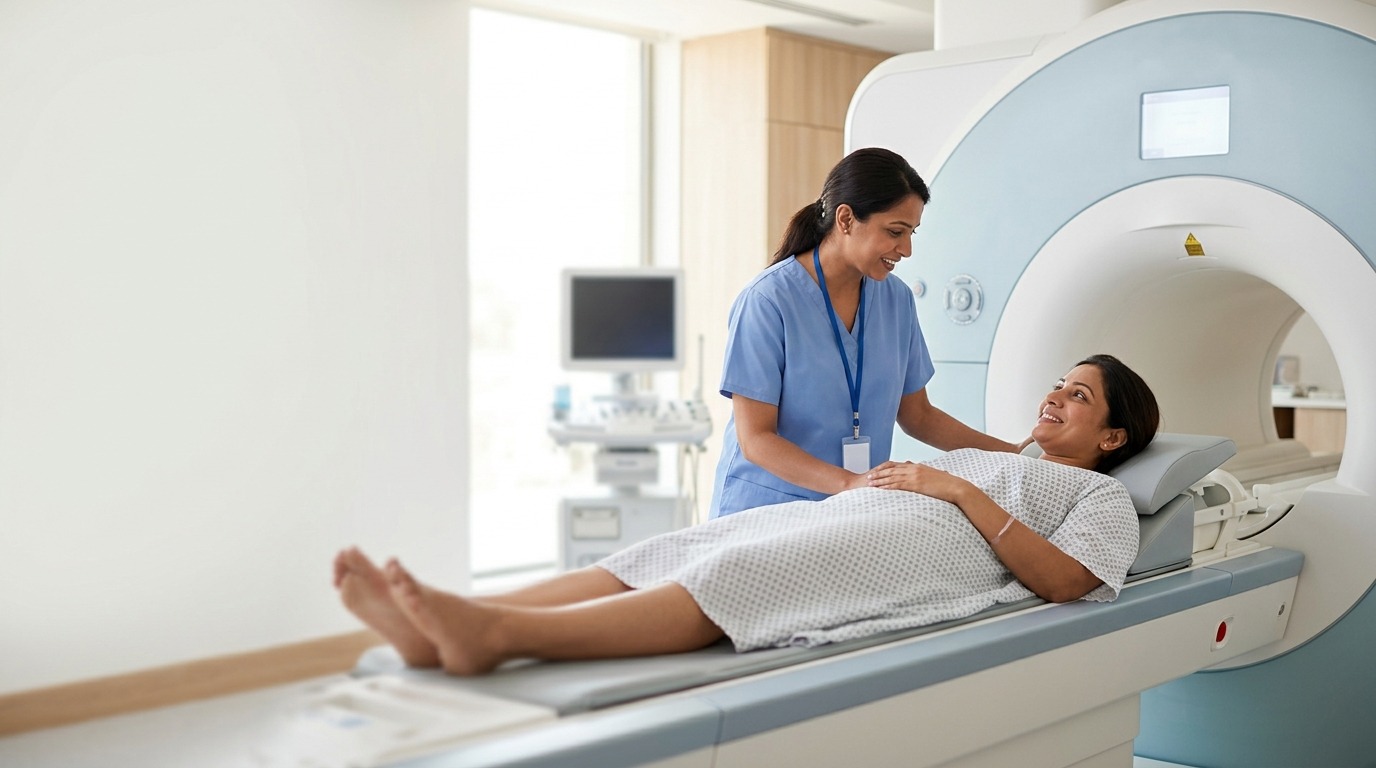
What the scan feels like: The machine produces loud knocking and tapping sounds throughout — completely normal. Earplugs or headphones are always provided. Single-region scans take 20–40 minutes. You must remain still during each imaging sequence of 2–6 minutes. There is no pain involved.
MRI Scan Cost — Delhi NCR by Location
MRI Scan Cost in South Delhi
South Delhi — covering Greater Kailash, Hauz Khas, Saket, Safdarjung Enclave, and Vasant Kunj — has the highest concentration of premium diagnostic labs in Delhi. MRI scan cost in South Delhi ranges from ₹5,000 to ₹12,000 for single-region scans. Multiple centres offer 3T machines and CGHS empanelment. Find MRI centres in South Delhi →
MRI Scan Cost in Noida
Noida — particularly Sectors 18, 62, 125, and 137 — offers comparable scanner quality to South Delhi at 10–15% lower prices. MRI scan cost in Noida ranges from ₹4,000 to ₹9,000 for most single-region scans. Several Noida centres offer 3T machines and same-day reports. Compare MRI scan prices in Noida
MRI Scan Cost in Gurgaon
Gurgaon — DLF Phase 1–5, Cyber City, Sector 56, and Sohna Road — serves a large corporate and expat patient population. MRI scan cost in Gurgaon ranges from ₹5,000 to ₹12,000. Premium diagnostic chains here frequently offer 3T machines, CGHS empanelment, and same-day digital reports. Find MRI centres in Gurgaon
MRI Scan Cost in Dwarka
Dwarka — Sectors 1 through 23 — is one of Delhi's fastest-growing residential areas with good diagnostic infrastructure. MRI scan cost in Dwarka ranges from ₹4,000 to ₹8,500. Several NABL-accredited labs with 1.5T machines operate in the area, and some offer CGHS rates. MRI scan centres near you in Dwarka
MRI Scan Cost in Rohini
Rohini — Sectors 3 through 25 — is home to some of North Delhi's most well-established diagnostic centres, including several CGHS-empanelled labs. MRI scan cost in Rohini ranges from ₹4,000 to ₹8,500, with 3T available at select centres. Book an MRI scan in Rohini
Understanding Your MRI Report
|
Term in Your Report |
What It Means |
|
Normal study |
No significant abnormality detected. |
|
Hyperintense |
Tissue appears bright on that imaging sequence — significance depends on which sequence and the clinical context. |
|
Hypointense |
Tissue appears dark — interpretation depends on sequence and context. |
|
Disc herniation / disc prolapse |
Disc material is bulging or pressing on adjacent nerve roots. Very common in lumbar and cervical spine MRI. |
|
Disc desiccation / dehydration |
The disc is losing water content — an age-related finding, not always symptomatic. |
|
Foraminal stenosis |
Narrowing of the opening through which a nerve exits the spine. |
|
Oedema |
Tissue swelling — may indicate recent injury, inflammation, or infection. |
|
Space-occupying lesion |
An abnormal mass occupying space — requires clinical correlation with your specialist. |
|
T1 / T2 / FLAIR / DWI |
Different MRI sequences that highlight different tissue properties. Your radiologist interprets all sequences together. |
|
No significant interval change |
Compared with a previous scan — findings are stable since the last imaging. |
Always have your MRI report reviewed by the doctor who ordered it. The radiologist describes what is visible in the images. Your treating doctor interprets what it means for your specific symptoms, history, and clinical picture.
Book Your MRI Scan in Delhi
EVE Healthcare partner centres offer MRI scans across Delhi, Noida, and Gurgaon at pre-verified, transparent prices. Same-day availability for most scan types. No referral letter required for self-pay bookings.
Use the search tool above to find a centre near you, compare prices and machine types, and confirm your slot. Or tap the WhatsApp button — our booking team responds in under 5 minutes.
Also see: CT Scan Cost Delhi → · PET CT Scan Cost Delhi → · Fibroscan Cost Delhi → · MRI vs CT Scan → · CGHS Diagnostic Centres Delhi →
.png)
.png)
.png)
-(1).png)
-(1)-(1).png)
-(1).png)