
-(1).png)
If you have back pain and you are searching for an MRI in Delhi, you are asking one of two questions — either your doctor has already referred you and you want to know where to book it cheaply, or you have been dealing with back pain for a while and you are wondering whether you actually need an MRI.
This page answers both questions honestly.
MRI lumbar spine cost in Delhi ranges from ₹3,500 to ₹9,000 at NABL-accredited standalone diagnostic labs in 2026 — significantly less than the ₹12,000–₹20,000 charged at private hospitals for the same scan.
Quick Answers — Back Pain MRI Delhi 2026
MRI Lumbar Spine (lower back) — without contrast: ₹3,500 – ₹9,000 MRI Cervical Spine (neck/upper back) — without contrast: ₹3,500 – ₹9,000 MRI Lumbar + Cervical (both regions): ₹7,000 – ₹16,000 MRI Whole Spine: ₹9,000 – ₹20,000 Same-day availability: Yes — Delhi, Noida, Gurgaon CGHS rate (NABH-accredited): ₹3,500 per spinal region
All prices from EVE Healthcare partner centres — NABL-accredited standalone labs. Hospital rates excluded. Prices verified June 2026.
Do You Actually Need an MRI for Your Back Pain?
This is the most important question on this page — and the one that most back pain MRI pages skip entirely.
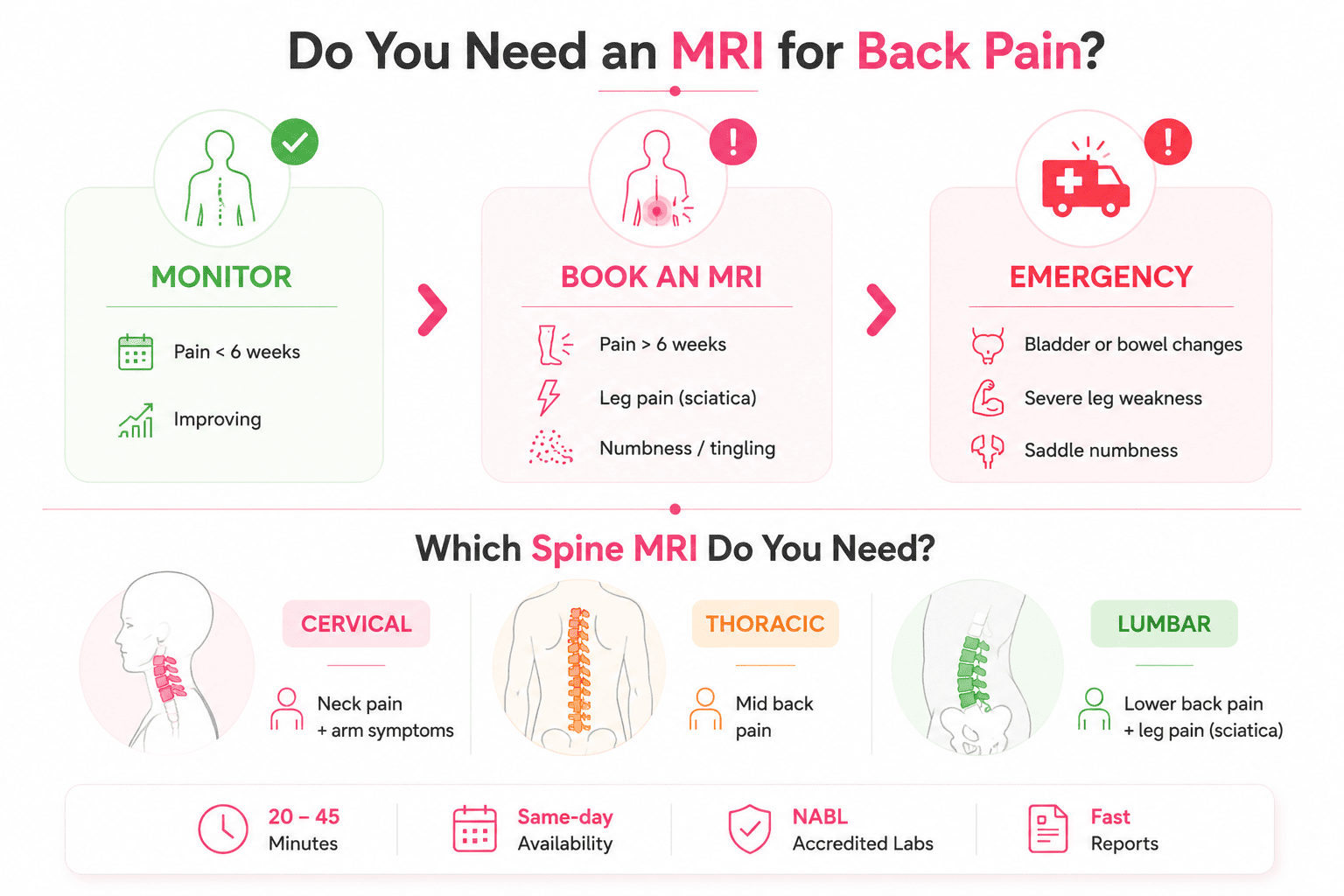
The honest clinical answer: For most back pain, MRI is not needed in the first 4–6 weeks.
Imaging studies are not indicated in a patient without red flag signs unless symptoms persist for 6 weeks, and MRI is the imaging modality of choice when imaging is indicated. Bajaj Finserv Health
MRI is generally reserved for red flags or persistent symptoms after 4–6 weeks, integrated with clinical evaluation to direct conservative care versus image-guided interventions. Koshikaa
This does not mean your pain is not real. It means that most back pain — even severe back pain — resolves with conservative management (physiotherapy, activity modification, anti-inflammatory medication) before imaging changes anything. Scanning before 6 weeks in uncomplicated cases rarely changes management and occasionally increases anxiety about findings that would have resolved on their own.
When MRI is NOT yet necessary:
- Back pain present for less than 4–6 weeks with no neurological symptoms
- Pain that is improving, even slowly, with physiotherapy
- No leg pain, no numbness, no weakness in legs or feet
When MRI IS needed — the clinical pathway:
|
Situation |
MRI Needed? |
Urgency |
|
Back pain + leg pain radiating below the knee |
Yes — if not improving after 4–6 weeks of conservative treatment |
Routine |
|
Back pain + numbness or tingling in leg or foot |
Yes — referral to spine specialist recommended |
Within 1–2 weeks |
|
Back pain + leg weakness (difficulty walking, foot drop) |
Yes |
Urgent — within days |
|
Back pain + bladder or bowel changes (difficulty urinating or loss of control) |
Yes |
Emergency — same day |
|
Back pain + fever, unexplained weight loss |
Yes — rule out infection or malignancy |
Urgent |
|
Back pain after trauma (fall, accident) |
X-ray first; MRI if X-ray unclear or neurological symptoms |
Urgent |
|
Back pain not improving after 6 weeks of physiotherapy |
Yes |
Routine |
|
Back pain in patient over 50 with no prior history |
Yes — after clinical assessment |
Routine |
The cauda equina rule — memorise this: Red flags requiring immediate MRI and surgical evaluation include cauda equina syndrome — urinary retention or incontinence, bilateral lower extremity weakness, and saddle anaesthesia. If you have any combination of these symptoms alongside back pain, go to a hospital emergency department today — do not book a routine MRI appointment. LabsAdvisor
The Sciatica Question — Is Your Back Pain Actually Sciatica?
The most common reason for back pain MRI referrals in Delhi's working population is not pure back pain — it is radiculopathy: back pain that radiates down one or both legs, often with numbness, tingling, or weakness.
This pattern — commonly called sciatica when it affects the sciatic nerve — indicates that a disc or bony structure is compressing a spinal nerve root. This is clinically different from purely muscular back pain. It is also what MRI is specifically excellent at diagnosing: the disc, the nerve root, the degree of compression, and which spinal level is affected.
The distinction that matters for your MRI booking:
- Pure lower back pain with no leg symptoms — MRI is often not the first investigation. Your doctor may try physiotherapy first.
- Lower back pain + leg pain, numbness, or tingling — MRI lumbar spine is the appropriate investigation after 4–6 weeks or immediately if neurological symptoms are present.
- Neck pain + arm pain, numbness, or tingling — MRI cervical spine, not lumbar spine.
Always confirm with your doctor which region of the spine they want scanned. Lumbar (lower back), cervical (neck), and dorsal/thoracic (mid-back) are separate MRI scans. Booking the wrong region means the scan cannot answer your doctor's question.
The Booking Mistake That Wastes a Half-Day
This is the "only EVE can write this" section. It comes from real booking platform data.
The most common back pain MRI booking error EVE patients make: booking "MRI spine" without specifying the region.
The spine has three scannable regions:
- Lumbar spine — lower back (most common back pain origin, L1–L5 and sacrum)
- Cervical spine — neck and upper back (C1–C7)
- Dorsal / Thoracic spine — mid-back (T1–T12)
Each is a separate MRI scan with a separate booking code and a separate price. If your prescription says "MRI lumbar spine" and you book "MRI spine" without specifying, some centres will ask you to clarify and delay your appointment. Others will scan a different region than intended.
How to avoid this: When booking through EVE Healthcare, read your prescription exactly and tell our team the precise words your doctor wrote. "MRI LS spine," "MRI lumbar spine," "MRI L-spine," and "MRI lower back" all mean the same thing — lumbar spine. Confirm this at booking.
What MRI Finds in Back Pain Patients — The Most Common Report Terms Explained
Most patients in Delhi receive their MRI report before their follow-up appointment and spend hours googling the terminology. This section explains the 8 most common findings.
Disc Bulge / Disc Herniation / PIVD (Prolapsed Intervertebral Disc) A spinal disc that has moved beyond its normal boundary. A bulge is a broad, symmetrical extension. A herniation (or prolapse) is a more focal extrusion. Both can compress nerve roots — the degree of compression and the resulting symptoms determine clinical significance. An incidental disc bulge with no nerve contact and no symptoms is not an urgent finding.
Canal Stenosis / Spinal Canal Stenosis Narrowing of the spinal canal — the space through which the spinal cord and nerve roots pass. Can be caused by disc herniation, bony overgrowth (osteophytes), or ligament thickening. Mild stenosis is common after age 40 and may cause no symptoms. Severe stenosis with neurological symptoms may require surgical consultation.
Nerve Root Compression / Radiculopathy The MRI report specifically notes which nerve root is compressed and at which level (e.g. "L4-L5 disc herniation with right L5 nerve root compression"). This is the finding your surgeon or neurologist needs to correlate with your clinical symptoms — leg pain, numbness, or weakness in a specific distribution.
Disc Desiccation Drying and degeneration of disc material — a normal finding with ageing. Present on most MRI scans of patients over 35. Unless associated with significant disc height loss or nerve compression, it is not a surgical finding.
Ligamentum Flavum Hypertrophy Thickening of the ligament running behind the spinal canal. A common cause of canal stenosis in older patients. Often present alongside disc degeneration.
Modic Changes Signal changes in the vertebral end-plates adjacent to a disc — an indicator of disc-related bone marrow changes. Associated with chronic discogenic pain in some patients.
Spondylolisthesis Forward slippage of one vertebra over the one below. Graded 1–4 by severity. Grade 1 and 2 are often managed conservatively. Grade 3 and 4 may require surgical evaluation.
Schmorl's Nodes Small indentations in the vertebral end-plate where disc material has pushed through. Usually incidental and clinically insignificant unless symptomatic.
The critical instruction: Do not interpret your MRI report without your treating doctor. Findings that appear alarming in print — "moderate canal stenosis," "disc herniation at L4-L5" — are very common in the Delhi population and are managed conservatively in the majority of cases. The report must be interpreted in the context of your symptoms, clinical examination, and treatment history.
MRI Cost for Back Pain in Delhi 2026 — Complete Price Guide
|
MRI Scan Type |
Standalone NABL Lab (₹) |
Private Hospital (₹) |
CGHS Rate NABH (₹) |
|
MRI Lumbar Spine — without contrast |
3,500 – 9,000 |
12,000 – 20,000 |
3,500 |
|
MRI Lumbar Spine — with contrast |
6,500 – 13,000 |
15,000 – 25,000 |
5,000 |
|
MRI Cervical Spine — without contrast |
3,500 – 9,000 |
12,000 – 20,000 |
3,500 |
|
MRI Dorsal / Thoracic Spine — without contrast |
3,500 – 9,000 |
12,000 – 20,000 |
3,500 |
|
MRI Lumbar + Cervical (both) |
7,000 – 16,000 |
22,000 – 36,000 |
7,000 |
|
MRI Whole Spine |
9,000 – 20,000 |
25,000 – 45,000 |
10,500 |
|
3T MRI Lumbar Spine |
7,000 – 14,000 |
16,000 – 28,000 |
3,500 |
"Lowest" = floor price at EVE partner centres. "Average" = median across Delhi NCR network. All EVE partner centres are NABL-accredited. Hospital rates excluded from main table — listed for comparison only.
EVE Healthcare Insight — Back Pain MRI Booking Data Delhi NCR 2025–2026
|
Metric |
Data |
|
Most booked scan type for back pain |
MRI Lumbar Spine |
|
Average booked price |
₹4500 |
|
Most booked area |
South Delhi |
|
3T MRI bookings as % of spine scans |
70% |
|
Most common clinical indication |
Disc prolapse |
Why Delhi Has One of India's Highest Rates of Spine MRI Demand
This context makes the page genuinely informative rather than just a price list — and it is the section no competitor page provides.
Delhi NCR's back pain and spinal MRI demand is driven by three overlapping factors specific to this geography:
1. The IT and desk-based workforce in Noida and Gurgaon A systematic review and meta-analysis of 20 studies covering 15,709 Indian IT professionals found that the overall pooled prevalence of work-related musculoskeletal pain was 66% — two in three IT workers experience it. The spine is the most affected site. Noida's Expressway belt and Gurgaon's DLF corridor house the highest concentration of desk-bound professionals in the country — creating a demographic with structurally elevated spine disease risk.
2. Delhi's commuting burden Delhi NCR has one of the highest average daily commute times in India — a significant proportion of the workforce spends 2–4 hours daily in suboptimal seated postures in cars, Metro, and buses. Sustained compressive loading of lumbar discs during commuting is a documented risk factor for accelerated disc degeneration and disc herniation.
3. Poor ergonomic infrastructure A significant proportion of Delhi NCR's corporate office space — particularly in older buildings and smaller companies — operates with inadequate ergonomic workstation setups. Extended sitting with poor lumbar support at static computer workstations is mechanistically associated with the disc pathology that generates MRI referrals.
The consequence is clinically visible: lumbar spine MRI is consistently the highest-volume single-region MRI booked through EVE Healthcare's Delhi NCR network.
Is a Standalone Lab MRI as Good as Apollo, Fortis, or Max Hospital?
The question every Delhi back pain patient navigates.
For lumbar spine, cervical spine, and dorsal spine MRI — yes, at a NABL-accredited standalone lab.
The diagnostic information required from a spine MRI — disc morphology, canal dimensions, nerve root contact, cord signal — is equally well-provided by a 1.5T machine at a NABL-accredited standalone lab as by an equivalent machine at Apollo, Fortis, or Max Saket. NABL accreditation requires the same calibration and quality standards regardless of building type.
When to choose a hospital specifically:
- Your neurosurgeon or spine surgeon at that hospital wants images in their in-house system before the same-day surgical consultation
- Your MRI indicates findings that may require same-day intervention
- Intraoperative MRI for complex surgical planning — available only at select neurosurgical centres
For the vast majority of back pain MRI referrals in Delhi — chronic disc disease, radiculopathy assessment, stenosis staging — a standalone NABL-accredited lab delivers equivalent diagnostic quality at 40–60% lower cost.
Area-Wise MRI Availability for Back Pain in Delhi NCR
|
Area |
Price Range |
3T Available |
Same-Day |
Metro Access |
|
South Delhi (Saket, GK, Hauz Khas) |
₹4,000 – ₹9,000 |
Yes |
Yes |
Yellow / Violet Line |
|
West Delhi (Dwarka, Janakpuri) |
₹3,500 – ₹8,500 |
Yes |
Yes |
Blue Line |
|
North Delhi (Rohini, Pitampura) |
₹3,500 – ₹8,500 |
Yes |
Yes |
Red Line |
|
Central Delhi (Karol Bagh) |
₹4,000 – ₹9,000 |
Yes |
Yes |
Blue / Yellow Line |
|
Noida (Sector 18, 62, 137) |
₹3,500 – ₹8,500 |
Yes |
Yes |
Blue / Aqua Line |
|
Gurgaon (DLF, Sector 56) |
₹4,000 – ₹9,000 |
Yes |
Yes incl. nights |
Yellow Line |
CGHS Rates for Spine MRI in Delhi
|
MRI Scan |
Non-NABH Rate (₹) |
NABH Rate (₹) |
|
Spine — any single region — without contrast |
2,975 |
3,500 |
|
Spine — any single region — with contrast |
4,250 |
5,000 |
|
Whole spine — without contrast |
5,525 |
6,500 (approx.) |
Source: CGHS Rate Schedule effective October 2025, Ministry of Health & Family Welfare, Government of India.
Bring your CGHS Smart Card and a valid referral letter. Confirm CGHS empanelment before visiting.
Preparation for Your Spine MRI
No special preparation is needed for most spine MRI scans. Eat normally, drink normally, take all medications as usual.
Important:
- Remove all metal before the scan — belt buckles, underwire bras, hair pins, piercings
- Inform the centre in advance of any metal implants — spinal instrumentation (rods, screws), joint replacements, pacemaker, cochlear implant
- Wear loose, comfortable clothing — a two-piece outfit (top and trousers) is more practical than a dress
- The scan takes 20–45 minutes depending on how many spinal regions are scanned
- You will lie on your back on a flat table. The table moves into the MRI bore (tunnel). For lumbar spine — your lower half enters first, your head typically remains outside or at the edge
- The machine is loud — you will be offered earplugs or headphones
- If you are claustrophobic: see our Open MRI Delhi → guide for options
Clinical Note
From the reviewing orthopaedic and spine specialist: In my Delhi practice, the most consistent pattern I see is the 30–45-year-old professional with a 2–3 year history of intermittent lower back pain who finally presents after an episode of acute sciatica — leg pain, foot numbness, or morning stiffness severe enough to disrupt work. They have often tried multiple courses of physiotherapy and NSAIDs without lasting relief. The MRI lumbar spine almost always shows a disc herniation at L4–L5 or L5–S1 — occasionally both. Most of these patients are managed conservatively after the MRI — the imaging confirms the diagnosis and rules out surgical urgency rather than leading to surgery. The MRI changes the management in a different way: it gives the patient and their physiotherapist a specific target for rehabilitation. That diagnostic clarity, available at an NABL-accredited standalone lab in their sector within 24 hours at ₹4,000–₹6,000, is the single most useful investigation for this patient profile. For the smaller group presenting with progressive neurological deficit — foot drop, bilateral leg weakness, bladder symptoms — the MRI changes management urgently. These patients need imaging immediately regardless of how long they have been symptomatic.
Book Your Back Pain MRI in Delhi
EVE Healthcare partner centres offer MRI lumbar spine, cervical spine, and whole spine across Delhi, Noida, and Gurgaon — with same-day appointments, NABL-accredited machines, and CGHS rates at empanelled centres.
When booking: tell our team the exact region your doctor has prescribed (lumbar, cervical, dorsal, or whole spine) and whether contrast has been specified. We confirm scanner availability and your slot in under 5 minutes.
Also see: MRI Scan Cost Delhi → · MRI vs CT Scan → · 3T MRI Delhi → · Knee Pain MRI Delhi → · Open MRI Delhi → · CGHS MRI Rate Delhi → · MRI Scan Cost Noida → · MRI Scan Cost Gurgaon
.png)
.png)
.png)
-(1)-(1).png)
-(1).png)
-(1).png)