.png)
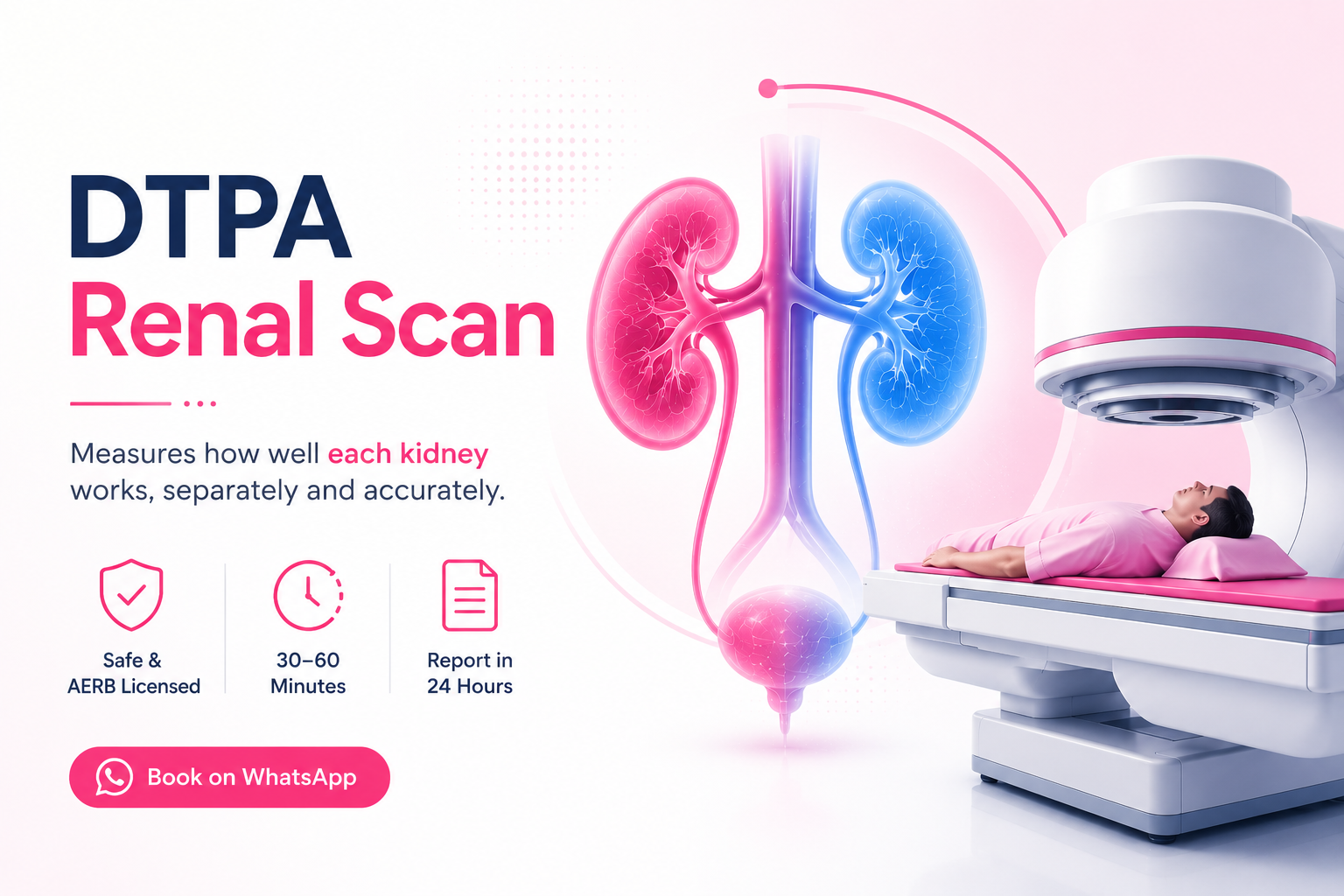
Both are nuclear medicine scans of the kidney. Both use a Tc-99m tracer. Both are performed on a gamma camera. And they answer completely different questions.
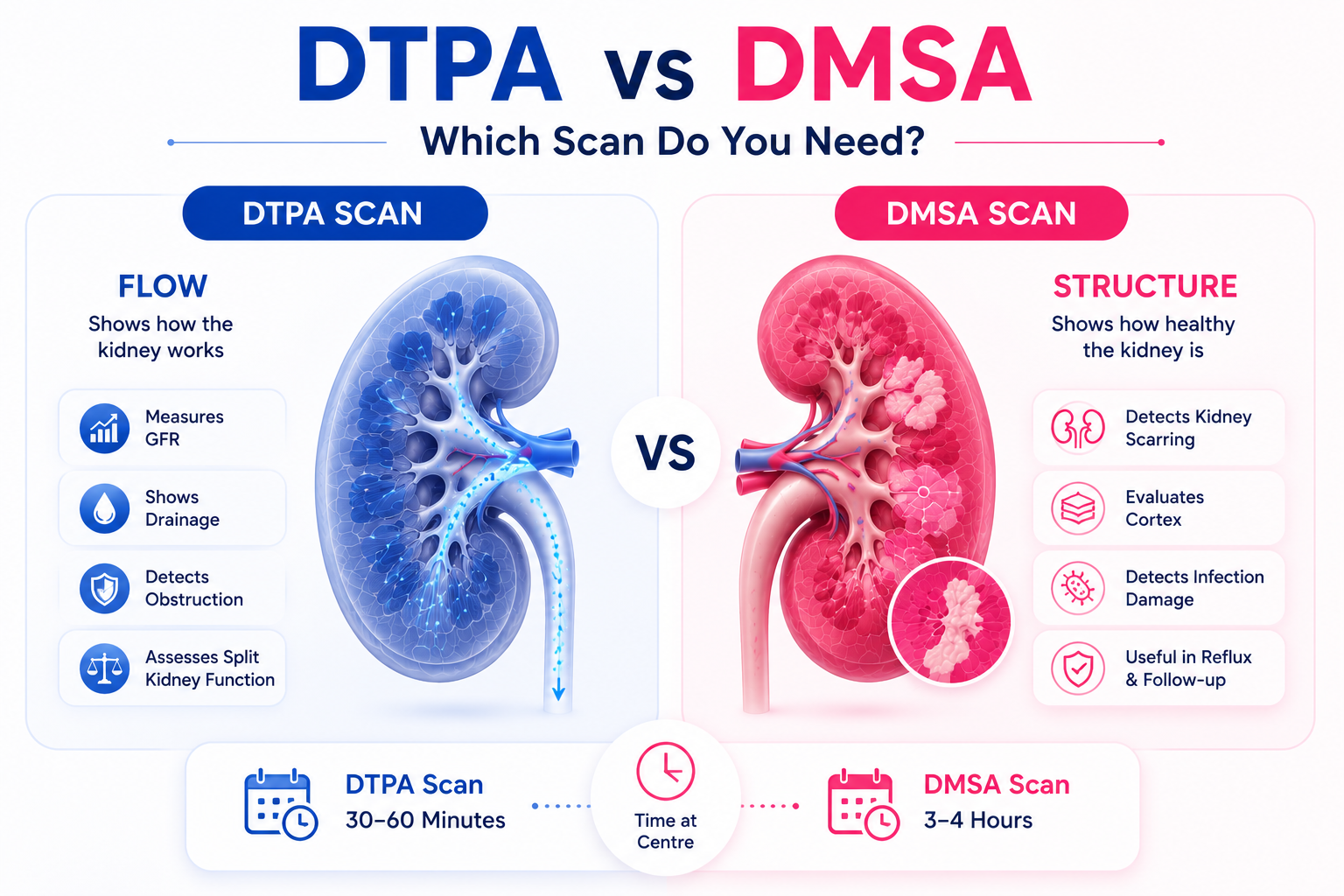
The distinction is simple once you see it. A DTPA scan is dynamic: it watches the tracer move through the kidneys in real time, measuring how fast blood is filtered and whether urine drains freely. A DMSA scan is static: the tracer binds to the kidney cortex and stays there, and a single image taken hours later reveals which parts of that cortex are still alive and which have scarred.
EVE Healthcare offers both at AERB-licensed nuclear medicine centres across Delhi NCR, DTPA from ₹4,000 and DMSA from ₹4,500, reported by qualified nuclear medicine physicians. Book on WhatsApp or call +91 9990032078.
The Core Difference: Flow vs Structure
Tc-99m DTPA is cleared from the blood almost entirely by glomerular filtration. It arrives at the kidney, gets filtered, and passes out through the collecting system into the bladder. Because it moves, you can track it. That movement is what reveals filtration rate, blood flow, and whether anything is blocking drainage.
Tc-99m DMSA behaves in the opposite way. It binds to the tubular cells of the renal cortex and remains bound. Because it stays put, it maps functioning cortical tissue with precision. Where the map shows a hole, there is no working tissue there.
That single property difference drives everything else about the two scans, from how long they take to what your doctor learns from them.
Side-by-Side Comparison
| DTPA | DMSA | |
|---|---|---|
| Type | Dynamic | Static |
| Tracer behaviour | Filtered and excreted | Binds to cortical tubules |
| Cleared by | Glomerular filtration | Retained in cortex |
| Measures GFR? | Yes, directly (Gates method) | No |
| Shows drainage/obstruction? | Yes | No |
| Shows cortical scarring? | No | Yes, gold standard |
| Time at centre | 30 to 60 minutes | 3 to 4 hours |
| Wait after injection | None, imaging is immediate | 2 to 3 hours |
| Cost (EVE Healthcare) | from ₹4,000 | from ₹4,500 |
| Typical Delhi range | ₹3,500 – ₹19,500 | ₹4,000 – ₹8,000 |
What DTPA Is Ordered For
A DTPA scan answers questions about how well the kidneys are working and whether urine is getting out.
The most common indication is hydronephrosis, where a kidney appears swollen and the question is whether it is genuinely obstructed. Adding an injection of furosemide during imaging, called a diuretic DTPA scan, settles this definitively. If the kidney drains promptly after the diuretic despite the dilation, obstruction is ruled out. If drainage stays delayed, obstruction is confirmed. This distinction determines whether surgery is warranted.
DTPA is also standard before nephrectomy, confirming the remaining kidney can carry the load alone, and in living kidney donor workup, where most transplant centres require a total GFR of at least 80 mL/min for acceptance. It monitors transplanted kidneys after surgery, investigates renovascular hypertension when paired with a captopril challenge, and tracks each kidney's contribution over time in chronic kidney disease.
Read more: DTPA renal scan cost in Delhi.
What DMSA Is Ordered For
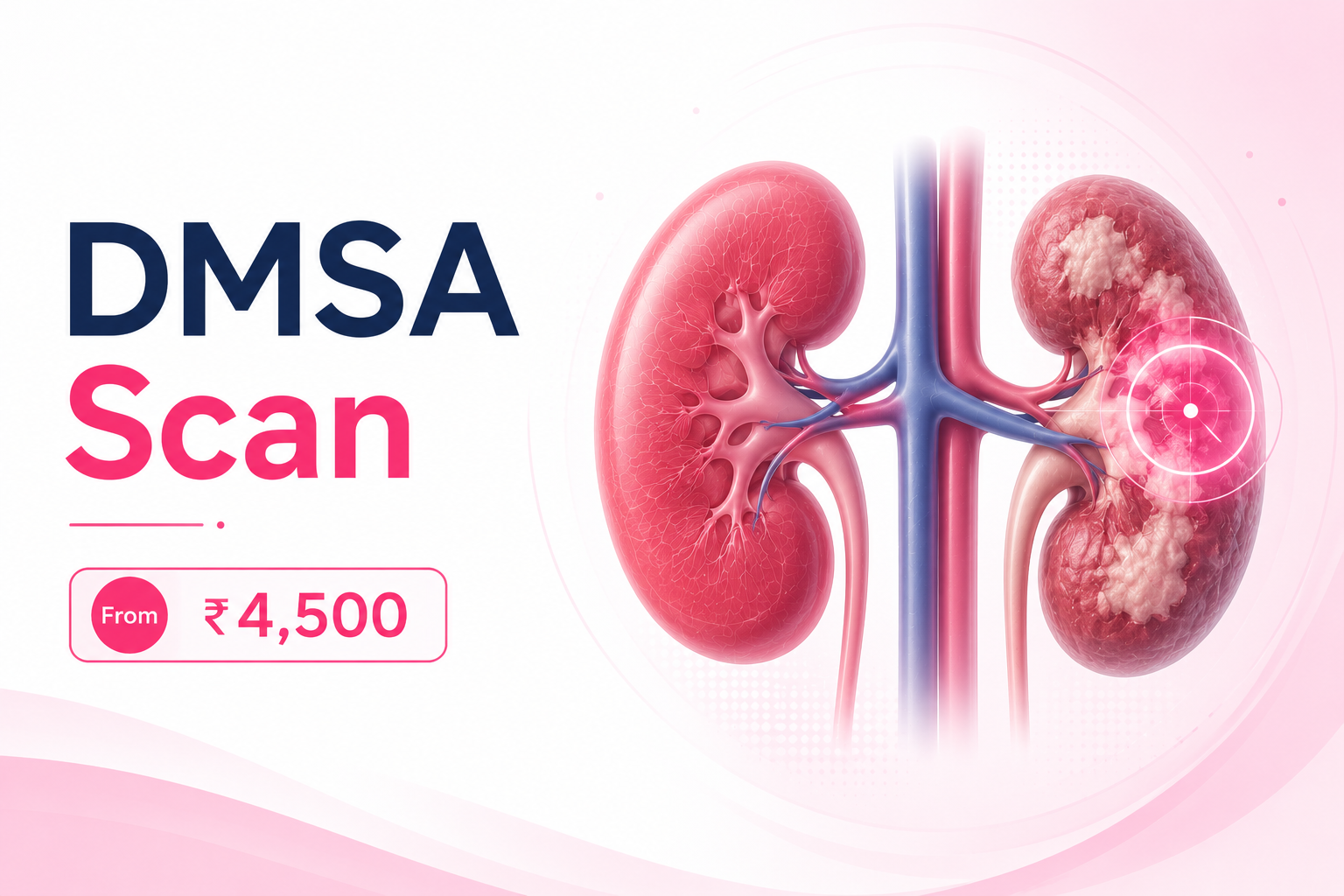
A DMSA scan answers a different question entirely: has infection or reflux permanently damaged the kidney?
The classic patient is a child with recurrent or febrile urinary tract infection. Every child with confirmed vesicoureteric reflux carries a real risk of cortical scarring, and DMSA is the only reliable way to establish whether it has happened. Scarring matters because it is a recognised cause of hypertension, and extensive scarring can progress to chronic renal impairment.
DMSA also confirms acute pyelonephritis during active infection, where reduced uptake indicates inflammation. It assesses ectopic and horseshoe kidneys, suspected renal agenesis, and follows known scarring over time.
Read more: DMSA scan cost in Delhi.
Timing Is Not the Same for Both
DTPA imaging begins the moment the tracer is injected. There is nothing to wait for.
DMSA is the opposite, and the waiting is not optional. The tracer needs two to three hours to bind to the renal cortex. Imaging before that produces a poor study.
More importantly, when the DMSA scan is done relative to infection changes what it means. To detect permanent scarring, it must be performed four to six months after a febrile urinary tract infection. Scanned earlier, acute inflammation looks identical to a scar, and a child may be labelled with permanent damage they do not have. To confirm acute pyelonephritis during the infection itself, DMSA is done immediately. Same scan, two different questions, two different timings.
Reading the Numbers
On a DMSA report, differential renal function of 45 to 55 percent per kidney is normal. Function of 40 to 44 percent is mildly reduced, 10 to 39 percent substantially impaired, and below 10 percent the kidney is considered non-functioning. A difference of 10 percent or more between the two kidneys is treated as a significant loss of function. A renal scar is formally defined as loss of functional tissue in at least two directions.
On a DTPA report, the headline figure is GFR, calculated by the Gates method from the fraction of tracer each kidney takes up in the first two to three minutes. This fraction is proportional to filtration rate, so total and individual kidney GFR are derived without a single blood or urine sample. The result correlates closely with 24-hour creatinine clearance.
Note what this means: DMSA gives you a percentage split, not a filtration rate. Only DTPA gives you an actual GFR number.
Why Neither Can Substitute for the Other
Patients sometimes ask whether they can book the cheaper scan, or the shorter one. The honest answer is no.
A DTPA scan cannot show cortical scarring, because the tracer washes through the kidney rather than binding to cortical tissue. There is nothing to image once it has passed.
A DMSA scan cannot show drainage or obstruction, because it captures a single static timepoint hours after the tracer has already settled. There is no movement left to observe.
If your prescription says DMSA and you book DTPA to save time, you will receive a technically valid scan that answers a question nobody asked.
Where MAG3 Fits In
There is a third tracer worth knowing about. MAG3 is cleared mainly by tubular secretion rather than glomerular filtration. Like DTPA it is dynamic and shows drainage, but it cannot measure GFR.
Its advantage is uptake. The kidneys take up MAG3 far more avidly than DTPA, so it produces clearer images when function is poor. DTPA has a known limitation here: variable binding to plasma proteins can underestimate GFR, and in significantly reduced renal function DTPA images become faint. In those patients, and in infants, many nuclear medicine physicians prefer MAG3.
DTPA remains standard wherever an actual GFR value is what the clinician needs.
Why Ultrasound Is Not an Alternative to DMSA
Ultrasound is usually the first kidney scan a patient receives, and it misses most scarring. In a study of 285 renal units, ultrasound identified parenchymal defects in 14 percent of kidneys while DMSA identified them in 31 percent, giving ultrasound a sensitivity of roughly 36 percent.
A normal ultrasound does not rule out renal scarring. This is precisely why paediatric nephrologists insist on DMSA after febrile urinary tract infection rather than accepting a reassuring ultrasound.
Cost of DTPA and DMSA in Delhi NCR
| Scan | EVE Healthcare | Typical Delhi range | CGHS (NABH) |
|---|---|---|---|
| DTPA Renal Scan | from ₹4,000 | ₹3,500 – ₹19,500 | ₹3,500 – ₹4,500 |
| Diuretic DTPA (furosemide) | ₹4,500 – ₹8,000 | ₹4,000 – ₹12,000 | ₹4,000 – ₹5,000 |
| DMSA Scan | from ₹4,500 | ₹4,000 – ₹8,000 | ₹3,500 – ₹5,000 |
| DMSA with SPECT | ₹5,500 – ₹9,000 | ₹5,000 – ₹10,000 | on approval |
The wide spread across Delhi reflects hospital overheads rather than any difference in scan quality. What determines whether your report is usable is the AERB licence and whether a qualified nuclear medicine physician interprets it, not the price. EVE Healthcare partner centres are AERB-licensed, with CGHS and ECHS cashless available at empanelled centres.
What to Confirm Before Booking Either Scan
Confirm the centre holds a valid AERB licence, mandatory for every nuclear medicine scan performed in India, and that a nuclear medicine physician reads and signs the report rather than a technician. Ask about tracer availability on your appointment date, because Tc-99m has a half-life of roughly six hours and is prepared in batches rather than kept in stock. For DMSA, ask whether SPECT is included if your doctor requested it, since it gives a volumetric estimate of defect size that planar imaging cannot. And if you are a CGHS or ECHS beneficiary, confirm empanelment for that specific scan rather than assuming general empanelment covers it.
Related Scans
- DTPA Renal Scan Cost in Delhi
- DMSA Scan Cost in Delhi
- MRI Kidney Scan Guide
- CT Scan KUB Cost in Delhi
Book your DTPA or DMSA scan — WhatsApp +91 9990032078 or call. AERB-licensed nuclear medicine centres across Delhi NCR · Reports by nuclear medicine physicians.
-(1).png)
.png)