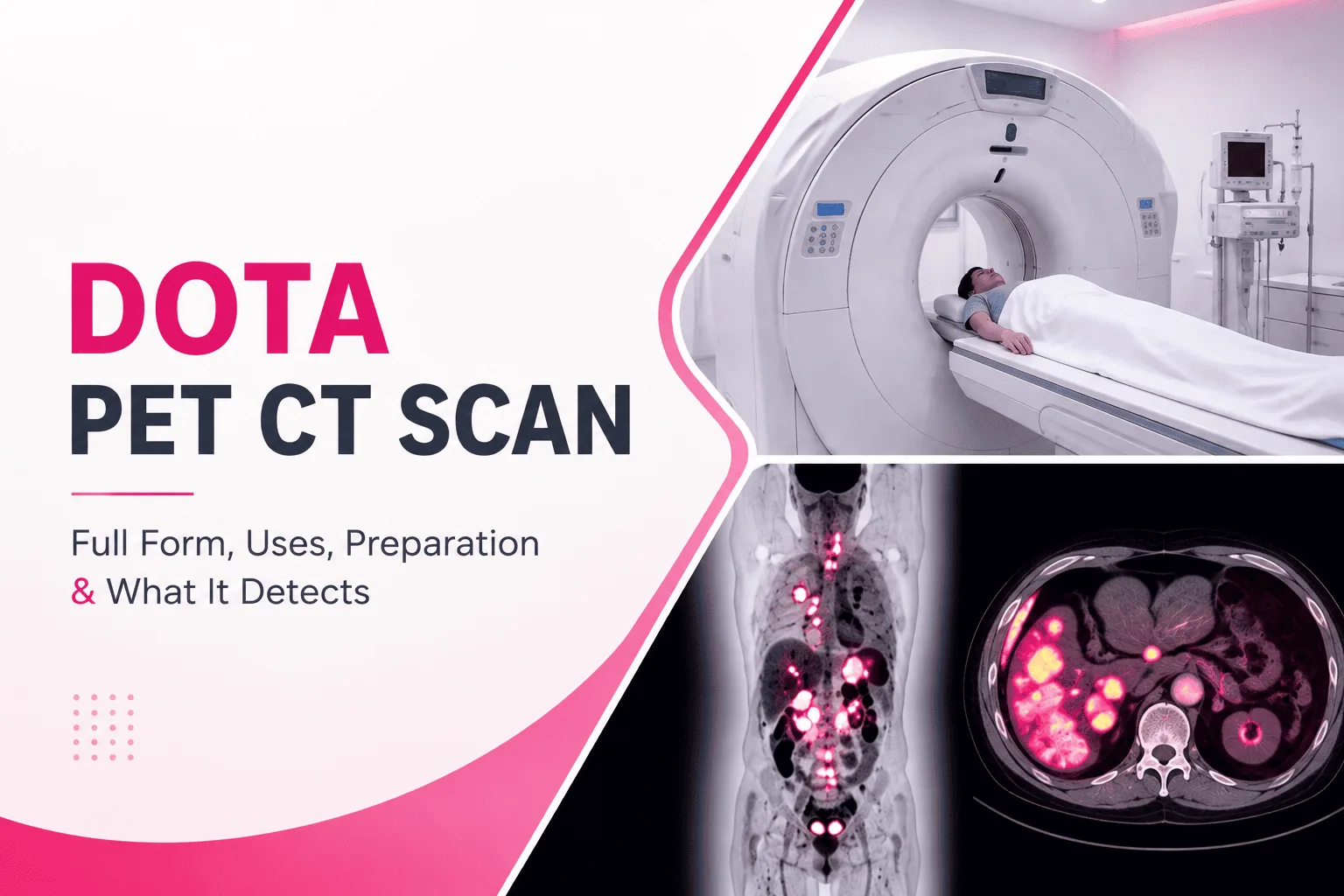

If your doctor has referred you for a PET CT scan but you are unsure which type — or if your prescription just says "PET CT" without specifying the tracer — this page gives you a complete, plain-language guide to every PET CT tracer type available in Delhi NCR and which cancer or condition each one is designed for.
The short answer: PET CT is not one scan — it is a family of scans. Each type uses a different radioactive tracer that targets a different biological process. The wrong tracer produces an uninterpretable scan regardless of how good the machine is. Confirming the correct tracer before booking is the most important step in the PET CT process.
Why Different PET CT Tracers Exist — The Core Concept
Every PET CT scan works the same way mechanically — a radioactive tracer is injected, the PET scanner detects where the tracer accumulates, and the CT provides the anatomical framework. What changes between scan types is the tracer — and the tracer determines what the scan can see.
Think of tracers as molecular keys designed for specific locks:
- FDG is a glucose key — it targets cells that consume abnormally high amounts of glucose. Most aggressive cancers do this.
- PSMA is a prostate membrane key — it targets a protein expressed specifically on prostate cancer cells.
- DOTANOC/DOTATATE is a somatostatin receptor key — it targets receptors expressed on neuroendocrine tumour cells.
- DOPA is a dopamine pathway key — it targets dopamine synthesis, relevant in Parkinson's disease and certain dopamine-secreting tumours.
- F-Choline is a cell membrane key — it targets choline uptake in rapidly dividing prostate cancer cells.
FDG remains the main player in molecular imaging. PSMA tracers are useful in staging and restaging prostate cancer. Somatostatin-targeting peptides such as DOTATOC and DOTATATE or DOPA are valuable in neuroendocrine tumours. rocketreach
The Quick Decision Table — Which PET CT Do You Need?

|
Your Diagnosis or Clinical Question |
Correct Tracer |
Why |
|
Lymphoma — staging or restaging |
FDG |
Lymphoma cells are highly FDG-avid |
|
Lung cancer — staging, restaging |
FDG |
Most lung cancers have high glucose metabolism |
|
Head and neck cancer |
FDG |
Standard staging investigation |
|
Colorectal cancer |
FDG |
Staging and recurrence detection |
|
Cervical cancer |
FDG |
Staging and lymph node assessment |
|
Oesophageal cancer |
FDG |
Staging and treatment monitoring |
|
Breast cancer (most types) |
FDG |
Staging and restaging |
|
Prostate cancer — newly diagnosed high risk |
PSMA |
Far superior sensitivity to FDG for prostate cancer |
|
Prostate cancer — rising PSA after treatment |
PSMA |
Detects recurrence at PSA levels where CT/MRI is negative |
|
Prostate cancer — before PSMA therapy (Lu-177) |
PSMA |
Confirms PSMA expression before radioligand therapy |
|
Neuroendocrine tumours (NETs) — carcinoid, gastrinoma, insulinoma |
DOTANOC / DOTATATE |
NETs express somatostatin receptors — FDG is often negative |
|
Pheochromocytoma / paraganglioma |
DOTANOC or DOPA |
Both useful — doctor specifies based on tumour characteristics |
|
Unknown primary neuroendocrine tumour |
DOTANOC / DOTATATE |
Maps somatostatin receptor expression across whole body |
|
Before PRRT (Peptide Receptor Radionuclide Therapy) |
DOTANOC / DOTATATE |
Confirms receptor expression, maps disease distribution |
|
Parkinson's disease — diagnosis confirmation |
DOPA |
Assesses dopaminergic system integrity |
|
Dopamine-secreting tumours |
DOPA |
Targets dopamine synthesis pathway |
|
Prostate cancer — alternative to PSMA |
F-Choline |
Used when PSMA is not available or as second-line |
|
Cardiac viability / myocardial perfusion |
Cardiac tracer (Rubidium/Ammonia) |
Assesses heart muscle blood flow and viability |
FDG PET CT — The Workhorse of Oncology
What it is: FDG (Fluorodeoxyglucose) is a radioactive glucose analogue. Cancer cells consume far more glucose than normal cells — FDG is taken up intensely by them.
What it is used for: Most common cancers — lymphoma, lung, head and neck, colorectal, cervical, oesophageal, thyroid (FDG-avid types). FDG PET CT is the standard for initial staging, restaging after treatment, and detecting recurrence.
What it misses: Cancers with low glucose metabolism — prostate cancer (especially low-grade), well-differentiated neuroendocrine tumours, renal cell carcinoma. Using FDG for these cancers produces unreliable results.
Preparation required: Low-carbohydrate diet for 24 hours before. Complete fasting for 6 hours before. Blood glucose check before injection. Diabetic patients require special protocol.
Cost in Delhi: ₹8,000 – ₹14,000 at AERB-licensed nuclear medicine centres.
PSMA PET CT — The Prostate Cancer Revolution
What it is: PSMA (Prostate-Specific Membrane Antigen) is a protein expressed at very high levels on prostate cancer cells. PSMA tracers — most commonly Ga-68 PSMA or F-18 PSMA — bind to this protein specifically.
What it is used for: Prostate cancer at every stage. PSMA PET CT has largely replaced older imaging methods for:
- Initial staging of high-risk localised prostate cancer
- Detecting recurrence after radical prostatectomy or radiotherapy — even at PSA levels as low as 0.2–0.5 ng/mL where CT and bone scan are negative
- Staging metastatic prostate cancer
- Confirming PSMA expression before Lu-177 PSMA radioligand therapy
Why FDG is not used for prostate cancer: Prostate cancer — especially well-differentiated and low-grade disease — has relatively low glucose metabolism. FDG PET CT frequently produces negative or equivocal results in prostate cancer patients even when active disease is present. PSMA PET CT is significantly superior for prostate cancer at all stages.
Preparation required: Fasting for 4–6 hours. No specific carbohydrate restriction. Hydration encouraged. Blood glucose check not required for PSMA.
Cost in Delhi: ₹14,000 – ₹22,000 at AERB-licensed nuclear medicine centres.
DOTANOC / DOTATATE PET CT — For Neuroendocrine Tumours
What it is: DOTANOC (Ga-68 DOTA-NOC) and DOTATATE (Ga-68 DOTA-TATE) are somatostatin analogues that bind to somatostatin receptors expressed on neuroendocrine tumour (NET) cells. Both are highly similar — your nuclear medicine physician will specify which based on availability and tumour type.
What it is used for: Neuroendocrine tumours — a family of tumours that arise from neuroendocrine cells throughout the body:
- Carcinoid tumours (gastrointestinal, pulmonary)
- Gastrinoma, insulinoma, glucagonoma
- Pheochromocytoma and paraganglioma (DOTANOC is commonly used — though DOPA may be preferred for specific subtypes)
- Merkel cell carcinoma
- Assessment before and after PRRT (Peptide Receptor Radionuclide Therapy)
Why FDG fails for most NETs: Well-differentiated NETs have low glucose metabolism — they are FDG-negative or weakly FDG-positive. DOTANOC/DOTATATE detects them through their somatostatin receptor expression, which is independent of glucose metabolism. A patient with a well-differentiated NET and a negative FDG PET CT may have extensive disease on DOTANOC PET CT.
The important exception: Poorly differentiated or high-grade NETs (Grade 3) may lose somatostatin receptor expression and become FDG-avid. For these patients, FDG PET CT is often more useful than DOTANOC. Your oncologist and nuclear medicine physician determine which investigation is appropriate based on your tumour grade.
Preparation required: Fasting for 4–6 hours. Stop long-acting somatostatin analogues (octreotide, lanreotide) 4–6 weeks before the scan — these compete with the DOTANOC tracer for receptor binding. This is a critical preparation step that many patients are not told. Confirm with your oncologist and nuclear medicine physician when to pause somatostatin analogue therapy before DOTANOC/DOTATATE PET CT.
Cost in Delhi: ₹18,000 – ₹25,000 at AERB-licensed nuclear medicine centres.
DOPA PET CT — For Parkinson's and Dopamine-Secreting Tumours
What it is: F-18 DOPA (Fluorodopa) is a radioactive version of the dopamine precursor DOPA. It maps dopamine synthesis activity in the brain and dopamine-secreting tissue throughout the body.
What it is used for:
- Parkinson's disease — confirms dopaminergic system degeneration. Used when clinical diagnosis is uncertain and the neurologist needs imaging evidence of dopamine loss.
- Essential tremor vs Parkinson's — differentiates true Parkinson's from other tremor disorders that do not affect the dopaminergic system
- Pheochromocytoma and paraganglioma — for specific genetic subtypes where DOPA is preferred over DOTANOC
- Some rare dopamine-secreting NETs
Why DOPA is not the standard NET tracer: For most gastroenteropancreatic NETs — carcinoid, gastrinoma, insulinoma — DOTANOC/DOTATATE is preferred because it maps somatostatin receptors, which are the target for PRRT therapy. DOPA is more useful for neural crest-derived tumours (phaeochromocytoma, paraganglioma) and Parkinson's diagnosis.
Preparation required: Specific dietary and medication restrictions apply — your nuclear medicine centre will provide a protocol. Some medications affecting dopamine metabolism must be paused before the scan. Confirm with the centre.
Cost in Delhi: ₹18,000 – ₹28,000 at AERB-licensed nuclear medicine centres (less commonly performed — confirm availability).
F-Choline PET CT — Prostate Cancer Alternative
What it is: F-18 Choline (Fluorocholine) targets choline uptake — a process elevated in rapidly dividing cells including prostate cancer.
What it is used for: Prostate cancer — as an alternative to PSMA in specific situations:
- When PSMA is temporarily unavailable
- In patients with very low PSA where PSMA sensitivity is reduced
- As a complementary investigation in complex cases
PSMA vs F-Choline for prostate cancer: PSMA is now generally considered superior to F-Choline for prostate cancer restaging and recurrence detection. PSMA detects recurrence at lower PSA levels with higher sensitivity. F-Choline remains a valid option when PSMA is not available or as a second-line investigation.
Cost in Delhi: ₹16,000 – ₹22,000 at AERB-licensed nuclear medicine centres (confirm availability).
Cardiac PET CT — For Heart Disease
What it is: Cardiac PET CT uses tracers such as Rubidium-82 or N-13 Ammonia to assess myocardial blood flow, or FDG in a specific cardiac protocol to assess myocardial viability.
What it is used for:
- Myocardial perfusion assessment — whether parts of the heart muscle are receiving adequate blood flow
- Myocardial viability — whether damaged heart muscle can recover after revascularisation
- Cardiac sarcoidosis — in a specific FDG cardiac protocol with prolonged carbohydrate restriction
This is EVE's Cardiac PET CT Scan service — different preparation and protocol from oncology FDG PET CT.
Cost in Delhi: ₹20,000 – ₹35,000 depending on tracer and protocol.
What To Do If Your Prescription Just Says "PET CT"
This is the most common booking problem EVE encounters for PET CT.
Your prescription says "PET CT" without specifying the tracer. What to do:
Step 1: Check the prescription again. Look for any of these words — FDG, PSMA, DOTANOC, DOTATATE, DOPA, Choline, Ga-68, F-18. If any of these appear — that is your tracer specification.
Step 2: Look at the clinical indication written on the prescription. "PET CT for lymphoma staging" almost certainly means FDG. "PET CT for rising PSA" almost certainly means PSMA. "PET CT for NET restaging" almost certainly means DOTANOC.
Step 3: If still unclear — do not book. Call your oncologist or the nuclear medicine physician's office and ask specifically: "Which tracer do you want for this PET CT?" One phone call of 2 minutes prevents a ₹15,000–₹25,000 scan that cannot answer the clinical question.
Step 4: Share your prescription with EVE Healthcare via WhatsApp. Our team reviews it and confirms the tracer with your oncologist before booking is confirmed. This is our standard process for all PET CT bookings — we do not confirm a PET CT appointment without tracer confirmation.
The Tracer Summary Table — Quick Reference
|
Tracer |
Full Name |
Available at EVE |
Primary Use |
Cost Range |
|
FDG |
Fluorodeoxyglucose |
Yes |
Most cancers — staging, restaging |
₹8,000 – ₹14,000 |
|
PSMA |
Prostate-Specific Membrane Antigen |
Yes |
Prostate cancer |
₹14,000 – ₹22,000 |
|
DOTANOC |
Ga-68 DOTA-NOC |
Yes |
Neuroendocrine tumours |
₹18,000 – ₹25,000 |
|
DOTATATE |
Ga-68 DOTA-TATE |
Yes |
Neuroendocrine tumours |
₹18,000 – ₹25,000 |
|
DOPA |
F-18 Fluorodopa |
Yes (select) |
Parkinson's, phaeochromocytoma |
₹18,000 – ₹28,000 |
|
F-Choline |
F-18 Fluorocholine |
Yes (select) |
Prostate cancer alternative |
₹16,000 – ₹22,000 |
|
Cardiac |
Rubidium/Ammonia/FDG cardiac |
Yes |
Heart disease |
₹20,000 – ₹35,000 |
All prices from EVE Healthcare partner centres — AERB-licensed nuclear medicine centres in Delhi NCR. Prices verified June 2026.
The Most Important Booking Instruction
When booking any PET CT through EVE Healthcare — state the tracer by name. Not "whole body PET CT." Not "PET scan." Say: "FDG whole body PET CT" or "PSMA PET CT" or "DOTANOC PET CT."
If you cannot name the tracer — share the prescription via WhatsApp. Our team reviews it, confirms the tracer with your referring doctor if necessary, and only then confirms the appointment.
Clinical Note
From the reviewing nuclear medicine physician: The tracer selection question is the question I most often wish had been resolved before a patient arrives at our centre. I have had patients referred for DOTANOC PET CT for neuroendocrine tumours who arrive having been booked for FDG — because the booking centre defaulted to FDG when the prescription said "PET CT." The scan is technically performed correctly. The images are read by an experienced physician. And the result is: no significant FDG-avid disease. Which is the expected result in a patient with a well-differentiated NET — because these tumours are FDG-negative. The patient leaves thinking their scan was normal. The oncologist receives a report that cannot stage the disease. And three weeks later they need to repeat the investigation with the correct tracer. The preparation question — which tracer — takes one phone call to resolve before booking. It takes a three-week delay, an additional scan, and a completely avoidable patient experience to resolve after booking the wrong one. The decision about which tracer to use is clinical — it belongs to the oncologist or nuclear medicine physician. The responsibility for confirming the decision before the appointment belongs to whoever takes the booking. At EVE Healthcare, that confirmation is our standard process for every PET CT booking.
Book Your PET CT Scan in Delhi
EVE Healthcare partner centres offer FDG, PSMA, DOTANOC, DOTATATE, DOPA, F-Choline, and Cardiac PET CT scans across Delhi NCR — AERB-licensed nuclear medicine centres, same-week availability for most tracers, and digital report delivery.
WhatsApp your prescription to +91 9990032078. Our team confirms the tracer, preparation protocol, and appointment before you travel to the centre.
Also see: Whole Body PET CT Scan Cost Delhi → · PSMA PET CT Scan Cost Delhi → · DOTANOC PET CT Scan Cost Delhi → · How to Prepare for PET CT → · Is PET CT Scan Safe? → · CGHS PET CT Rate Delhi