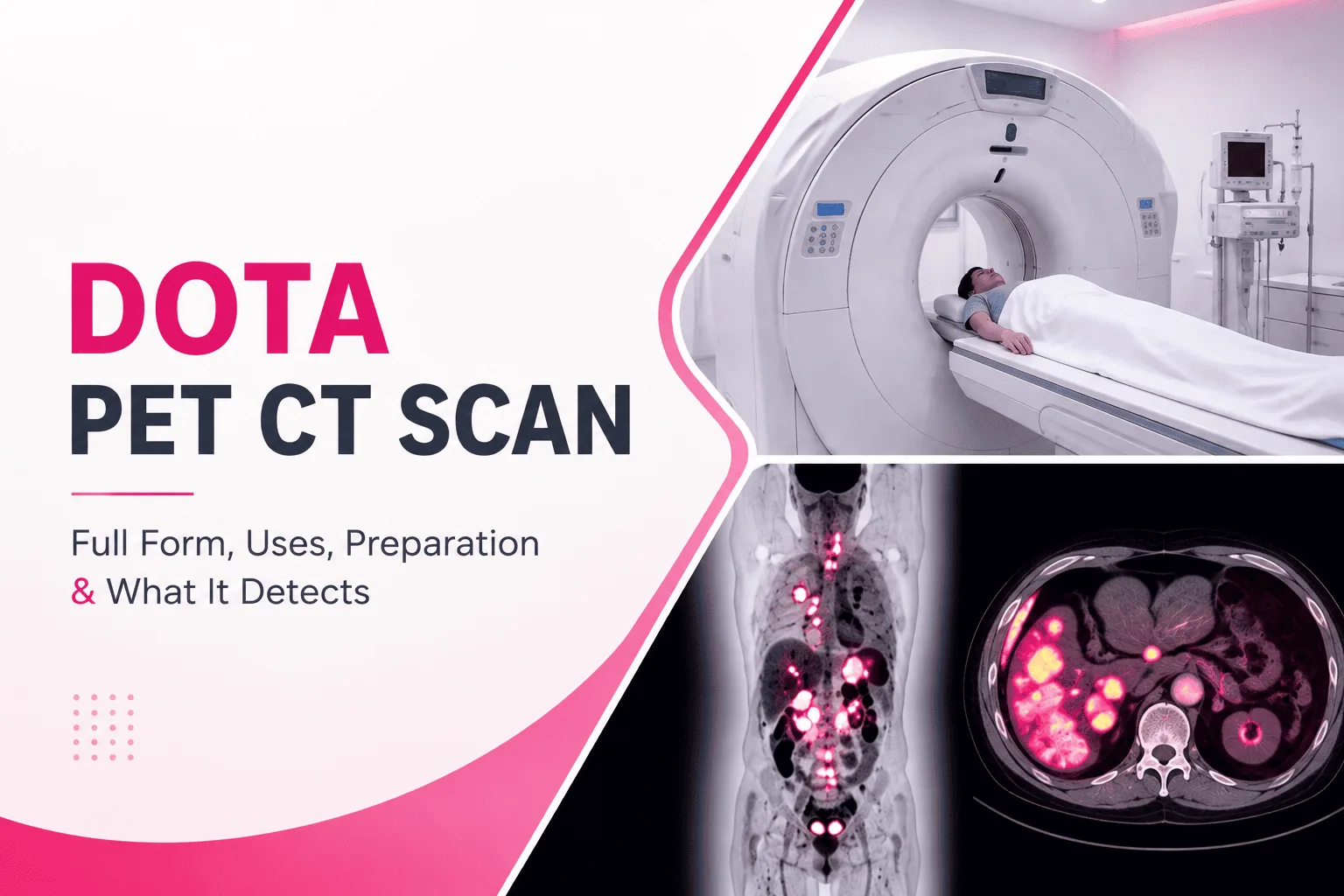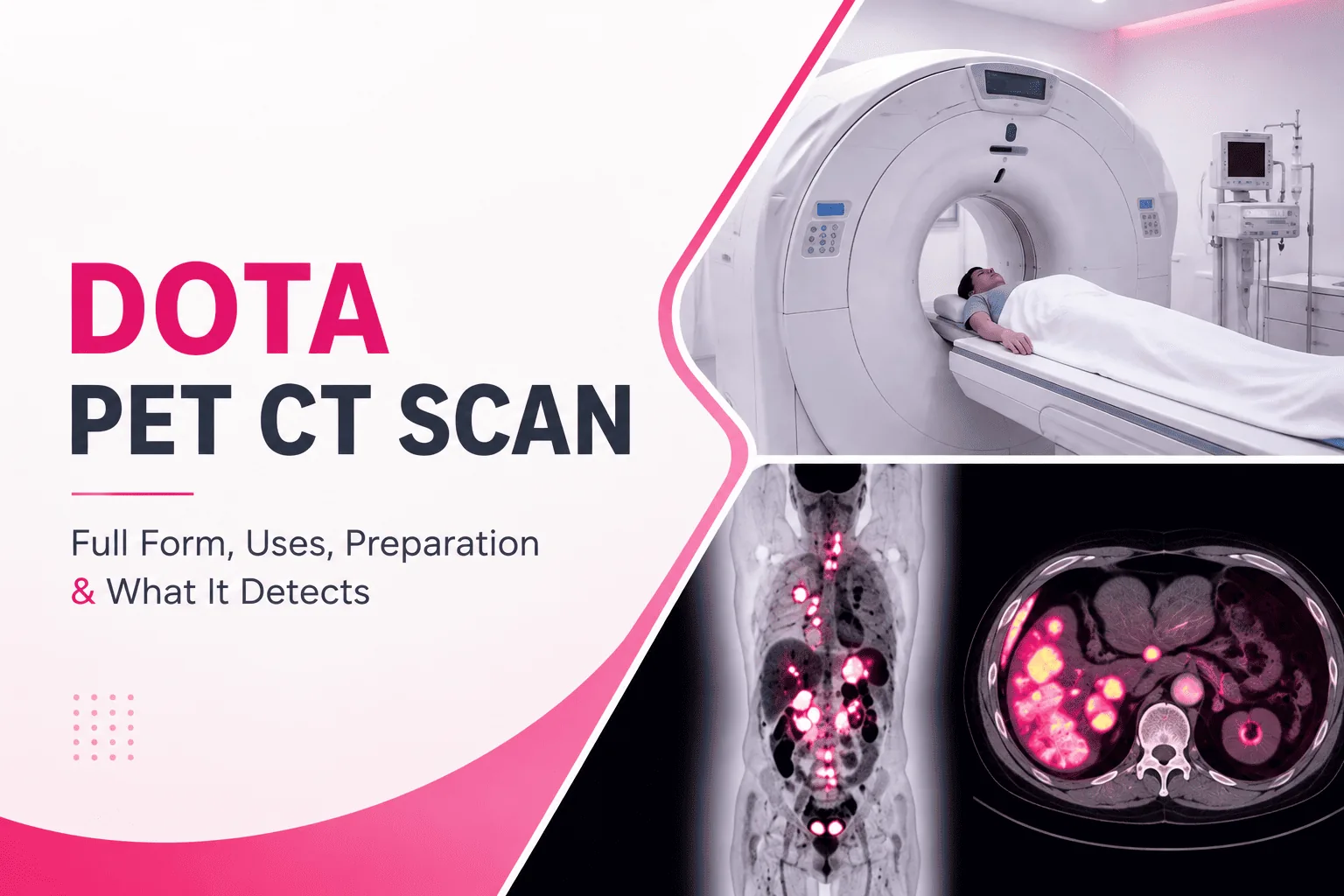

If you have been referred for a PET CT scan and you are worried about the radioactive injection or the radiation dose — this page gives you honest numbers and honest context.
The direct answer: PET CT scan is safe for patients with a genuine clinical indication. The radiation dose is real but quantified. The FDG radioactivity decays rapidly. The cancer risk from a single PET CT scan is very small compared to the diagnostic benefit of the information it provides — particularly for a patient making a cancer staging or treatment decision.
This page does not minimise your concern. It gives you the specific numbers so you can form your own informed view.
Two Sources of Radiation in PET CT — Understanding Both
PET CT combines two investigations in one scanner session. Each contributes separately to the total radiation dose.
Source 1 — The FDG tracer (radioactive injection): The effective dose from FDG PET scan is typically 8 mSv for adults using 400 MBq of FDG — and this is the same whether a part of the body or the whole body is imaged.
Source 2 — The CT component: The effective dose from the CT component depends on the acquisition parameters. A high-resolution diagnostic CT scan can be quite high — up to 30 mSv for a whole body CT scan. In its simplest form used only for localisation of PET abnormalities, the CT dose can be as low as 7 mSv for a whole body study.
Total dose for a standard whole body FDG PET CT:
An Indian study from the Institute of Nuclear Medicine and Allied Sciences in Delhi estimated the effective dose from PET CT investigations as 14.2 mSv in males and 17.2 mSv in females for an administered FDG activity of 370 MBq.
The Radiation Dose in Context — What 14 mSv Actually Means
Numbers without context produce more anxiety, not less. Here is the context:
|
Source of Radiation Exposure |
Dose |
|
Natural background radiation in India (annual) |
1–3 mSv per year |
|
Chest X-ray |
0.1 mSv |
|
CT abdomen (standard) |
8–10 mSv |
|
Standard FDG PET CT whole body |
14–17 mSv |
|
Long-haul international flight |
0.1 mSv |
|
Annual natural background equivalent of PET CT |
5–17 years |
A standard FDG PET CT delivers approximately 14–17 mSv — equivalent to 5–17 years of natural background radiation in India. This is a meaningful dose. It is also a dose that radiation protection experts and oncologists consider acceptable and clinically justified for a patient making a cancer staging or restaging decision.
The cancer risk calculation: A PET CT scan at approximately 6 mSv increases the lifetime risk of developing an untreatable cancer by approximately 0.03% compared to the general population — which has a baseline lifetime cancer mortality risk of approximately 25%.
For a full FDG PET CT at 14–17 mSv, the incremental cancer risk is approximately 0.05–0.08%.
The clinical context that makes this acceptable: For a patient who has just received a cancer diagnosis and needs whole body staging before treatment begins — the alternative to the PET CT is not zero radiation. It is clinical uncertainty about whether the cancer has spread — uncertainty that directly affects treatment decisions. The 0.05–0.08% theoretical incremental risk from the staging scan is clinically irrelevant compared to the consequence of undertreating or overtreating a cancer because staging was incomplete.
The FDG Radioactive Injection — The Fear Addressed Directly

The phrase "radioactive injection" is the specific element of PET CT that triggers the most anxiety. Here is what it means in clinical terms.
What radioactive means for FDG:
FDG (Fluorodeoxyglucose) contains Fluorine-18 — a radioactive isotope that decays by emitting a positron. The radioactive isotope F-18 decays by positron emission, having a half-life of 110 minutes.
A half-life of 110 minutes means: after 110 minutes, half the radioactivity has decayed. After another 110 minutes, half of the remainder has decayed. By 12 hours after injection — approximately 7 half-lives — roughly 99% of the F-18 radioactivity has physically decayed.
The decay timeline:
|
Time After Injection |
Approximate Remaining Radioactivity |
|
110 minutes (1 half-life) |
50% |
|
220 minutes (2 half-lives) |
25% |
|
6 hours (approx. 3.3 half-lives) |
~10% |
|
12 hours (approx. 6.5 half-lives) |
~1% |
|
24 hours |
Negligible |
By the time you go to sleep on the night of your PET CT scan, virtually all of the FDG radioactivity has physically decayed. It does not accumulate. It does not remain active for days. It does not permanently alter your cells.
How it leaves the body: FDG that is not taken up by cells is excreted through the kidneys into urine. This is why patients are encouraged to drink water generously after the scan — to help flush the FDG through the kidneys faster. The combination of radioactive decay and urinary excretion means the body is essentially clear of FDG within 24 hours of the scan.
Precautions After PET CT — What You Need to Do and Why
Major cancer centres recommend that for at least one hour after your scan you avoid skin-to-skin contact with pregnant people and anyone under 18.
Patients will be required to follow radiation protection advice after the scan which includes staying away from pregnant women and young children for about 8 hours while the radioactive tracer can still be in their system.
Practical instructions for after your PET CT:
|
Precaution |
Duration |
Who It Applies To |
|
Avoid close contact with pregnant women |
6–8 hours |
All FDG PET CT patients |
|
Avoid close contact with children under 5 |
6–8 hours |
All FDG PET CT patients |
|
Avoid holding infants or young children |
6–8 hours |
All FDG PET CT patients |
|
Drink water generously |
Full day of scan |
All patients — helps excrete FDG via urine |
|
Normal contact with other adults |
No restriction |
Immediate |
|
Return to work |
Next day or same day |
If feeling well |
|
Drive yourself home |
Yes — immediately |
No sedation involved |
The common anxiety the nuclear medicine team hears: "Am I going to make my family radioactive?" The honest answer is no. The levels of radioactivity emitted from your body after a PET CT scan are too low to affect the health of people around you in normal social contact. The precautions above are standard radiation protection measures applied out of abundant caution for the most sensitive groups — pregnant women and young children — not because normal interaction poses a real hazard.
Is PET CT Safe for Specific Groups?
Diabetic patients: Diabetes itself does not increase radiation risk from PET CT. However, blood glucose management before FDG PET CT requires careful attention — see the How to Prepare for PET CT → guide for specific diabetic preparation protocol.
Patients who have had previous PET CT scans: Cumulative radiation exposure is relevant for patients who require frequent PET CT monitoring. This is a valid concern and one your oncologist actively manages — each scan is justified against the clinical need. If you are concerned about cumulative dose, discuss this explicitly with your oncologist at the time of each referral. They may be able to use lower-dose CT acquisition parameters or substitute MRI for some follow-up investigations.
Elderly patients: Age reduces the theoretical incremental cancer risk from radiation because older patients have fewer remaining life years in which a radiation-induced cancer could develop. For an elderly patient with a cancer diagnosis, the risk-benefit balance of PET CT staging is overwhelmingly in favour of proceeding.
Patients with kidney disease: FDG is excreted through the kidneys. Severe kidney disease does not contraindicate PET CT — the radioactivity decays regardless of excretion — but it may affect the quality of pelvic images due to tracer accumulation in the bladder. Your nuclear medicine physician will advise.
Can pregnant women have PET CT? Generally avoided during pregnancy — particularly in the first trimester. In urgent clinical situations where staging is critical and cannot be deferred, it may be performed after a careful risk-benefit discussion. This is a specialist decision. Do not book PET CT in pregnancy without explicit oncologist and nuclear medicine physician guidance.
Side Effects of the FDG Injection — What Patients Actually Experience
FDG PET CT has an excellent safety profile. The documented side effects are minimal:
The IV cannula placement: A brief needle prick for the IV line. The same minor risks as any blood test — occasional bruising, very rare local infection at the site. No significant risk.
The FDG injection itself: FDG is colourless, odourless, tasteless, and has no sensation. Allergic reactions to FDG are extremely rare — far rarer than iodine contrast reactions with CT.
During the uptake phase: No sensation from the tracer circulating. Some patients feel mild warmth from the IV flush.
Post-scan: No residual effects. No nausea. No fatigue from the radiation itself. Mild radiation fatigue is not a documented phenomenon at PET CT doses — if you feel tired after a PET CT scan, it is from the fasting, the travel, and the emotional weight of a cancer investigation — not from the radiation.
PET CT vs CT Scan — Which Is More Radiation?
This is one of the most searched comparisons in diagnostic radiation safety.
|
Investigation |
Typical Total Radiation Dose |
|
Chest X-ray |
0.1 mSv |
|
CT brain |
2 mSv |
|
CT chest |
7 mSv |
|
CT abdomen |
8–10 mSv |
|
FDG PET CT (standard whole body) |
14–17 mSv |
|
FDG PET CT (low-dose CT component) |
8–12 mSv |
|
CT abdomen + pelvis + chest (full staging CT) |
20–30 mSv |
A standard FDG PET CT delivers more radiation than a single CT abdomen — but less than or comparable to a full staging CT of the chest, abdomen, and pelvis combined. In oncology practice, PET CT often replaces multiple individual CT scans that would together deliver equivalent or higher dose.
The dose reduction opportunity: Major reductions in radiation doses from PET CT scans can be achieved by modifying the acquisition parameters for CT. Modern AERB-licensed nuclear medicine centres in Delhi use dose reduction protocols — lower tube current, iterative reconstruction algorithms — that bring typical PET CT doses toward the lower end of the 8–17 mSv range without compromising image quality.
The ALARA Principle — How Nuclear Medicine Centres Manage Your Dose
Every AERB-licensed nuclear medicine centre in India is required to follow the ALARA principle — As Low As Reasonably Achievable. This means:
- The FDG dose is calculated based on your body weight — heavier patients receive proportionally more, lighter patients receive less
- CT acquisition parameters are adjusted to the minimum needed for diagnostic quality
- The scan field is limited to the clinically relevant body region — avoiding unnecessary radiation to areas outside the scan indication
- Pregnancy status is confirmed before every scan
When you attend an AERB-licensed nuclear medicine centre, dose optimisation is a regulatory requirement — not an optional practice.
The Honest Bottom Line
PET CT scan is not without radiation. It is safe for patients with a genuine clinical indication.
The FDG radioactivity decays within 24 hours. The total dose — 14–17 mSv for a standard whole body FDG PET CT — produces a theoretical incremental lifetime cancer risk of approximately 0.05–0.08%. For a patient making a cancer staging decision, this risk is clinically negligible compared to the consequence of staging inaccuracy.
The precautions after the scan — avoiding close contact with pregnant women and young children for 6–8 hours — are straightforward and appropriate. They do not prevent normal daily activity.
If you have been referred for a PET CT scan by your oncologist — the referral represents their clinical judgment that the diagnostic information justifies the dose. That judgment has been made by physicians who are fully aware of the radiation involved and who make this risk-benefit calculation for every patient they refer.
Clinical Note
From the reviewing nuclear medicine physician: The radiation question is the one I spend the most time on with patients before their first PET CT scan. The concern is understandable — being injected with a radioactive substance is not an everyday experience, and the word "radioactive" carries associations that diagnostic nuclear medicine does not warrant. The practical facts are these: the FDG half-life is 110 minutes, meaning the radioactivity is essentially gone by the time the patient wakes up the next morning. The total dose — 14 mSv for a typical whole body FDG PET CT in Delhi — is real but clinically acceptable for a patient staging a cancer diagnosis. The incremental cancer risk is approximately 0.05–0.08% over a lifetime. For a patient who has just been told they have cancer and needs to know whether it has spread before treatment begins, the staging information from the PET CT changes their entire treatment pathway. That is the risk-benefit calculation that justifies every referral I receive. What I tell patients directly: you are not going to harm your family by going home after a PET CT scan. Drink water, avoid your grandchildren and pregnant relatives for 8 hours, sleep well. The radioactivity will be almost entirely gone by morning.
Book Your PET CT Scan in Delhi
EVE Healthcare partner centres offer FDG, PSMA, DOTANOC, and Cardiac PET CT scans at AERB-licensed nuclear medicine centres across Delhi NCR — with dose optimisation protocols and CGHS rates at empanelled centres.
WhatsApp +91 9990032078 or use the search tool at eve-healthcare.com.
Also see: Whole Body PET CT Scan Cost Delhi → · FDG vs PSMA vs DOTANOC → · How to Prepare for PET CT → · CGHS PET CT Rate Delhi → · Is CT Scan Safe?