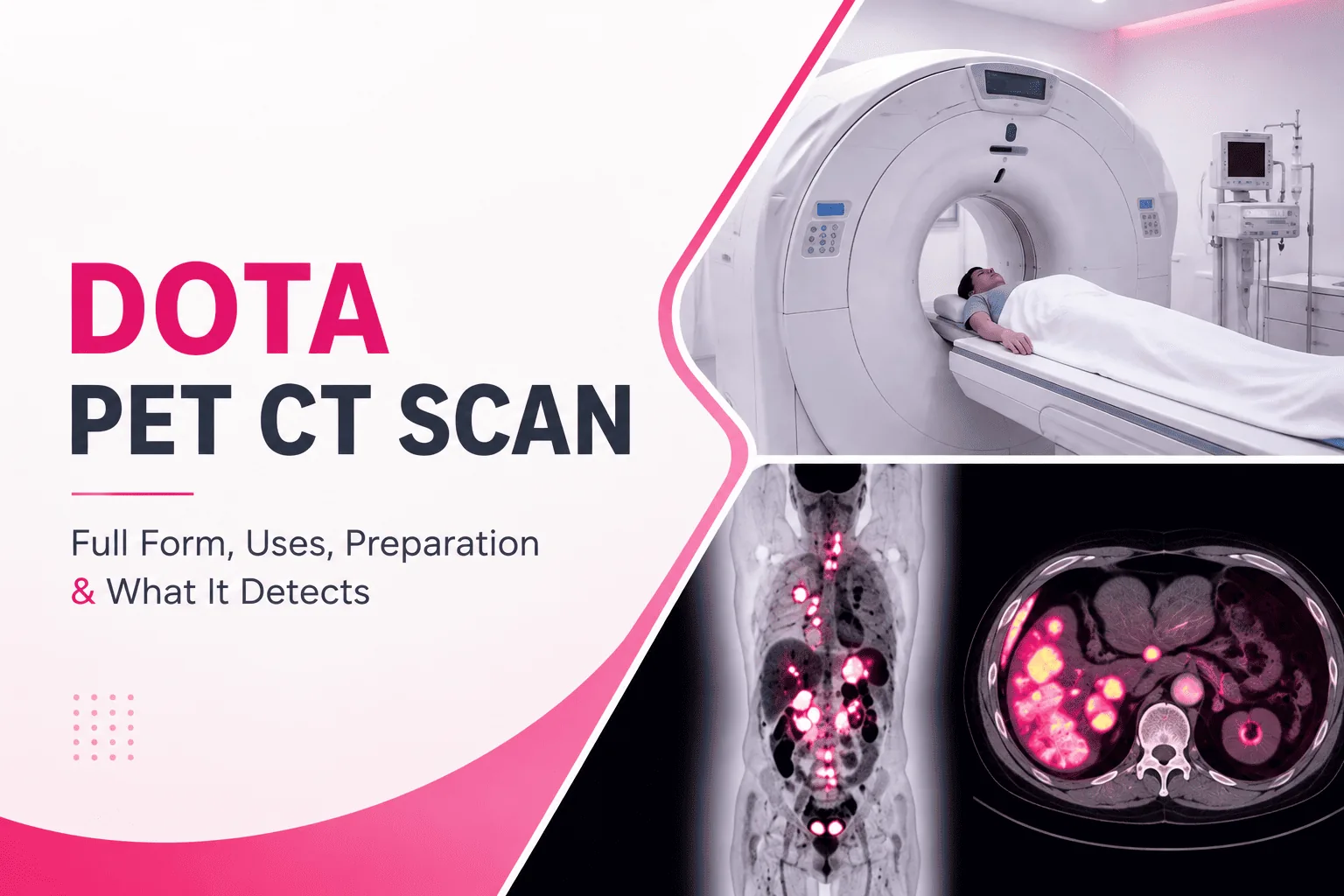
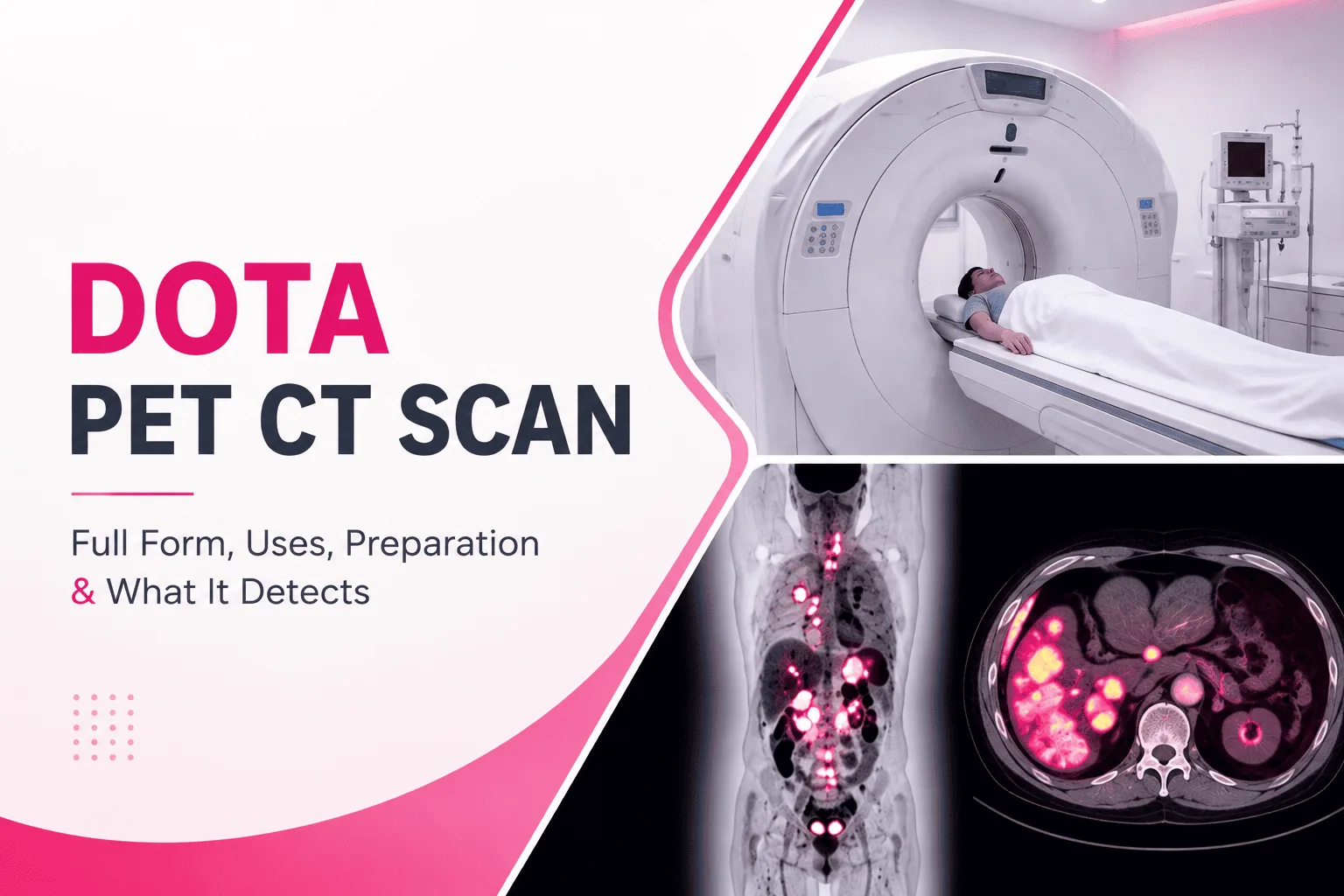
If your doctor has written DOTA PET CT or DOTA scan on your prescription, you have probably already searched for it and found conflicting information. Some sources call it a DOTATATE scan, others DOTANOC, others a Gallium scan. All of them describe the same family of investigation, and the confusion comes from one thing most explanations skip.
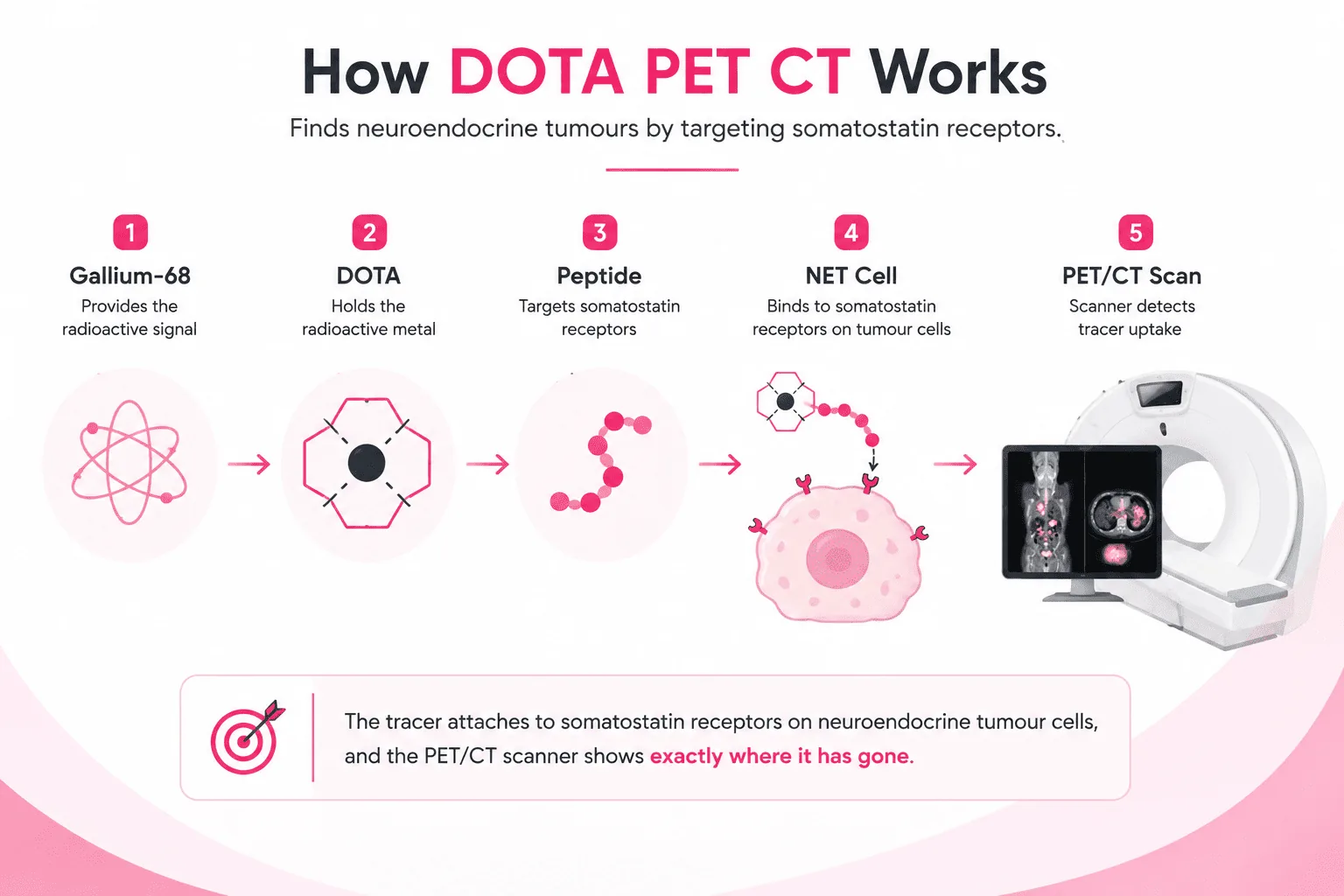
In simple words: DOTA PET CT is a type of somatostatin receptor PET imaging used mainly to find and stage neuroendocrine tumours. DOTA itself is not the tracer — it is the molecule that holds the radioactive atom in place and links it to a tumour-seeking peptide.
This guide explains what the scan is, what it detects, how it is performed, and what the terms in your report mean.
For pricing, CGHS rates and booking in Delhi NCR, see our DOTA PET CT scan cost guide.
DOTA Full Form
DOTA stands for 1,4,7,10-Tetraazacyclododecane-1,4,7,10-tetraacetic acid.
It is also known as tetraxetan. In chemical databases it appears as PubChem CID 121841, CAS number 60239-18-1, with the molecular formula C16H28N4O8.
DOTA is a macrocyclic chelator — a twelve-membered ring containing four nitrogen atoms, each carrying a carboxymethyl group. Its function is to hold a metal ion securely. In PET imaging that metal is usually Gallium-68.
The chelator alone does not find tumours. What finds tumours is the peptide attached to it — a synthetic analogue of somatostatin engineered to bind somatostatin receptors on tumour cell surfaces.
So the complete tracer has three parts. Gallium-68 provides the signal the scanner detects. DOTA holds the gallium. The peptide seeks the tumour.
DOTA vs DOTATATE vs DOTANOC vs DOTATOC
This is the terminology most patients find confusing.
| Term | What it refers to |
|---|---|
| DOTA | The chelator molecule — 1,4,7,10-Tetraazacyclododecane-1,4,7,10-tetraacetic acid |
| DOTATATE | DOTA conjugated to the TATE peptide (Tyr3-octreotate) |
| DOTANOC | DOTA conjugated to the NOC peptide (1-Nal3-octreotide) |
| DOTATOC | DOTA conjugated to the TOC peptide (Tyr3-octreotide) |
| Ga-68 | Gallium-68, the radioactive isotope held by the chelator |
| SSTR PET | Somatostatin receptor PET — the general term for this class of scan |
DOTATATE, DOTATOC and DOTANOC are different DOTA-conjugated somatostatin receptor targeting peptides. They are used for broadly similar clinical purposes, although their receptor binding profiles and availability can differ. DOTATATE has particularly high affinity for somatostatin receptor subtype 2, while DOTANOC has a comparatively broader binding profile across subtypes 2, 3 and 5.
When a prescription simply says DOTA PET CT or DOTA scan, the exact peptide depends on which tracer the nuclear medicine centre produces. Ask the centre which peptide they will use and note it in your records — this matters if you have follow-up imaging later.
What DOTA PET CT Detects
DOTA PET CT is used primarily to detect and stage neuroendocrine tumours, usually called NETs.
Neuroendocrine tumours arise from cells sharing properties of both nerve cells and hormone-producing cells. These cells occur throughout the body — pancreas, small intestine, stomach, colon, rectum, lungs, thyroid and adrenal glands. Because they can appear almost anywhere, NETs are often difficult to locate with conventional imaging alone.
Tumour types where SSTR PET is commonly used include gastroenteropancreatic NETs of the digestive tract and pancreas, pancreatic NETs such as insulinoma and gastrinoma, carcinoid tumours of the gut and lung, phaeochromocytoma, paraganglioma, and medullary thyroid carcinoma.
The scan is also used when a patient has confirmed NET metastases but the primary tumour site has not been identified on CT or MRI.
Why a Standard FDG PET CT May Miss These Tumours
A standard FDG PET CT works on a simple principle. Rapidly dividing cells consume more glucose, and FDG is a radioactive glucose analogue. Cells consuming the most glucose appear brightest.
Many neuroendocrine tumours break this assumption. Well-differentiated NETs often grow slowly and may consume little more glucose than surrounding tissue. On FDG PET CT they can appear negative even when disease is present.
DOTA PET CT uses a different biological target. Neuroendocrine tumour cells frequently overexpress somatostatin receptors on their surface. The DOTA-peptide tracer binds those receptors regardless of how quickly the tumour is growing.
This is why a patient can have an unremarkable FDG PET CT and a clearly positive SSTR PET for the same disease. The two scans ask different biological questions.
There is a clinical nuance. Poorly differentiated, higher-grade NETs may lose somatostatin receptor expression as they dedifferentiate, while simultaneously becoming more glucose-avid. In some patients FDG PET CT is positive where SSTR PET is not. Oncologists occasionally request both scans in advanced disease to map which lesions are receptor-positive and which are glucose-avid, as this can influence treatment planning.
How the Scan Is Performed
Unlike FDG PET CT, DOTA PET CT generally does not require fasting or carbohydrate restriction. Follow the specific preparation instructions provided by your nuclear medicine centre, as local protocols vary.
At the centre a cannula is placed in a vein and the Gallium-68 DOTA-peptide tracer is injected. You then rest for a period while the tracer circulates and binds to receptors — commonly around forty-five to sixty minutes, though this varies by protocol. You will be asked to stay still during this time.
The scan itself typically takes twenty to forty minutes depending on the imaging field required. You lie on a table that moves through the scanner and breathe normally.
Total time at the centre is usually two to three hours. Your centre will confirm the expected duration when you book.
Afterwards you can generally resume normal activities. Centres commonly advise drinking plenty of water and emptying the bladder frequently afterwards.
If You Take Somatostatin Analogue Medication
This is the preparation detail that matters most, and getting it wrong can affect the result.
Somatostatin analogues such as octreotide LAR, Sandostatin LAR or lanreotide work by occupying the same receptors the tracer needs to bind. If a long-acting injection was given recently, receptors may be substantially occupied and tracer uptake can appear reduced.
If you take a long-acting somatostatin analogue, tell the nuclear medicine team the date of your last injection. The scan is generally planned close to the end of the dosing interval, often just before the next long-acting dose. FDA labelling for Ga-68 DOTATATE recommends imaging just prior to the next scheduled long-acting dose, and notes that short-acting analogues may be used up to 24 hours before imaging.
Do not stop, delay or change your medication without medical advice. Confirm timing with your nuclear medicine physician or treating specialist.
Understanding Your Report
SSTR-positive or tracer-avid means the lesion takes up tracer, indicating somatostatin receptor expression.
SSTR-negative or non-avid means the lesion does not take up tracer. In a patient with known NET this may suggest a dedifferentiated component.
SUVmax is a quantitative measure of tracer uptake in a lesion. Higher uptake can indicate greater somatostatin receptor expression, but SUVmax must be interpreted in the context of the scan protocol, uptake time, lesion size, scanner and reconstruction settings, and other clinical findings. It is not a standalone number.
Modified Krenning score grades tracer uptake relative to normal organs:
| Grade | Uptake |
|---|---|
| 0 | No uptake |
| 1 | Very low uptake |
| 2 | Uptake less than or equal to liver |
| 3 | Uptake greater than liver |
| 4 | Uptake greater than spleen |
The modified Krenning score helps assess somatostatin receptor expression and can contribute to determining whether a patient may be suitable for peptide receptor radionuclide therapy. Eligibility depends on the overall clinical and imaging assessment — selection criteria using SSTR PET are not completely standardised across centres.
Physiological uptake refers to normal tracer accumulation in organs that naturally carry somatostatin receptors — spleen, kidneys, adrenal glands and pituitary. This is expected and is not a disease finding.
Discordant findings means the CT and PET components disagree about a lesion. Your specialist will interpret this in clinical context.
DOTA PET CT and PRRT
For patients being considered for peptide receptor radionuclide therapy, commonly called Lu-177 DOTATATE therapy, SSTR PET imaging plays a central role in assessment.
PRRT attaches a therapeutic radioisotope, Lutetium-177, to a somatostatin-targeting peptide. The therapy delivers radiation to cells expressing somatostatin receptors. Confirming receptor expression on imaging is therefore part of the assessment process.
Follow-up imaging may be used to assess treatment response. However, changes in tracer uptake on SSTR PET need to be interpreted alongside lesion size, number, distribution and other clinical or imaging findings. Unlike FDG PET, a change in SUVmax alone should not be used to determine response or progression on SSTR PET.
Where possible, using the same tracer for follow-up as was used at baseline reduces variability when comparing scans.
DOTA PET CT Compared to Other Scans
| DOTA PET CT (SSTR PET) | FDG PET CT | CT Scan | MRI | |
|---|---|---|---|---|
| Detects | Somatostatin receptors | Glucose metabolism | Structure | Soft tissue structure |
| Primary use | Neuroendocrine tumours | Most solid tumours, lymphoma | Anatomy, staging | Liver and pancreatic lesions |
| NET detection | Generally highly sensitive for SSTR-positive NETs | Often negative in well-differentiated NETs | Moderate | Moderate to good |
| Locates unknown primary in NET | Frequently helpful | Rarely | Sometimes | Sometimes |
| Informs PRRT assessment | Yes | No | No | No |
| Carbohydrate restriction | Generally not required | Required | Not required | Not required |
| Radiation | Yes — tracer and CT | Yes — tracer and CT | Yes | None |
Radiation and Safety
DOTA PET CT involves exposure to ionising radiation from both the radiotracer and the CT component. The total dose varies depending on the tracer, administered activity and the CT protocol used by the centre. Your nuclear medicine physician can advise on the dose for your specific scan.
Gallium-68 has a physical half-life of approximately 68 minutes. It is also cleared from the body, mainly through the kidneys. Centres commonly advise staying well hydrated and emptying the bladder frequently after the scan, which helps reduce radiation exposure to the bladder wall.
The scan is avoided in pregnancy. Inform the nuclear medicine team before any injection if you are pregnant or think you might be.
If you are breastfeeding, tell the nuclear medicine team before the scan. The recommended interruption period depends on the radiotracer used — for Ga-68 DOTATATE, FDA labelling recommends interrupting breastfeeding for 12 hours after administration.
Availability and Booking
DOTA PET CT is not available at every diagnostic centre or every nuclear medicine department. Gallium-68 is produced by a generator maintained on site, and the tracer is synthesised for each batch of patients. Centres therefore schedule these scans on specific days rather than offering them daily.
The practical consequence is that you generally cannot walk in for a DOTA PET CT. Advance booking is needed so the centre can arrange tracer production for your date.
Before travelling to any centre, confirm two things — that the tracer will be available on your specific appointment date, and which peptide they will be using.
In Delhi NCR, SSTR PET imaging is available at AERB-licensed nuclear medicine centres across Delhi, Noida, Gurgaon, Faridabad and Ghaziabad. For current pricing and CGHS rates see our DOTA PET CT scan cost in Delhi guide.
Related Guides
For pricing and CGHS rates see our DOTA PET CT cost in Delhi guide. For standard cancer staging PET CT see our PET CT scan cost in Delhi guide. For prostate cancer imaging see our PSMA PET CT scan guide. For radiation information across PET CT types see our is PET CT scan safe guide.
Book DOTA PET CT Scan
EVE Healthcare partner AERB-licensed nuclear medicine centres offer SSTR PET imaging across Delhi NCR. Our team confirms tracer availability for your date, advises on somatostatin analogue timing where applicable, and shares the centre's preparation instructions before you travel.
WhatsApp +91-9990032078 or visit eve-healthcare.com
This page is for general information and does not replace advice from your treating doctor or nuclear medicine physician. Preparation, timing and interpretation should follow the instructions given by the centre performing your scan.