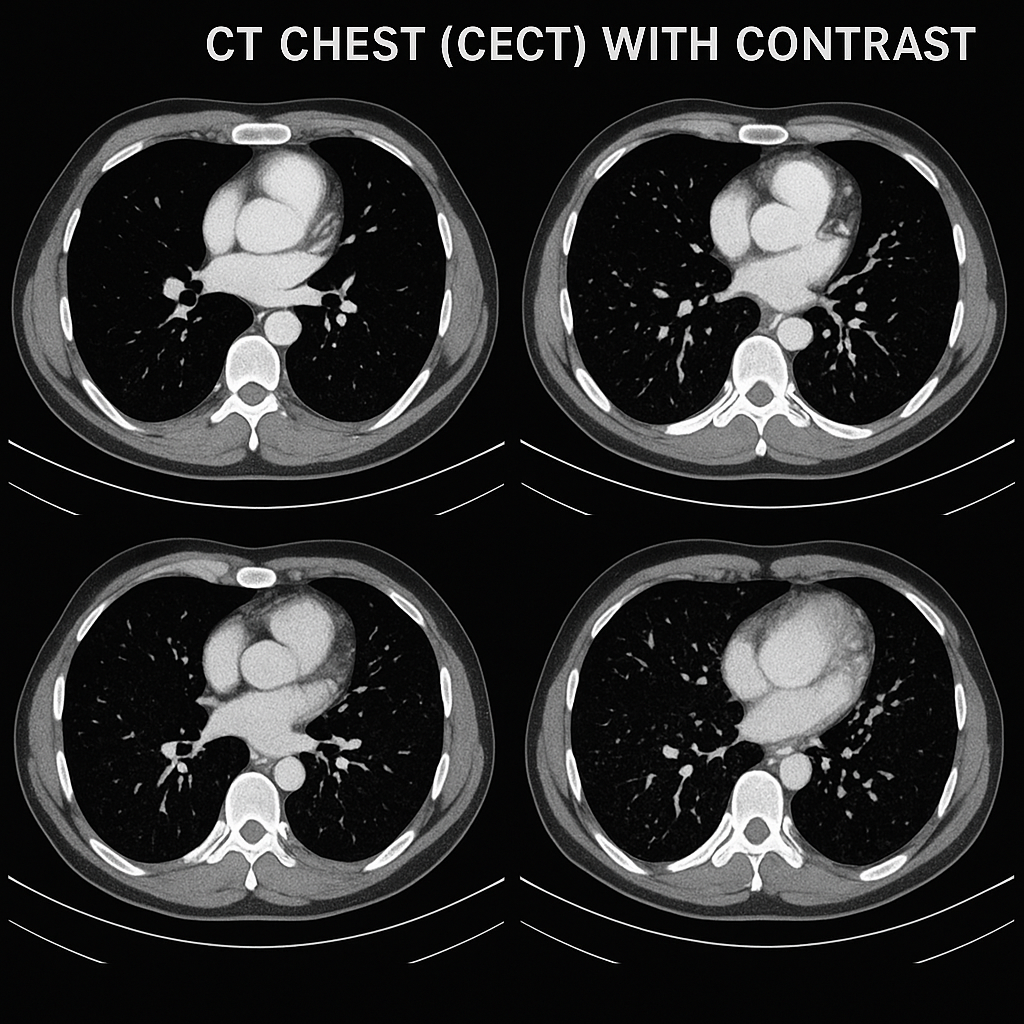
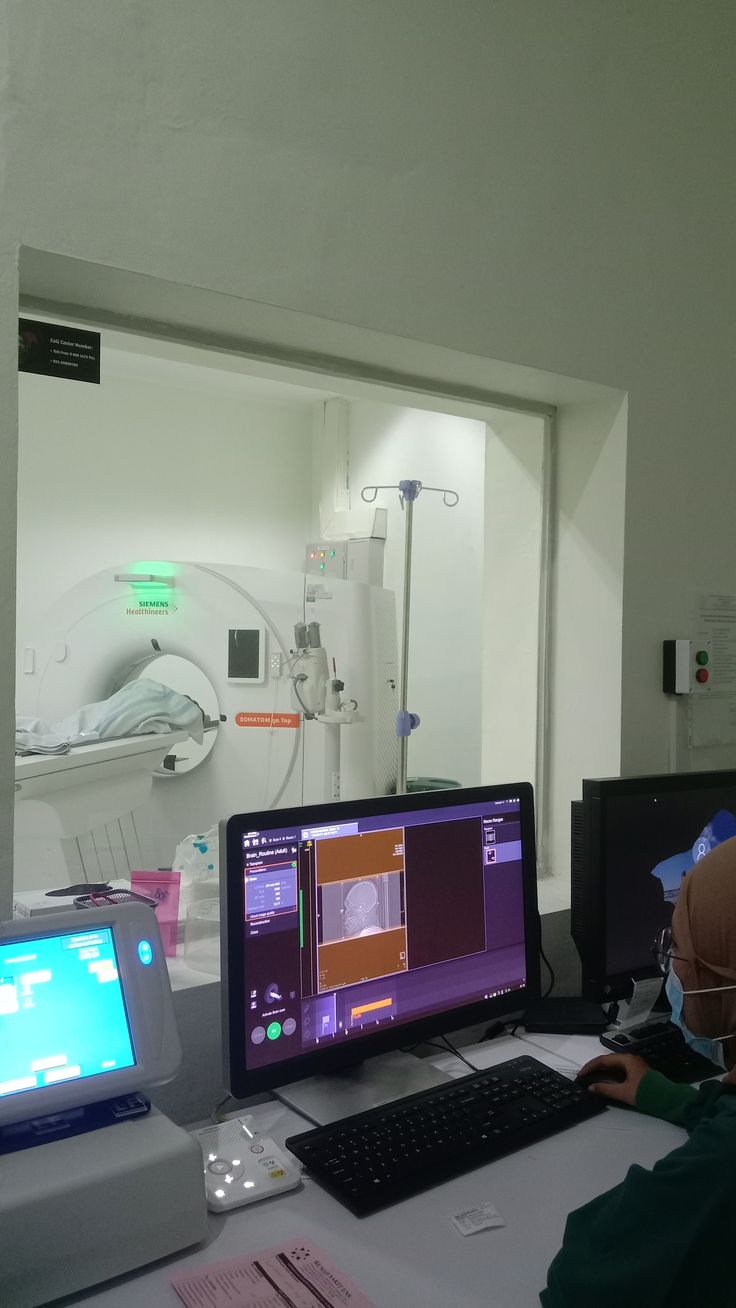
If your doctor has prescribed a CT chest scan and the prescription says "CECT chest", "plain CT chest" or "HRCT chest" — this guide explains exactly what each means, what it costs in Delhi NCR, how to prepare, and how to book same-day.
Book CT chest scan at a NABL-accredited lab across Delhi NCR — WhatsApp +91-9990032078
CT Chest Scan Cost in Delhi 2026
| Scan Type | Cost at Standalone Lab | Cost at Private Hospital | CGHS Rate (NABH) |
|---|---|---|---|
| Plain CT Chest (without contrast) | ₹1,800 – ₹4,000 | ₹5,000 – ₹10,000 | ₹1,800 – ₹2,400 |
| CECT Chest (with contrast) | ₹2,500 – ₹6,000 | ₹6,000 – ₹14,000 | ₹2,500 – ₹3,500 |
| HRCT Chest (high resolution) | ₹2,300 – ₹5,000 | ₹6,000 – ₹12,000 | ₹2,300 – ₹3,000 |
| CTPA (CT Pulmonary Angiography) | ₹3,500 – ₹7,000 | ₹8,000 – ₹16,000 | ₹3,500 – ₹5,000 |
Always follow your doctor's prescription exactly — plain CT, CECT and HRCT are different investigations that answer different clinical questions.
Book via EVE Healthcare partner centres across Delhi NCR — WhatsApp +91-9990032078 for same-day confirmation.
What Does CECT Chest Mean?
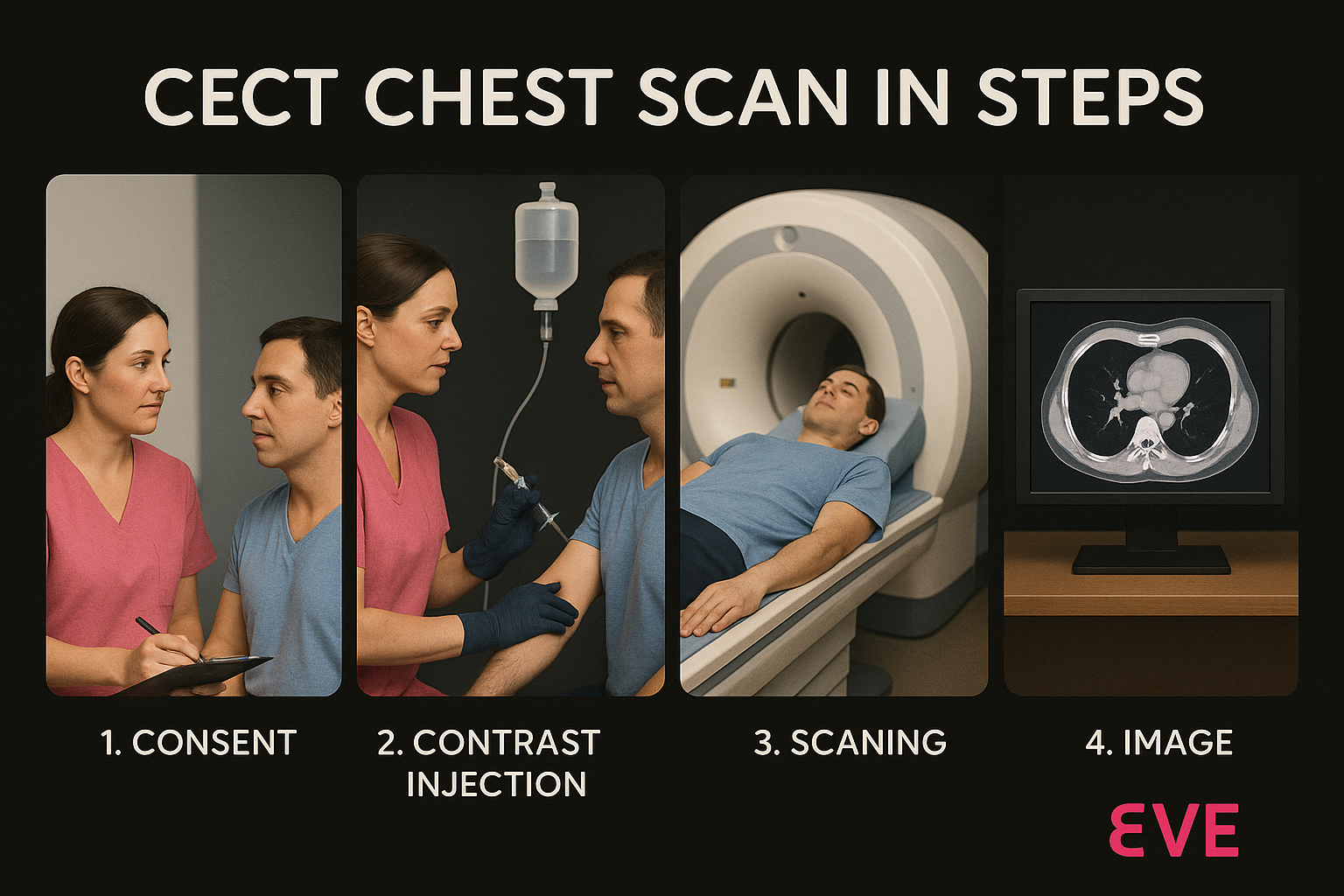
CECT stands for Contrast-Enhanced CT. It means the CT scan is performed with an intravenous injection of iodine-based contrast dye, which highlights blood vessels, lymph nodes, tumours and areas of inflammation in the chest.
Your prescription will say one of the following:
- CECT Chest or CT Chest with Contrast — contrast dye is required
- Plain CT Chest or NCCT Chest — no contrast, no preparation needed
- HRCT Chest — high-resolution thin slices, no contrast needed
- CTPA — CT Pulmonary Angiography for suspected blood clots in the lungs
Do not upgrade from plain CT to CECT on your own — they are prescribed for different reasons.
What is the Difference Between Plain CT, CECT and HRCT Chest?
Plain CT Chest (without contrast)
Done without contrast injection. Used for:
- Lung infections and pneumonia
- Pleural effusion (fluid around the lung)
- Rib fractures and chest trauma
- Lung nodule initial assessment
- General chest assessment when contrast is not clinically required
No fasting. No preparation. Reports in 2 to 4 hours.
CECT Chest (with contrast)
Done with IV iodine contrast. Used for:
- Pulmonary embolism (CTPA protocol — blood clot in lung arteries)
- Lung cancer staging — assessing lymph node involvement and vascular invasion
- Mediastinal masses — thymus, lymphoma, thyroid
- Chest wall and pleural tumours
- Aortic aneurysm and vascular abnormalities
- Post-COVID complications with suspected vascular involvement
Fast for 4 to 6 hours. Inform doctor of kidney disease, metformin or contrast allergy.
HRCT Chest (high resolution)
Uses ultra-thin 1mm slices without contrast. Used for:
- Interstitial lung disease (ILD)
- Pulmonary fibrosis
- Bronchiectasis
- Sarcoidosis
- Post-COVID lung assessment — the most common HRCT indication in Delhi NCR since 2021
- Early emphysema and COPD assessment
No fasting. No contrast. No preparation.
When is CECT Chest Ordered Instead of Plain CT?
| Clinical Situation | Correct Scan |
|---|---|
| Suspected blood clot in lungs | CECT Chest — CTPA protocol |
| Lung cancer staging | CECT Chest |
| Mediastinal mass assessment | CECT Chest |
| Pneumonia not responding to treatment | Plain CT Chest |
| Pleural effusion assessment | Plain CT Chest |
| Breathlessness with persistent cough | HRCT Chest |
| Post-COVID breathlessness | HRCT Chest |
| Suspected pulmonary fibrosis | HRCT Chest |
| Rib fracture after trauma | Plain CT Chest |
How to Prepare for CT Chest
Plain CT Chest and HRCT Chest
- No preparation required
- Eat and drink normally
- Remove all metal objects, jewellery and bra underwires before the scan
- The scan takes 5 to 10 minutes
CECT Chest (with contrast)
- Fast for 4 to 6 hours before the scan
- Water is allowed and encouraged
- Inform the technician if you have kidney disease — IV contrast can affect kidney function
- Inform the technician if you are on metformin — metformin may need to be paused for 48 hours after contrast
- Inform the technician of any previous allergic reaction to contrast dye
- Remove all metal objects before the scan
- Total appointment time is 45 to 60 minutes including IV line placement and post-scan observation
Is CT Chest Safe?
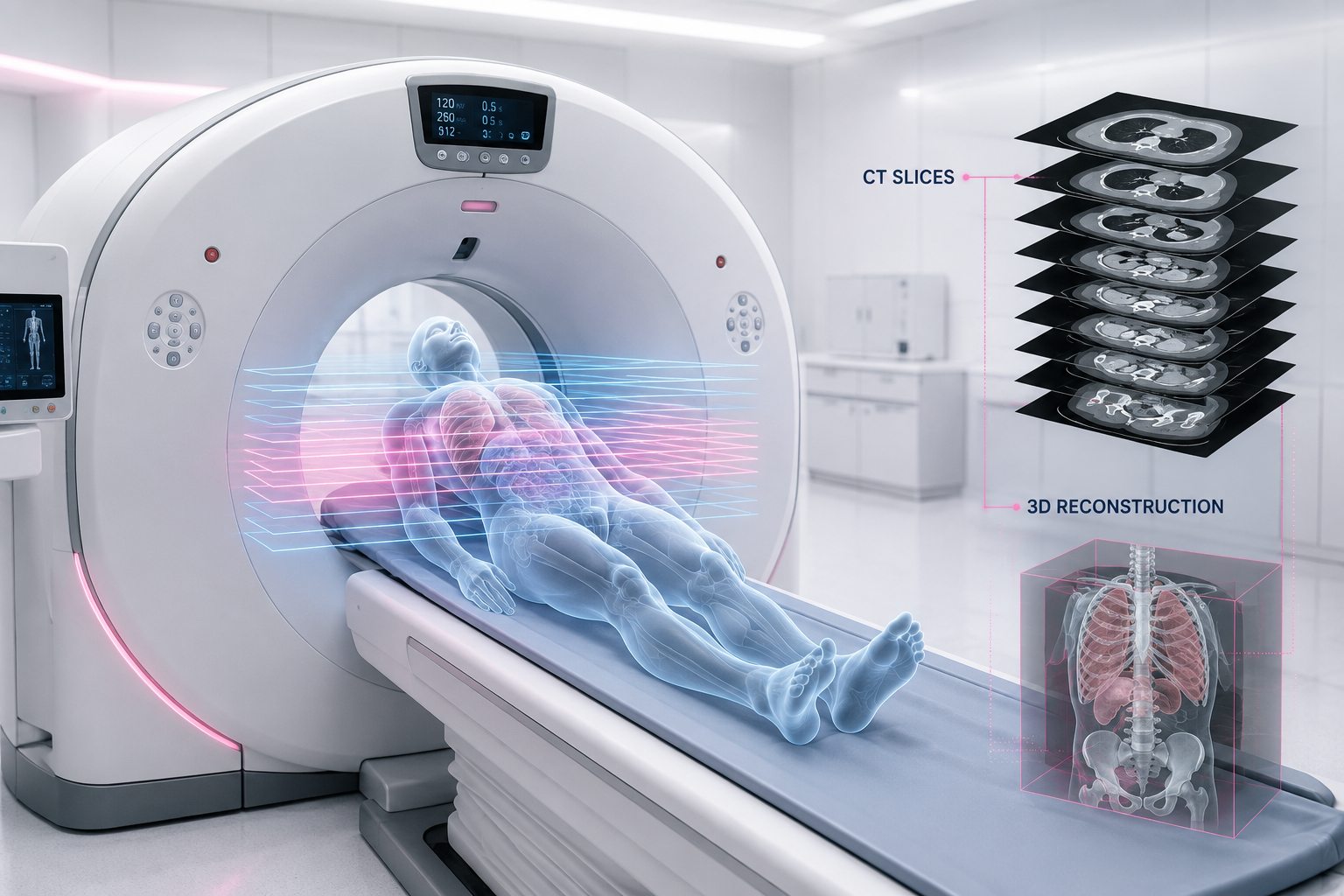
Yes. CT chest is safe for diagnostic use. The radiation from a single CT chest — approximately 7 mSv — is well within established safety thresholds. A medically necessary CT scan should not be avoided because of radiation concern.
For CECT with contrast, IV iodine contrast is safe for most patients. Patients with impaired kidney function (creatinine above 1.5) or previous severe contrast reactions require pre-medication or alternative investigation. Inform your doctor and the technician of any kidney or allergy concerns before the scan.
What Can CT Chest Detect?
CT chest scans detect a wide range of chest conditions:
- Lung cancer — primary tumour size, location, lymph node involvement, distant metastases
- Pulmonary embolism — blood clots in the pulmonary arteries (CTPA)
- Infections — pneumonia, tuberculosis, lung abscess, fungal infections
- Interstitial lung disease — pulmonary fibrosis, sarcoidosis, hypersensitivity pneumonitis
- Pleural disease — pleural effusion, mesothelioma, pleural thickening
- Mediastinal conditions — lymphoma, thymoma, thyroid masses
- Post-COVID lung — ground glass opacities, organising pneumonia, fibrotic changes
- Bronchiectasis — dilated airways from recurrent infections
- Cardiac conditions — pericardial effusion, cardiac masses (CECT)
- Aortic disease — aortic aneurysm, aortic dissection (CECT)
Book CT Chest Scan in Delhi NCR
EVE Healthcare partner NABL-accredited diagnostic centres offer plain CT chest, CECT chest, HRCT chest and CTPA across Delhi NCR — with same-day availability and reports within 2 to 4 hours.
Book online at eve-healthcare.com or WhatsApp +91-9990032078 to confirm same-day appointments across South Delhi, Noida, Gurgaon and Ghaziabad.
-(1).png)
-(1).png)
-(1)-(1).png)