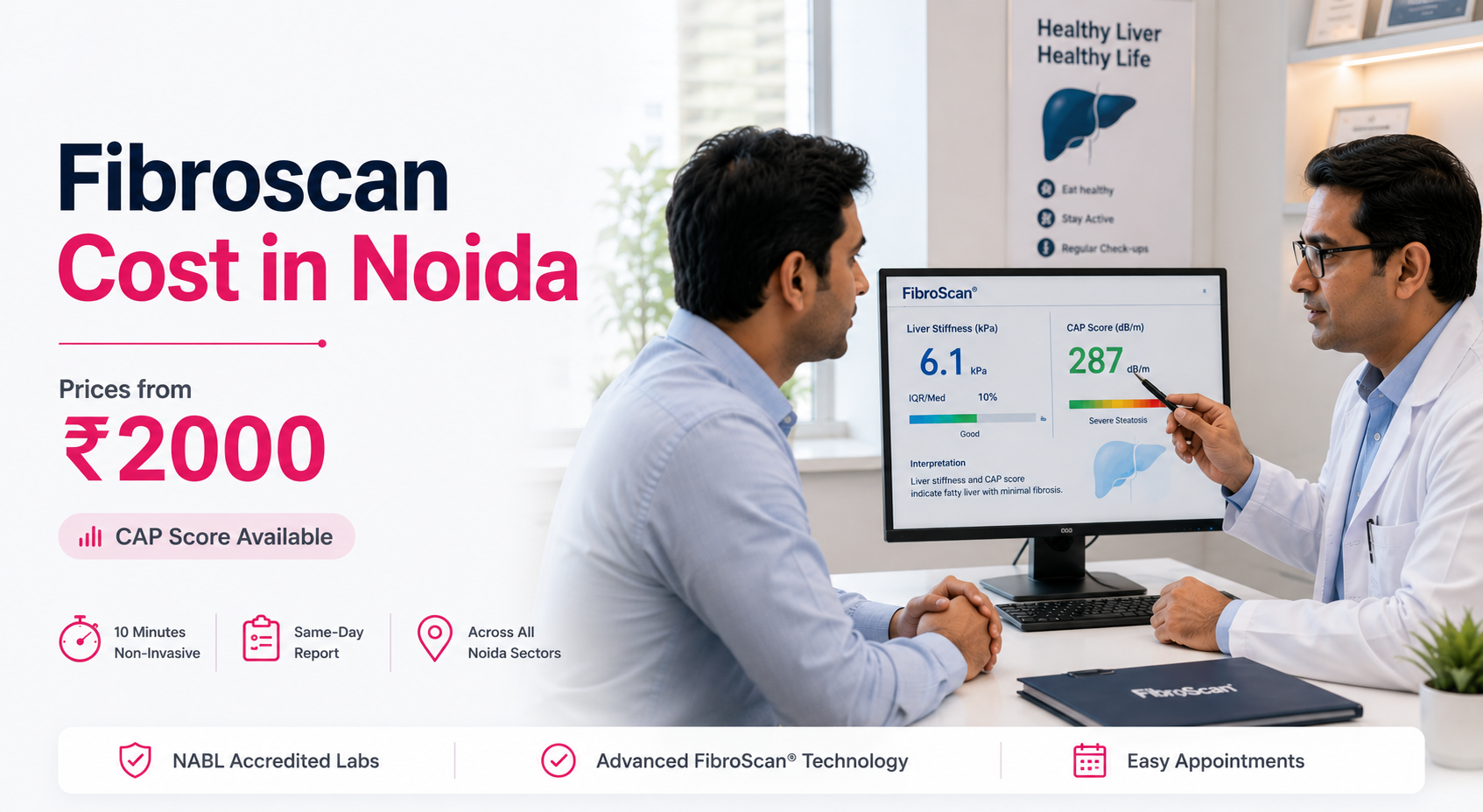
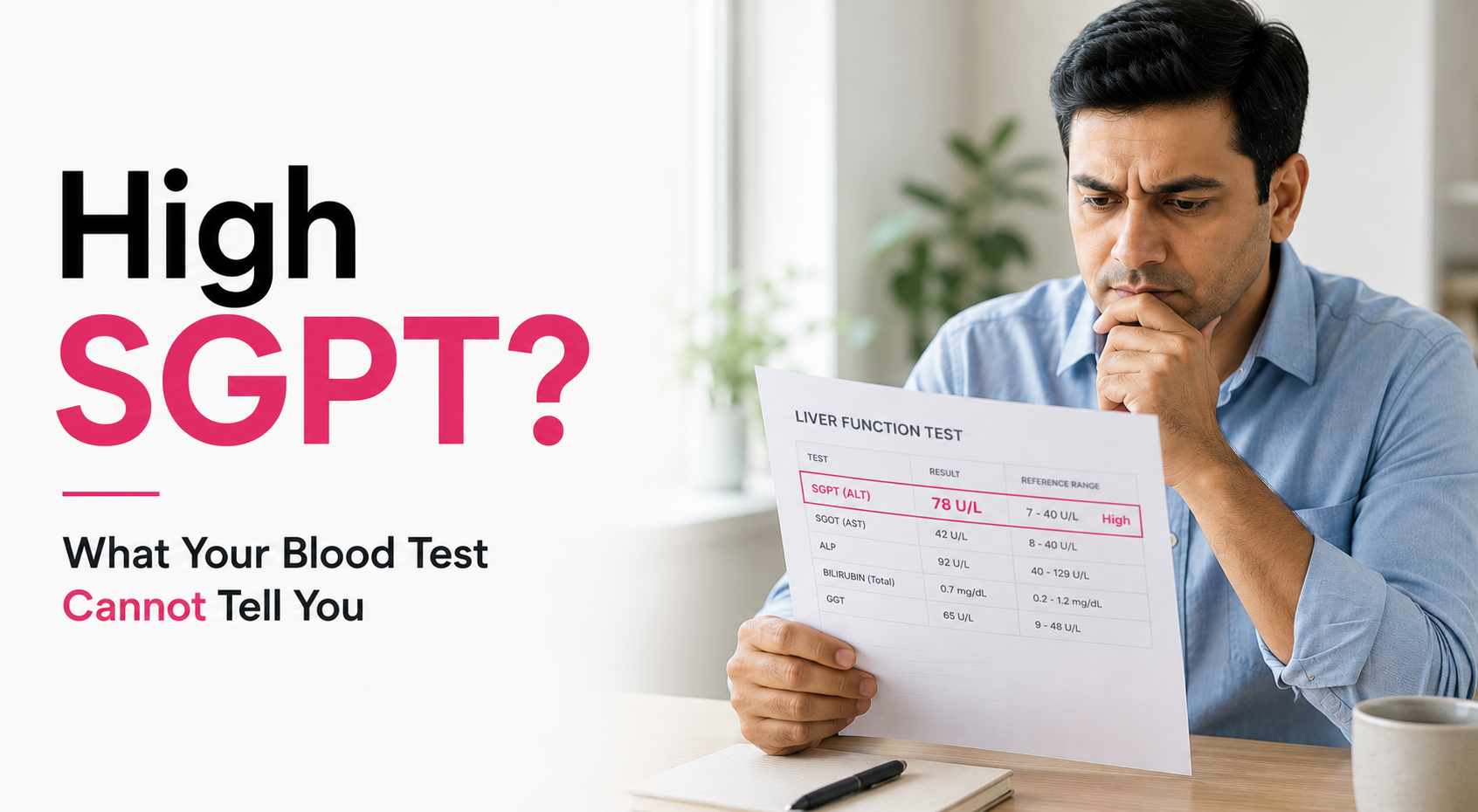
If your blood test shows a high SGPT — and your doctor has said "get a Fibroscan" — this page explains exactly why, what the Fibroscan will tell you that the blood test cannot, and what it costs in Delhi in 2026.
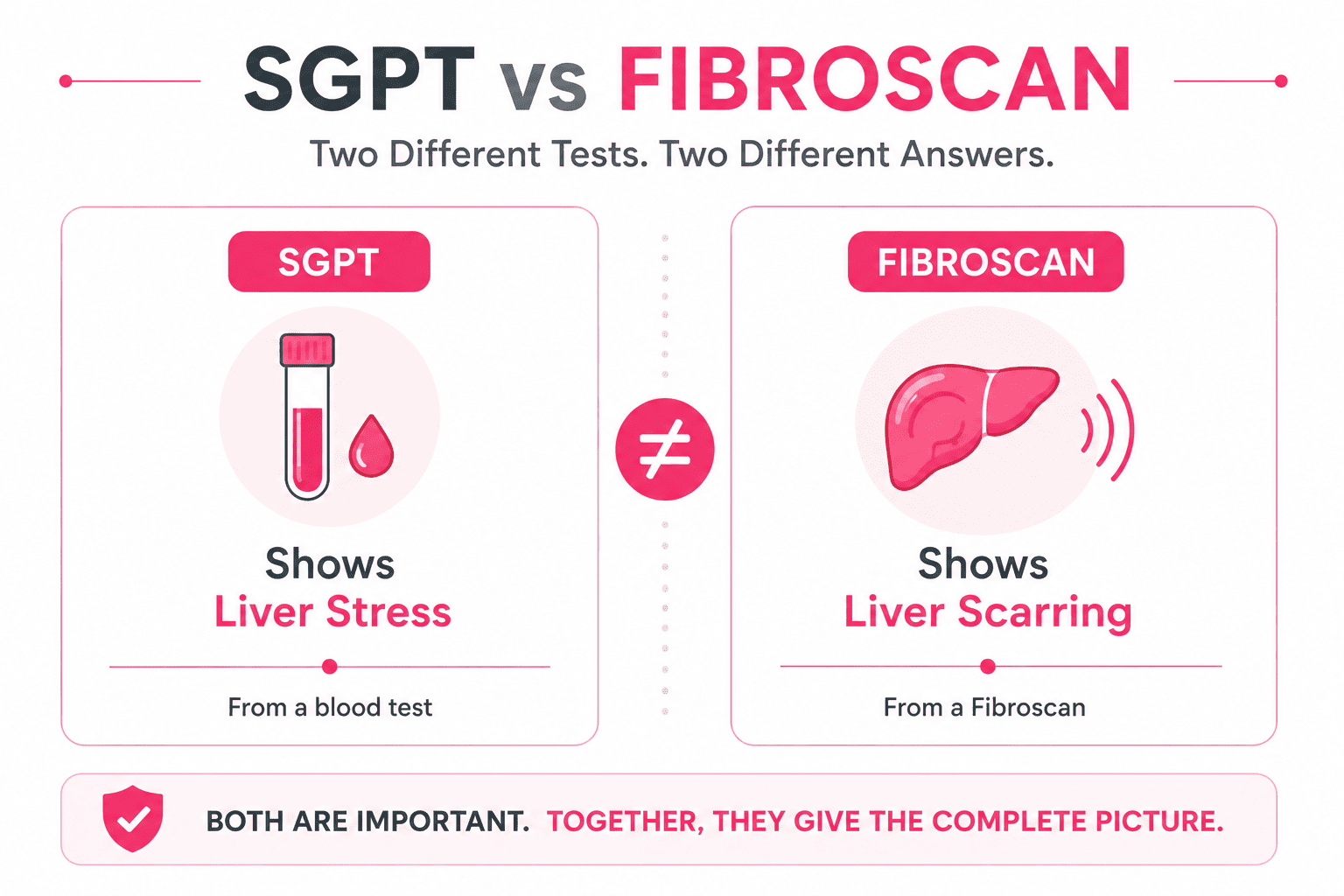
The short answer first: Your SGPT tells your doctor that your liver cells are under stress. Fibroscan tells your doctor what that stress has done to the liver structure — specifically whether fibrosis (scarring) has started. These are two different pieces of information. You need both.
What Is SGPT and What Does "High" Mean?
SGPT stands for Serum Glutamate Pyruvate Transaminase — also called ALT (Alanine Aminotransferase). It is an enzyme found primarily inside liver cells. When liver cells are damaged or inflamed, they release SGPT into the bloodstream. A blood test measures how much SGPT is circulating.
Normal SGPT range: 7–40 U/L in most Indian laboratory reference ranges (some labs use up to 56 U/L — check your specific lab's reference range on your report).
What different levels of elevation mean:
|
SGPT Level |
Clinical Significance |
Typical Next Step |
|
40 – 80 U/L (1–2x normal) |
Mild elevation — common. Most often NAFLD, alcohol, or medication effect |
Fibroscan + lifestyle assessment |
|
80 – 200 U/L (2–5x normal) |
Moderate elevation — warrants investigation |
Fibroscan + full LFT + viral hepatitis screen |
|
200 – 500 U/L (5–12x normal) |
Significant elevation — active liver injury |
Urgent gastroenterologist review |
|
Above 500 U/L |
Severe liver injury |
Emergency medical assessment |
Important: A mildly elevated SGPT (40–80 U/L) is not a diagnosis. It is a signal. The same SGPT level can come from fatty liver, alcohol, medication, vigorous exercise, thyroid disease, or muscle injury. The Fibroscan — combined with clinical history — helps identify the cause and severity.
Why SGPT Alone Is Not Enough — What It Cannot Tell You
This is the most important clinical distinction on this page — and the reason your doctor has asked for a Fibroscan alongside or after the blood test.
SGPT tells you: Liver cells are releasing enzymes — indicating cell damage or inflammation.
SGPT cannot tell you:
- Whether the liver has started to scar (fibrosis)
- How much fat has accumulated in the liver (steatosis grade)
- Whether the fibrosis is early (reversible) or advanced (irreversible)
- Whether the liver's long-term function is at risk
Fibroscan tells you:
- CAP score (Controlled Attenuation Parameter, in dB/m) — measures liver fat content
- LSM (Liver Stiffness Measurement, in kPa) — measures liver fibrosis
A patient with SGPT of 75 U/L and a Fibroscan showing LSM of 5.2 kPa has mild liver stress with no significant fibrosis — managed with lifestyle changes. A patient with SGPT of 75 U/L and a Fibroscan showing LSM of 11.8 kPa has significant fibrosis — managed very differently, with specialist input and possibly medication.
The same SGPT level. Completely different clinical outcomes. Only Fibroscan distinguishes them.
The Causes of High SGPT — The Most Common in Delhi
High SGPT is significantly associated with NAFLD — alongside high body weight, high waist circumference, high fasting sugar, high triglycerides, and high VLDL — in Indian community-based studies.
The most common causes of elevated SGPT in Delhi NCR's patient population, in order of frequency:
1. NAFLD — Non-Alcoholic Fatty Liver Disease (most common) Fat accumulation in liver cells causes inflammation — releasing SGPT. The most common cause of elevated SGPT in urban India. Associated with central obesity, diabetes, pre-diabetes, and metabolic syndrome.
2. Alcohol-related liver disease Regular alcohol consumption causes direct hepatocyte damage. Typically shows an AST:ALT ratio above 2:1 — distinguishable from NAFLD by pattern and history.
3. Medications Statins (cholesterol-lowering medications), antituberculosis drugs (rifampicin, isoniazid), paracetamol overuse, and some Ayurvedic/herbal preparations are common causes of drug-induced liver injury in India.
4. Viral hepatitis (B or C) Hepatitis B is endemic in India. Hepatitis C is less common but significantly underdiagnosed. Both cause persistent SGPT elevation. Your doctor will screen for both with a hepatitis panel alongside LFT.
5. Thyroid disease Both hypothyroidism and hyperthyroidism can elevate liver enzymes. If SGPT is elevated with other thyroid symptoms, TSH testing is included.
6. Vigorous exercise or muscle injury Intense exercise in the 24–48 hours before a blood test can transiently elevate ALT. If your elevated SGPT is an isolated incidental finding after exercise — a repeat test after 48 hours of rest may be appropriate before proceeding to Fibroscan.
What Fibroscan Measures — The Numbers Explained
When your Fibroscan report arrives, it will contain two key numbers:
LSM (Liver Stiffness Measurement) — the fibrosis indicator
|
LSM (kPa) |
Fibrosis Stage |
Clinical Meaning |
|
Below 7.0 |
F0–F1 |
No significant fibrosis — reassuring |
|
7.0 – 9.5 |
F1–F2 |
Mild to moderate fibrosis — lifestyle changes + monitoring |
|
9.5 – 12.5 |
F2–F3 |
Moderate to significant fibrosis — gastroenterologist review |
|
Above 12.5 |
F3–F4 |
Advanced fibrosis — specialist management needed |
|
Above 17.5 |
F4 / Cirrhosis risk |
High probability of advanced cirrhosis |
CAP Score (Controlled Attenuation Parameter) — the fat indicator
|
CAP Score (dB/m) |
Steatosis Grade |
Fat in Liver |
|
Below 248 |
S0 |
No significant steatosis |
|
248 – 268 |
S1 |
Mild steatosis |
|
268 – 280 |
S2 |
Moderate steatosis |
|
Above 280 |
S3 |
Severe steatosis |
The combination that matters: A high CAP score with a low LSM = lots of fat, no significant scarring = manage with diet and lifestyle. A high CAP score with a high LSM = lots of fat plus significant scarring = specialist gastroenterologist management urgently.
How SGPT and Fibroscan Work Together Over Time
In an Indian study of NAFLD patients, both ALT (SGPT) values and FibroScan measurements improved significantly after 6 months of lifestyle modification — confirming that serial FibroScan alongside liver enzyme monitoring is the appropriate tool for tracking treatment response in NAFLD patients.
This is why your doctor may ask for both tests repeated at follow-up — not just SGPT. SGPT normalising does not necessarily mean fibrosis has resolved. Fibroscan provides the structural confirmation.
The standard monitoring pathway for high SGPT with NAFLD:
Elevated SGPT detected on routine blood test
↓
Fibroscan + Full LFT + Hepatitis B/C screen
↓
Results reviewed by gastroenterologist
↓
LSM < 7.0 kPa → Lifestyle changes: diet, exercise, weight loss
↓
Repeat SGPT + Fibroscan at 6 months
↓
LSM improving → Continue lifestyle management
LSM stable or worsening → Specialist review, consider medication
Do You Need to Repeat the Blood Test Before Getting a Fibroscan?
No. This is the most common booking confusion EVE sees for SGPT + Fibroscan referrals.
If your doctor has said "get a Fibroscan" after seeing your elevated SGPT — you do not need to repeat the blood test before the Fibroscan. The Fibroscan and a fresh LFT (which includes SGPT) can be done simultaneously in a single visit at most EVE partner centres. One visit. Both results. One report for your doctor.
Tell our team when booking: "I need Fibroscan plus LFT in the same visit for high SGPT." We confirm this combination is available at your chosen centre before you travel.
High SGPT Fibroscan Cost in Delhi 2026
|
Package |
What Is Included |
Standalone Lab (₹) |
Hospital (₹) |
CGHS Rate (₹) |
|
Fibroscan only |
CAP + LSM measurement |
2,500 – 5,500 |
7,000 – 9,500 |
1,150 |
|
LFT only |
SGPT, SGOT, bilirubin, albumin, ALP |
400 – 900 |
800 – 1,800 |
Covered |
|
Fibroscan + LFT package |
Both in same visit |
3,000 – 6,500 |
8,000 – 12,000 |
— |
|
Hepatitis B surface antigen |
Rule out hepatitis B |
300 – 600 |
600 – 1,200 |
Covered |
|
Complete liver panel |
LFT + Hepatitis B/C + SGPT + Fibroscan |
4,000 – 8,000 |
10,000 – 18,000 |
— |
All prices from EVE Healthcare partner centres — NABL-accredited standalone labs with Echosens FibroScan machines. Prices verified June 2026.
Fibroscan for High SGPT — Near Me in Delhi NCR
|
Area |
Price Range |
Same-Day |
Combined LFT |
CGHS |
Metro |
|
South Delhi (Saket, GK, Hauz Khas) |
₹2,500 – ₹5,500 |
Yes |
Yes |
Yes (select) |
Yellow / Violet |
|
West Delhi (Dwarka, Janakpuri) |
₹2,500 – ₹5,000 |
Yes |
Yes |
Yes |
Blue Line |
|
North Delhi (Rohini, Pitampura) |
₹2,500 – ₹5,000 |
Yes |
Yes |
Yes |
Red Line |
|
Noida (Sector 18, 62) |
₹2,500 – ₹5,000 |
Yes |
Yes |
Yes (select) |
Blue Line |
|
Gurgaon (DLF, Sector 56) |
₹2,800 – ₹5,500 |
Yes |
Yes |
Yes (select) |
Yellow Line |
What to Do If Your SGPT Is Very High
If your SGPT is above 200 U/L — do not book a Fibroscan as your first step. See a gastroenterologist first.
At SGPT above 200 U/L, the liver is under active significant stress. A Fibroscan reading in the setting of very active hepatic inflammation can overestimate fibrosis because inflammation itself stiffens the liver temporarily — the kPa reading may not accurately reflect true fibrosis stage until the inflammation is assessed and partially treated. Your gastroenterologist will advise on the appropriate timing of Fibroscan after assessment.
For SGPT below 200 U/L with no other alarming features — Fibroscan is the appropriate next investigation and can be booked directly.
Preparation for Fibroscan for High SGPT
Fast for 2–3 hours before the scan — this improves the accuracy of the CAP (fat) measurement. Not mandatory, but recommended. Water is fine.
Continue all medications — do not stop any medications including statins before the Fibroscan. The medication history is important context for your gastroenterologist to interpret the result.
Avoid alcohol for at least 24 hours before the scan if possible — alcohol temporarily increases liver stiffness independent of underlying fibrosis.
The scan itself: You lie on your back, right arm raised. A small probe is placed on the skin of the right side of the abdomen, between the ribs. A gentle pulse is sent through the liver. The machine takes 10 measurements automatically and calculates the median LSM and CAP score. The scan takes 5–10 minutes. No injection. No scope. No discomfort beyond the mild probe pressure.
Clinical Note
From the reviewing gastroenterologist: The pattern I see most frequently in Delhi for elevated SGPT: a patient aged 35–50 who had SGPT of 62–85 U/L on a corporate health check, was told it was mildly elevated, was given no further guidance, and returns two years later with SGPT now 110 U/L, having never had a Fibroscan. In those two years, the liver's structural condition — the thing that determines long-term risk — was entirely unknown. The Fibroscan I do at that second presentation frequently shows fibrosis that was likely already beginning when the SGPT first went up. The clinical lesson: an elevated SGPT, even mild and isolated, in a patient with central obesity, diabetes, or regular alcohol use warrants a Fibroscan — not watchful waiting. The investigation that changes management is the LSM, not the SGPT level. A patient with SGPT of 65 and LSM of 5 kPa has a very different prognosis from one with SGPT of 65 and LSM of 12 kPa. You cannot know which patient you are without the Fibroscan.
Book Fibroscan for High SGPT in Delhi
EVE Healthcare partner centres offer Fibroscan and combined Fibroscan + LFT packages across Delhi, Noida, and Gurgaon — same-day availability, Echosens FibroScan machines, NABL-accredited labs, and digital report delivery.
When booking: tell our team your SGPT level and whether you want Fibroscan only or the combined Fibroscan + LFT package. If you have a prescription, share it via WhatsApp and we confirm the right package before your appointment.
WhatsApp +91 9990032078 or use the search tool at eve-healthcare.com.
Also see: Fibroscan Cost Delhi → · Fibroscan Cost Noida → · Fibroscan Cost Gurgaon → · Fatty Liver Test Delhi → · Normal Fibroscan Score → · What Is CAP Score?
.png)
.png)
.png)