.png)
If you have been told you need an endoscopy and you are searching "is endoscopy painful" — you are in the majority.
52.7% of patients undergoing upper GI endoscopy report anxiety about the procedure before it begins — in a study of 1,242 patients published in Digestive Diseases and Sciences. EVE Healthcare
If you are anxious about your endoscopy, you are not unusual — you are the statistical norm. This page gives you an honest answer backed by what the research actually shows, and what the specific moments of the procedure feel like — second by second — so you know exactly what to expect before you walk in.
The Direct Answer
Is endoscopy painful? For most patients — no. Uncomfortable for a few seconds — yes.
Pain implies tissue damage and lasting hurt. What most patients experience during an upper GI endoscopy without sedation is:
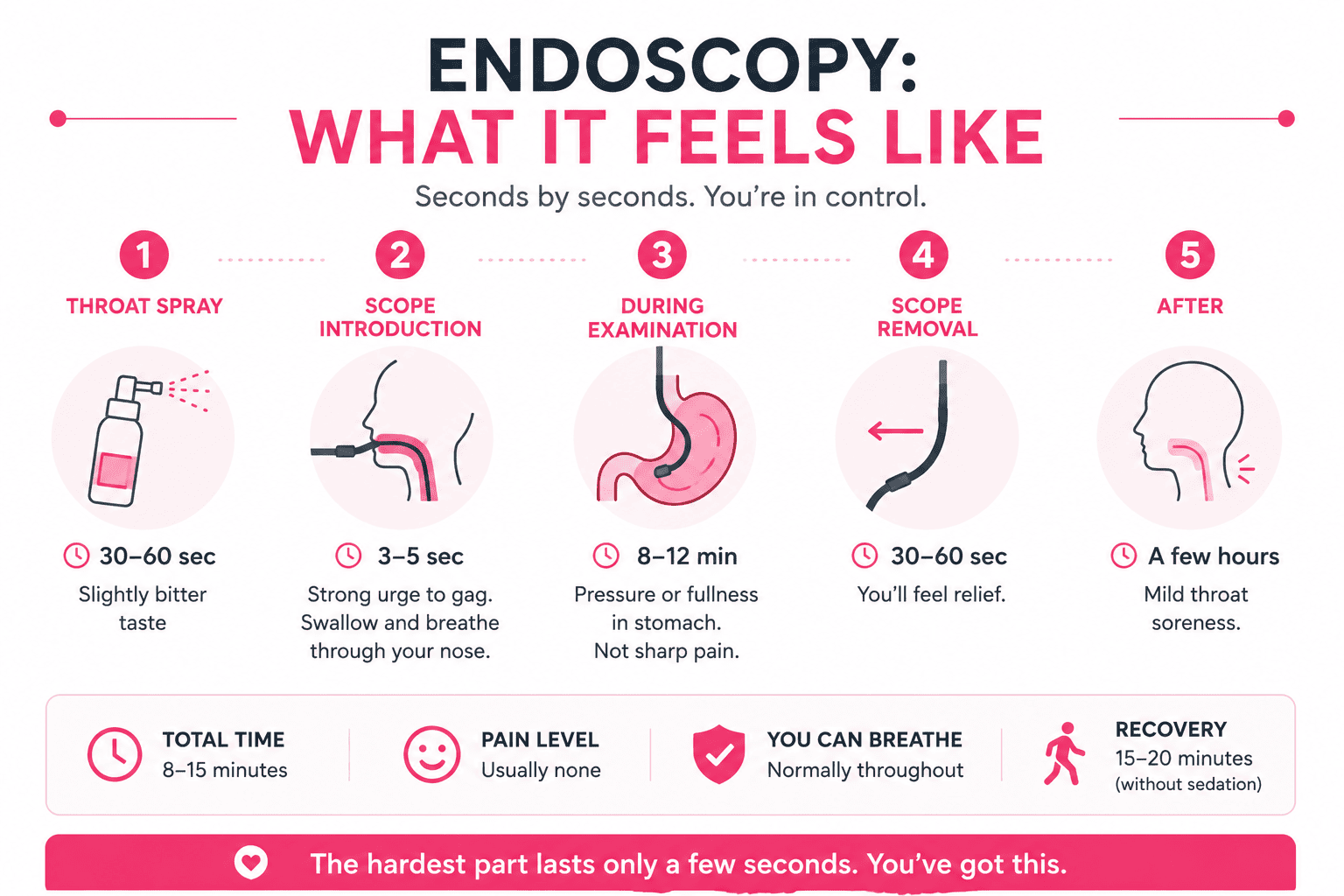
- A bitter taste from the throat spray — 30 seconds
- A gag reflex as the scope passes the back of the throat — 3–5 seconds — this is the hardest moment
- Pressure or fullness in the stomach during the examination — 8–12 minutes, manageable
- Mild throat soreness for a few hours after — like a cold
The gag reflex lasts seconds, not minutes. The stomach pressure is constant but not sharp. It ends faster than most patients expect.
Why Anxiety Matters Clinically — Not Just Emotionally
Pre-procedural anxiety significantly affects the quality of non-sedated endoscopy — higher anxiety scores are independent predictors of a more difficult procedure, with each unit increase in anxiety raising the odds of an unsuccessful examination by 3.8%. Koshikaa
This is why understanding the procedure before you arrive matters. A prepared patient is a less anxious patient. A less anxious patient has a better endoscopy. Patients consistently said that knowing approximately how long the procedure took might have made the experience more manageable. Deemagclinic
What Actually Happens — Second by Second
Patients who received detailed pre-procedure information — including that the endoscope does not obstruct breathing and that normal respiration is maintained throughout — had significantly lower pre-procedural anxiety than those who received only routine care.
The throat spray: Lignocaine spray is applied to the back of your throat. Slightly bitter taste. Takes 60–90 seconds to numb the gag reflex. Let it work fully before the scope is introduced — tell the gastroenterologist if you feel it has not taken effect yet.
Positioning: You lie on your left side on the examination couch, knees drawn up slightly. A plastic mouthpiece is placed between your teeth. Your head is supported.
The hardest moment — scope introduction: The gastroenterologist advances the endoscope to the back of your throat and asks you to swallow. This guides the scope into the oesophagus.
Patients consistently report that "swallowing the camera" is the hardest part of the procedure.
What it actually feels like: pressure at the back of the throat, a strong urge to gag, a sensation of something moving downward. This lasts 3–5 seconds. After the scope passes the throat, the gag reflex settles almost immediately for most patients.
During the examination: Pressure and fullness in the stomach as the gastroenterologist examines the oesophagus, stomach, and duodenum. Not sharp pain — the stomach lining has different pain receptors. If a biopsy is taken, you will not feel it.
Breathing: You can breathe normally throughout. The endoscope does not obstruct breathing — the scope passes through the oesophagus, not the windpipe. Normal respiration is maintained throughout and oxygen is supplemented as needed.
Scope removal: Most patients describe relief. With throat spray and no sedation, you can leave and return to normal activity within 15–20 minutes.
What to Do In the Room — Three Instructions
This is the section that separates a difficult endoscopy from a manageable one. Most patients are told what will happen. Almost nobody is told what to do with their body in the moment.
1. Breathe through your nose — not your mouth. Nasal breathing reduces the instinct to gag. Focus on slow, controlled nasal inhalation from the moment the scope is introduced.
2. Deliberately relax your jaw. Most patients clench without realising it. A clenched jaw tightens the throat and makes the scope introduction harder. Ask yourself just before the scope enters: "Is my jaw loose?" Then let it go.
3. Count to five. The hardest moment — the gag reflex — lasts five seconds or fewer. Knowing it ends at five makes it finite rather than open-ended. Count silently. By the time you reach five, the scope is past the throat and the worst is over.
These three instructions are the reason some patients walk out saying "that was nothing" and others say "it was terrible." The difference is almost never the procedure — it is preparation and body awareness.
What Patients Actually Say Afterwards
Patients who had previously undergone endoscopy consistently noted that their second experience was significantly easier than the first — primarily because they knew what to expect.
The single most consistent finding in endoscopy patient experience research: the anticipation is worse than the procedure. Not by a small margin. Consistently, significantly worse.
The risk of severe discomfort during unsedated endoscopy increased significantly with higher pre-procedural anxiety. Anxiety creates tension. Tension creates resistance. Resistance makes every sensation more intense. The three instructions above exist precisely to interrupt this cycle at the moment it matters most.
Sedation vs No Sedation — The Decision Framework
In India, conscious sedation for OGD is optional and costs an additional ₹1,500–₹3,500. It is not the default standard as it is in the UK or USA. You must specifically request it when booking.
|
Your Situation |
Recommendation |
|
First endoscopy, significant anxiety |
Sedation — worth the extra cost |
|
First endoscopy, mild anxiety |
Throat spray — most patients manage well |
|
Previous endoscopy tolerated well |
No sedation sufficient |
|
Previous endoscopy was very difficult |
Sedation |
|
Must return to work same day |
No sedation — recover in 30–60 minutes |
|
Colonoscopy (not just OGD) |
Sedation strongly recommended |
|
Significant cardiac or respiratory history |
Confirm with gastroenterologist before booking |
What sedation does: IV midazolam produces a deeply relaxed, drowsy state with little or no memory of the procedure. Most patients who choose sedation describe waking up surprised it is already over.
What sedation cannot guarantee: Sedation effects varied significantly — some patients did not remember the procedure at all; others felt no effect or felt they had not been given enough. If sedation does not produce the expected effect, tell the gastroenterologist.
The companion rule: Sedation requires a companion who physically accompanies you home. You cannot drive, take a cab alone, or return to work for 4–6 hours. No companion available — book without sedation. Throat spray recovery is complete within 30–60 minutes.
The Seven Fears — Each Answered in Two Sentences
Will I be able to breathe? Yes. The scope passes through the oesophagus — a completely separate tube from the windpipe. Normal breathing is maintained throughout the entire procedure.
Will I gag? Possibly, briefly. The throat spray significantly reduces the gag reflex — the sensation, when it occurs, lasts 3–5 seconds during scope introduction and then settles.
Will I be able to stay still? Yes. The difficult moment is the scope introduction. After that, the majority of patients lie still without significant effort.
What if I need to vomit? Actual vomiting during endoscopy is uncommon. If you feel intensely nauseated, signal the gastroenterologist — the procedure can be paused immediately.
How long does it actually take? 8–12 minutes for a diagnostic OGD. Total time at centre: 45–75 minutes without sedation, 2–3 hours with sedation.
Will the scope hurt going in? Pressure and movement — not sharp pain. The throat introduction is the most uncomfortable moment and it lasts 3–5 seconds.
Can I ask them to stop? Yes, at any point. The gastroenterologist will pause or withdraw the scope. Most patients do not exercise this option once the scope is past the throat — because the hardest moment has already passed.
The Booking Instruction That Prevents Cancellations
The most common endoscopy cancellation reason at EVE's Delhi NCR partner centres: patients arriving who were never told what the scope looks like or what the first 30 seconds feel like — and who refuse to proceed.
Tell our team you are anxious when you book — not on the day of the procedure. When booking, not at registration. The centre allocates extra preparation time, ensures the gastroenterologist speaks with you before the procedure, and confirms sedation availability. You will not be the only anxious patient they see that day. Centres that handle significant endoscopy volumes have seen every variation of procedural anxiety — and they manage it well when they know in advance.
Preparation That Makes a Difference
Fasting: 6–8 hours before OGD — nothing to eat, drink (including water, tea, coffee), or chew. Any food in the stomach causes cancellation.
Medications: Continue all regular medications with a tiny sip of water unless your gastroenterologist has specifically said otherwise. Blood thinners (warfarin, clopidogrel, aspirin) — ask your doctor specifically if biopsy is anticipated.
Diabetic patients: Discuss fasting blood sugar management with your doctor before booking.
Clothing: Loose, comfortable two-piece outfit. Easier than a dress — the sonographer needs access to the abdomen and IV site.
Endoscopy Cost in Delhi — When You Are Ready to Book
|
Procedure |
Without Sedation (₹) |
With Sedation (₹) |
CGHS Rate NABH (₹) |
|
OGD (Upper GI Endoscopy) |
2,500 – 6,000 |
4,500 – 9,000 |
2,500 |
|
Colonoscopy |
3,500 – 7,500 |
6,000 – 10,000 |
4,000 |
|
OGD + Colonoscopy |
6,000 – 12,000 |
9,000 – 16,000 |
5,500 |
Same-day appointments available across Delhi, Noida, and Gurgaon through EVE Healthcare partner centres.
Clinical Note
From the reviewing gastroenterologist: The patients who have the hardest time during endoscopy share one characteristic: they arrived expecting to fight it. They tense against the scope, hold their breath, clench their jaw. Every one of those responses makes the procedure harder — not because the scope changed, but because tension narrows the throat and amplifies every sensation. The patients who do best are often not the ones who chose sedation. They are the ones who breathed through it. The gag lasts five seconds. I have watched thousands of patients get through those five seconds — and almost every one of them, once the scope was in the stomach, looked surprised at how manageable it was. The preparation that matters most for this procedure is not fasting. It is knowing that five seconds is five seconds, that the scope does not touch the windpipe, and that the pressure you feel in the stomach is not damage — it is just air and movement. If you read this before your appointment, you already have the information that changes the experience.
Book Your Endoscopy in Delhi
WhatsApp +91 9990032078 or use the search tool at eve-healthcare.com. Tell our team you are anxious when you book — not on the day. We will prepare the centre for you.
Also see: Endoscopy Cost Delhi → · Endoscopy Cost Noida → · Endoscopy Cost Gurgaon → · Stomach Pain Endoscopy Delhi → · H. Pylori Test Delhi → · Colonoscopy Cost Delhi →
.png)
.png)