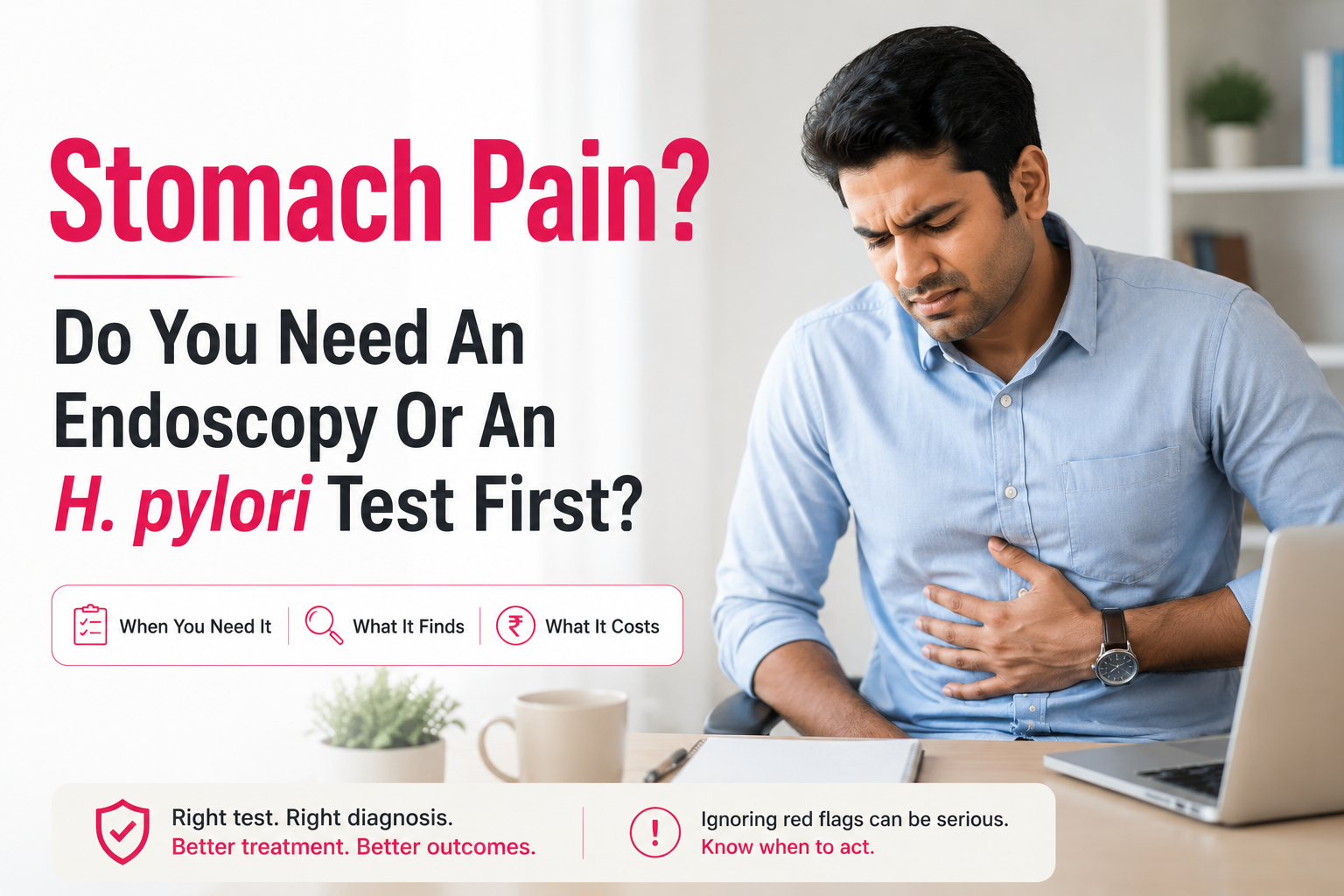
If you have stomach pain and you are searching for endoscopy in Delhi — this page answers the question before the cost: does your stomach pain actually need an endoscopy, or should something else happen first?
Endoscopy cost in Delhi for stomach pain ranges from ₹2,500 to ₹9,000 at accredited standalone gastroenterology centres. But the right first question is not what it costs. It is whether endoscopy is the right investigation for your specific presentation.
Does Your Stomach Pain Need an Endoscopy? — Quick Decision Guide
|
Your Situation |
Does It Need Endoscopy? |
What Happens First |
|
Upper abdominal pain or burning, under 45, no red flags |
Usually not immediately |
H. pylori test (breath test or stool antigen), then PPI trial |
|
Same as above but no response to 4–8 weeks of PPIs |
Yes — endoscopy now appropriate |
Book OGD endoscopy |
|
Upper abdominal pain, age 45 or above, new symptoms |
Yes — endoscopy recommended |
Book OGD endoscopy directly |
|
Stomach pain + weight loss, vomiting blood, difficulty swallowing |
Yes — urgently |
See gastroenterologist same day or emergency |
|
Stomach pain + black or tarry stools |
Yes — urgently |
Emergency department today |
|
Chronic acidity / GERD, stable, responding to medication |
No |
Continue management, review with gastroenterologist |
|
Stomach pain after confirmed H. pylori treatment — checking eradication |
Usually not — breath test preferred |
Urea breath test 4+ weeks after completing antibiotics |
The Red Flags — When Stomach Pain Needs Urgent Endoscopy
Alarm features that warrant endoscopy regardless of age include: vomiting, gastrointestinal bleeding, unexplained iron-deficiency anaemia, and unintentional weight loss. ISUOG
The complete red flag list for stomach pain that requires urgent gastroenterological assessment:
|
Red Flag |
Why It Matters |
|
Vomiting blood (haematemesis) or blood in vomit |
Active upper GI bleed — emergency |
|
Black, tarry, sticky stools (melaena) |
Digested blood from upper GI source — emergency |
|
Difficulty swallowing (dysphagia) |
May indicate oesophageal obstruction, stricture, or malignancy |
|
Unintentional weight loss — more than 3–4 kg without trying |
Alarm feature for serious underlying pathology |
|
Persistent vomiting — unable to keep food or fluids down |
Gastric outlet obstruction or other structural cause |
|
Anaemia — unexplained, especially iron-deficiency anaemia |
Chronic occult GI blood loss |
|
Stomach pain waking you from sleep consistently |
Peptic ulcer — night-time acid secretion on empty stomach |
|
Stomach pain in a patient over 45 — new onset |
Higher risk of structural pathology — endoscopy before empirical treatment |
|
Family history of stomach or oesophageal cancer with new GI symptoms |
Increased index of suspicion — earlier endoscopy |
|
Previous peptic ulcer or stomach surgery with new symptoms |
Prior pathology makes recurrence more likely |
If any of these are present: do not search for endoscopy costs online. Call a gastroenterologist today or go to an emergency department.
The H. pylori Question — Why Your Doctor May Not Send You Directly for Endoscopy
For patients under 60 with typical dyspepsia and no red flag features, guidelines recommend non-invasive H. pylori testing first — not endoscopy. Endoscopy is recommended for patients aged 60 and above or those who fail to respond to empirical therapy.
This is the most commonly misunderstood part of the stomach pain investigation pathway in Delhi. Patients who have had upper abdominal pain for weeks expect to be sent for an endoscopy immediately. Many are surprised when their gastroenterologist instead sends them for a urea breath test.
Why: For young patients with typical dyspepsia symptoms and no red flags, the most common treatable cause is H. pylori infection. In an Indian study of dyspepsia patients who underwent endoscopy, H. pylori was detected in 47.8% — and gastritis was the most common endoscopic finding at 72.8%.
If H. pylori is found and treated, symptoms resolve in a significant proportion of patients — without ever needing an endoscopy. The urea breath test (UBT) is non-invasive, highly accurate (sensitivity and specificity both 95–100%), costs ₹800–₹2,500 at standalone labs in Delhi, requires no fasting and no scope, and takes 30 minutes.
The pathway for typical stomach pain under 45 with no red flags:
Stomach pain → H. pylori breath test / stool antigen test
↓
POSITIVE → 14-day antibiotic eradication treatment
↓
Repeat breath test 4+ weeks later to confirm eradication
↓
Symptoms resolved? → No further investigation needed
Symptoms persist? → Endoscopy now indicated
↓
NEGATIVE → PPI trial (4–8 weeks) + lifestyle changes
↓
Response? → Continue management
No response? → Endoscopy now indicated
When endoscopy moves to the front of the queue:
- Age 45 or above with new stomach pain — endoscopy directly
- Any red flag feature present — endoscopy urgently
- No response to H. pylori treatment and PPI trial — endoscopy
- Doctor has specifically requested endoscopy after clinical assessment
What Endoscopy Actually Finds in Delhi's Stomach Pain Patients
Understanding what endoscopy typically finds for stomach pain — and what it rarely finds — reduces the anxiety that surrounds booking.
The Common Findings (Most Patients)
Gastritis Gastritis is the most common endoscopic finding in dyspepsia patients — present in 72.8% of cases in an Indian study. Inflammation of the stomach lining. May be caused by H. pylori, NSAIDs (regular aspirin, ibuprofen, diclofenac use), alcohol, or stress. Treatment changes clinical management — often H. pylori eradication, stopping NSAIDs, or acid suppression. ISUOG
H. pylori associated changes Redness, nodularity, and mucosal irregularity in the antrum and body of the stomach associated with H. pylori infection. Confirmed by biopsy (CLO test or histology). Treatment with 14-day antibiotics resolves in most patients.
GERD / Oesophagitis Redness, erosions, or ulcerations at the lower end of the oesophagus — caused by acid reflux. Graded A–D by severity. Changes acid suppression dosing and duration.
Peptic Ulcer — Gastric or Duodenal A break in the mucosa of the stomach or duodenum. Usually associated with H. pylori or NSAID use. Highly treatable when found — antibiotics for H. pylori, stopping NSAIDs, acid suppression. The finding that changes management most significantly.
The Less Common Findings
Barrett's Oesophagus Pre-cancerous change in the oesophageal lining from chronic acid reflux. More common in patients with long-standing GERD. Requires surveillance endoscopy at intervals depending on grade.
Polyps Most gastric polyps are benign — fundic gland polyps in PPI users, hyperplastic polyps. Your gastroenterologist will biopsy and advise on follow-up if polyps are found.
What Endoscopy Rarely Finds — But Patients Fear Most
Stomach cancer is detected by endoscopy in a small proportion of patients presenting with stomach pain — which is precisely why endoscopy is recommended for patients over 45 with new symptoms or those with red flags. For patients under 40 with no alarm features and no family history, stomach cancer is statistically uncommon. The endoscopy is not primarily looking for cancer in young patients with typical dyspepsia — it is looking for treatable pathology like H. pylori, ulcer, and GERD.
The Delhi Stomach Pain Profile — Why This City Has a Specific GI Pattern
Delhi NCR's gastroenterology clinics see a disproportionate volume of stress-related and H. pylori-driven stomach pathology compared to other Indian cities — driven by three converging factors:
1. H. pylori prevalence from shared food environments Corporate canteens, street food, shared water sources, and dense living conditions facilitate H. pylori transmission. Prevalence in urban India is estimated at 40–60% of the adult population. Delhi's large workforce dining at corporate canteens and food courts makes H. pylori acquisition particularly common.
2. NSAID overuse in the IT and corporate population Regular use of over-the-counter ibuprofen, aspirin, and diclofenac for work-related stress headaches and musculoskeletal pain — without a PPI for gastric protection — is a common cause of gastric erosions and peptic ulcer disease in Delhi's working population.
3. Stress-related functional dyspepsia Chronic occupational stress activates the gut-brain axis — altering gastric motility, acid secretion, and visceral pain sensitivity. Functional dyspepsia without structural pathology is extremely common in the IT and consulting population aged 30–45, and will show a completely normal endoscopy. The endoscopy in this case is not wasted — it rules out structural pathology and directs management toward the actual cause.
Endoscopy Cost for Stomach Pain in Delhi 2026
|
Procedure |
Without Sedation (₹) |
With Sedation (₹) |
CGHS Rate NABH (₹) |
|
OGD (Upper GI Endoscopy) |
2,500 – 6,000 |
4,500 – 9,000 |
2,500 |
|
OGD with biopsy (CLO test for H. pylori) |
3,500 – 7,500 |
5,500 – 10,000 |
3,500 |
|
Urea Breath Test (H. pylori — non-invasive) |
800 – 2,500 |
N/A |
Covered |
All prices from EVE Healthcare partner centres — NABL-accredited standalone gastroenterology centres in Delhi NCR. Prices verified June 2026.
Is Endoscopy Painful for Stomach Pain Patients?
The short answer: uncomfortable for a few seconds, not painful throughout. The throat spray numbs the gag reflex. The scope passes the throat in 3–5 seconds — the hardest moment. The stomach examination takes 8–12 minutes and produces pressure rather than pain.
For the complete honest guide to what endoscopy feels like — second by second — see our dedicated page: Is Endoscopy Painful? →
Endoscopy for Stomach Pain Near Me — Delhi NCR Area Guide
|
Area |
Price Range |
Sedation |
CGHS |
Same-Day |
Metro |
|
South Delhi (Saket, GK, Hauz Khas) |
₹3,000 – ₹9,000 |
Yes |
Yes (select) |
Yes |
Yellow / Violet |
|
West Delhi (Dwarka, Janakpuri) |
₹2,500 – ₹8,000 |
Yes |
Yes |
Yes |
Blue Line |
|
North Delhi (Rohini, Pitampura) |
₹2,500 – ₹8,000 |
Yes |
Yes |
Yes |
Red Line |
|
Noida (Sector 18, 62) |
₹2,500 – ₹7,500 |
Yes |
Yes (select) |
Yes |
Blue Line |
|
Gurgaon (DLF, Sector 56) |
₹3,000 – ₹9,000 |
Yes |
Yes (select) |
Yes |
Yellow Line |
Preparation If Your Doctor Has Confirmed Endoscopy
Fast for 6–8 hours — nothing to eat or drink including water, tea, or coffee. Any food in the stomach prevents the scan and results in cancellation.
Continue all medications with a tiny sip of water unless your gastroenterologist has specifically told you to hold any.
Blood thinners (warfarin, clopidogrel, aspirin): If a biopsy is anticipated, ask your gastroenterologist whether to pause these before the procedure.
Diabetic patients: Discuss fasting blood sugar management with your doctor before booking.
Sedation: If you want conscious sedation (optional in India — costs ₹1,500–₹3,000 extra) — arrange a companion to accompany you home. You cannot drive or take a cab alone after sedation.
Clinical Note
From the reviewing gastroenterologist: The stomach pain patient I see most often in Delhi fits a specific profile: 32–45 years old, IT or corporate professional, has been taking pantoprazole or omeprazole every morning for 6–9 months, gets partial relief, stops the medication and the pain returns, and has never had a H. pylori test. In most of these patients, the answer is not an endoscopy — it is a urea breath test. If H. pylori is positive — which it is in close to half of urban Indian dyspepsia patients — 14 days of eradication therapy resolves the pain that the PPI was only suppressing. The patients I send directly for endoscopy are those over 45 with new symptoms, those with red flags, and those who have genuinely failed both H. pylori eradication and an adequate PPI trial. For that group, the endoscopy frequently finds the answer — gastritis, ulcer, GERD with oesophagitis — and changes management immediately. For the younger patient with classic functional dyspepsia and a normal breath test, the endoscopy will show gastritis or nothing significant, and the management is the same as it would have been without the scope: lifestyle changes, stress management, and judicious acid suppression.
Book Your Endoscopy or H. pylori Test in Delhi
EVE Healthcare partner centres offer OGD endoscopy and urea breath test across Delhi, Noida, and Gurgaon — accredited centres, same-day availability, sedation options, and digital report delivery.
When booking: tell our team whether you have been referred for endoscopy directly or whether you want a H. pylori breath test first. If your gastroenterologist has confirmed endoscopy — tell us whether sedation is required and we confirm your slot and preparation instructions the evening before.
WhatsApp +91 9990032078 or use the search tool at eve-healthcare.com.
Also see: Endoscopy Cost Delhi → · Endoscopy Cost Noida → · Endoscopy Cost Gurgaon → · Is Endoscopy Painful? → · H. Pylori Test Delhi → · Colonoscopy Cost Delhi → · CGHS Endoscopy Rate Delhi
.png)
.png)
.png)