
The anomaly scan — also called the TIFFA scan or Level 2 ultrasound — is the most important pregnancy scan of the second trimester. Anomaly scan cost in Delhi ranges from ₹2,000 to ₹5,000 at accredited standalone diagnostic centres and ₹5,000 to ₹12,000 at private hospitals.
If your gynaecologist has referred you for an anomaly scan — or you are trying to understand what this scan does and whether the hospital price is justified — this page answers both questions honestly.
Quick Answers — Anomaly Scan Delhi 2026
Anomaly scan (TIFFA) — standalone NABL centre: ₹2,000 – ₹5,000 Anomaly scan — private hospital (Fortis, Max, Apollo): ₹5,000 – ₹12,000 Fetal medicine specialist anomaly scan: ₹5,000 – ₹12,000 CGHS rate (NABH-accredited): ₹1,700 Scan window: 18 weeks to 22 weeks — ideal at 20 weeks Duration: 30–45 minutes Same-day report: Yes at all EVE partner centres PC-PNDT: Form F and Aadhaar required at every centre
What Is the Anomaly Scan / TIFFA Scan?
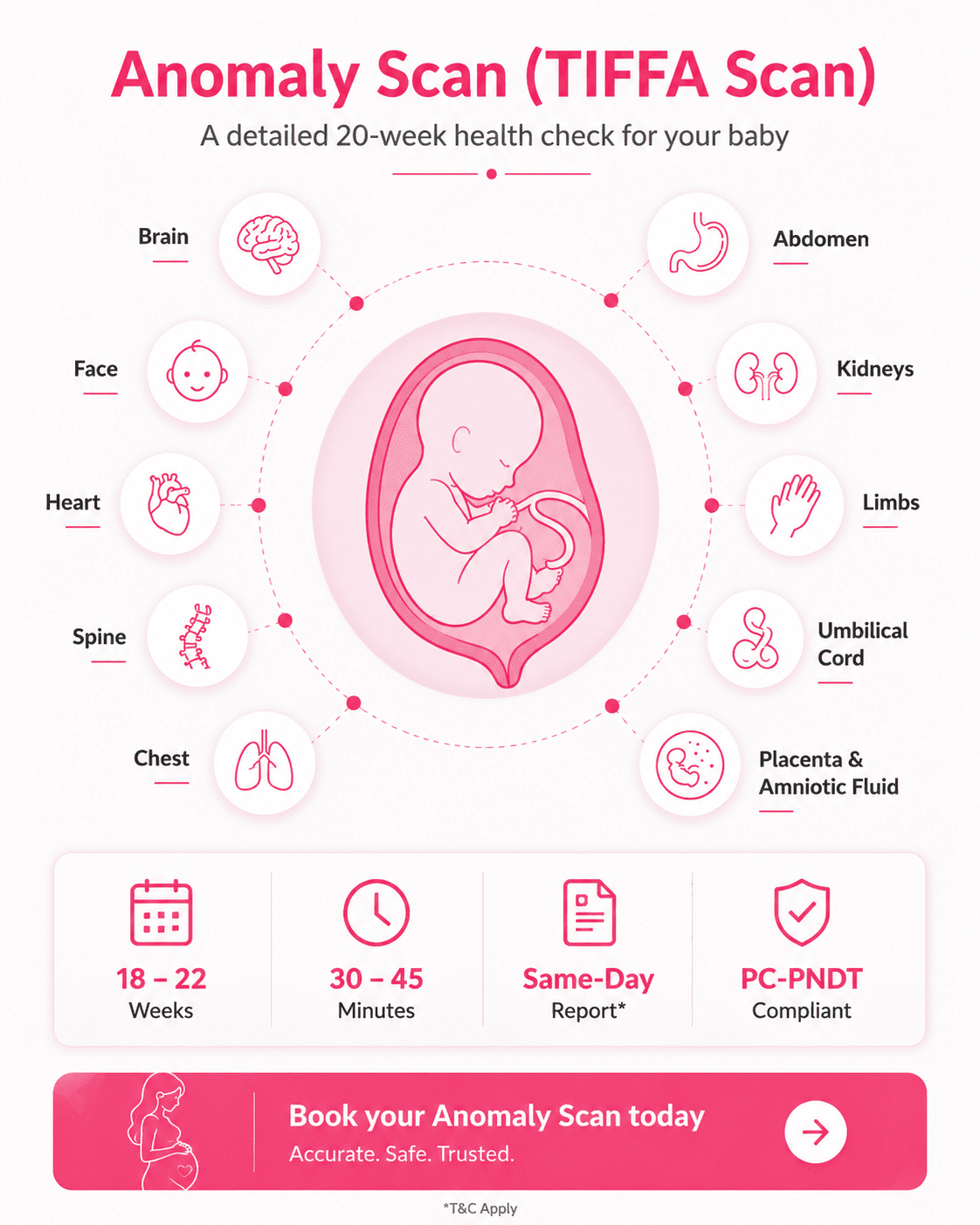
The second trimester TIFFA scan — Targeted Imaging For Fetal Anomalies — also called the anomaly scan, anatomy scan, or Level II ultrasound — is typically performed between 18 and 22 weeks of gestational age. These ultrasound scans observe the fetus for soft markers and structural changes that potentially indicate a risk of serious fetal anomaly.
TIFFA scan and anomaly scan are the same investigation. Both names refer to the same detailed structural survey of the fetus conducted between 18 and 22 weeks. If your gynaecologist has written either term on your referral — book the same scan.
The TIFFA scan is the World Health Organization-recommended mid-trimester ultrasound for all pregnancies. Fetal structural anomalies affect 2–3% of pregnancies. Ultrasound screening has become an essential tool for their detection. Nhmmeghalaya
What the Anomaly Scan Checks — The Complete Structure List
This is not a generic pregnancy scan. The TIFFA protocol is a systematic, head-to-toe survey of 20+ fetal structures. A properly performed TIFFA scan at a trained centre assesses:
|
System |
What Is Assessed |
|
Brain |
Cerebral ventricles (for hydrocephalus), cerebellum, cisterna magna, corpus callosum |
|
Face |
Profile, nasal bone, upper lip (for cleft lip), orbits, jaw |
|
Heart |
Four-chamber view, outflow tracts, size and position, rhythm |
|
Spine |
Vertebral column integrity, skin covering, sacrum |
|
Chest |
Lung appearance, diaphragm integrity |
|
Abdomen |
Stomach (visible = swallowing), liver, kidneys (both present and normal), bladder |
|
Abdominal wall |
Cord insertion — gastroschisis and omphalocele |
|
Limbs |
All four limbs, hands, feet, long bone measurements |
|
Placenta |
Location, appearance, relation to internal cervical os |
|
Amniotic fluid |
AFI (Amniotic Fluid Index) measurement |
|
Umbilical cord |
Three-vessel cord confirmed |
|
Growth parameters |
BPD, HC, AC, FL — confirms size appropriate for dates |
|
Cervix |
Length if clinically indicated |
The scan takes 30–45 minutes because each structure must be systematically identified and documented. A scan that takes 10–15 minutes is not a complete TIFFA survey.
The Honest Detection Rate — What the Anomaly Scan Can and Cannot Find
This is the section most pregnancy scan pages omit. Including it is both clinically important and trust-building.
Studies report overall detection rates for fetal anomalies ranging from 46% to 76%, with significant differences across organ systems.
Research shows that a single-stage anomaly scan screening detects around 50.5% of abnormalities. When combined with first-trimester screening in a two-stage approach, the detection rate improves significantly to about 83.8%.
Detection varies widely by anomaly type:
|
Anomaly |
Detection Rate |
|
Abdominal wall defects (gastroschisis) |
~96% |
|
Skeletal dysplasias |
~94% |
|
Neural tube defects (spina bifida) |
~90% |
|
Major cardiac defects |
~60–75% at specialist centres |
|
Cleft lip (with or without palate) |
~75% |
|
Renal (kidney) anomalies |
~85% |
|
Digestive tract abnormalities |
~33% |
|
Chromosomal markers (soft markers) |
Variable |
What this means for your scan:
A normal anomaly scan significantly reduces the probability of a major structural anomaly — it does not eliminate it. Some anomalies — particularly mild heart defects, subtle brain changes, and digestive tract conditions — may not be detectable at 18–22 weeks regardless of the quality of the scan.
Every anomaly scan report in India is accompanied by a disclaimer — signed by the patient — acknowledging that some fetal abnormalities may not be detected due to technical limitations. This is not a legal evasion. It is a clinical reality that every parent attending an anomaly scan should understand before the appointment.
A normal anomaly scan is genuinely reassuring. It is not an absolute guarantee.
Anomaly Scan at a Standalone Centre vs Hospital — The Honest Answer
This is the most common question EVE receives from pregnant patients in Delhi.
For a low-risk pregnancy with no prior abnormalities — a well-equipped NABL-accredited standalone diagnostic centre with a trained obstetric sonographer is clinically appropriate for the anomaly scan.
When to choose a Fetal Medicine Specialist (FMS) centre:
|
Situation |
Choose FMS Centre? |
|
First pregnancy, age under 35, normal NT, no risk factors |
Standalone trained centre is appropriate |
|
Age 35 or above |
FMS recommended |
|
Elevated NT or high-risk combined first-trimester screen |
FMS required |
|
Previous pregnancy with chromosomal or structural anomaly |
FMS strongly recommended |
|
Family history of congenital heart disease |
FMS — cardiac focus |
|
Diabetes, hypertension, or significant maternal illness |
FMS recommended |
|
Twin pregnancy |
FMS recommended |
|
Abnormal double marker or NIPT result |
FMS required |
What makes a standalone centre appropriate:
- Trained obstetric sonographer with documented TIFFA experience
- High-frequency ultrasound machine — Voluson E8, GE Logic, or equivalent
- Ability to perform cardiac views including four-chamber and outflow tracts
- Reports the complete TIFFA checklist — not a partial survey
What EVE confirms before booking your anomaly scan: Whether the centre performs the complete TIFFA protocol, sonographer experience in obstetric anomaly scanning, and whether a Fetal Medicine Specialist is available at that location for high-risk referrals.
Anomaly Scan Cost Delhi 2026 — Complete Price Guide
|
Option |
Cost (₹) |
Appropriate For |
|
Standalone NABL centre — standard TIFFA |
2,000 – 5,000 |
Low-risk pregnancy, no prior abnormalities |
|
Standalone NABL centre — TIFFA with fetal echo |
5,000 – 9,000 |
If cardiac concerns or family history of CHD |
|
Fetal Medicine Specialist centre |
5,000 – 12,000 |
High-risk pregnancy, previous anomaly, elevated NT |
|
Private hospital (Fortis, Max, Apollo) |
5,000 – 12,000 |
Where obstetrician is based at that hospital |
|
CGHS rate — NABH-accredited centre |
1,700 |
CGHS beneficiaries with valid referral |
All standalone prices from EVE Healthcare partner centres — NABL-accredited diagnostic centres in Delhi NCR. Prices verified June 2026.
EVE Healthcare Insight — Anomaly Scan Booking Data Delhi NCR 2025–2026
|
Metric |
Data |
|
Most common gestational age at booking |
19–20 weeks |
|
Average booked price |
₹3,500 - ₹4500 |
|
Most booked area |
South Delhi |
|
Most common repeat scan reason |
Suboptimal fetal position |
The PC-PNDT Requirement at Every Anomaly Scan
Every centre performing obstetric ultrasound in India is legally required to be registered under the PC-PNDT Act (Pre-Conception and Pre-Natal Diagnostic Techniques Act, 1994).
What you will need at the centre:
- Form F — completed at the centre (staff provide it). Records the clinical indication for the scan.
- Aadhaar card — mandatory for identity verification
- Gynaecologist's referral letter — confirms the clinical indication
- Previous scan reports — particularly the NT scan report if done
The sex disclosure law: The fetal sex will not be communicated — not by the sonographer, not by gesture, not indirectly. This is a criminal law violation carrying imprisonment of up to 3 years. It applies to all diagnostic techniques including ultrasound, NIPT, amniocentesis, and CVS. Do not ask.
Companion policy: Varies by centre. Most Delhi NCR centres allow one companion in the waiting area. Some restrict companion access to the scan room itself due to PC-PNDT compliance. Confirm when booking.
What Happens During the Anomaly Scan
A step-by-step walkthrough — because most patients have never had a 30–45 minute ultrasound before and do not know what to expect.
Before the scan: You will be asked to have a moderately full bladder — drink 2–3 glasses of water 30–45 minutes before your appointment. Not completely full — comfortably full. You will also complete Form F at the centre.
During the scan: You lie on your back on the examination couch. Ultrasound gel is applied to your abdomen. The sonographer places the probe on your skin and begins the systematic survey — starting typically with the fetal head and working down.
The scan takes 30–45 minutes. The sonographer may ask you to move position, walk around, or return in 20–30 minutes if the fetus is not cooperating. This is normal — fetal position significantly affects the ability to visualise certain structures. The cardiac views in particular require the fetus to be in a specific orientation.
After the scan: The report is typically available within 30–60 minutes at EVE partner centres. Digital delivery by WhatsApp or email is available.
What Happens If the Anomaly Scan Finds Something
This is covered in detail in our complete pregnancy ultrasound guide. The short version:
Minor soft marker (choroid plexus cyst, echogenic intracardiac focus, mild pyelectasis): Your risk is recalculated with all findings together. NIPT may be discussed. Most soft markers resolve on follow-up and the majority of babies with isolated soft markers are born healthy.
Uncertain finding: Repeat scan at 24–26 weeks by a Fetal Medicine Specialist. The majority of uncertain findings resolve on repeat imaging.
Major structural anomaly: Immediate referral to Fetal Medicine Specialist. Detailed cardiac echo if heart is involved. Genetic counselling. Full clinical discussion of what was found and what the options are.
The most important instruction: If the sonographer indicates a finding — do not attempt to interpret the report alone before speaking with your gynaecologist. Call your gynaecologist the same day and request an urgent review appointment.
Anomaly Scan Near Me — Delhi NCR Area Guide
|
Area |
Price Range |
FMS Available |
Same-Day Report |
CGHS |
Metro |
|
South Delhi (Saket, GK, Hauz Khas) |
₹2,500 – ₹9,000 |
Yes (select) |
Yes |
Yes (select) |
Yellow / Violet |
|
West Delhi (Dwarka, Janakpuri) |
₹2,000 – ₹7,000 |
Select |
Yes |
Yes |
Blue Line |
|
North Delhi (Rohini, Pitampura) |
₹2,000 – ₹7,000 |
Select |
Yes |
Yes |
Red Line |
|
Noida (Sector 18, 62) |
₹2,000 – ₹7,000 |
Yes (select) |
Yes |
Yes (select) |
Blue Line |
|
Gurgaon (DLF, Sector 38, 56) |
₹2,500 – ₹9,000 |
Yes (select) |
Yes |
Yes (select) |
Yellow Line |
CGHS Rate for Anomaly Scan in Delhi
|
Investigation |
Non-NABH Rate (₹) |
NABH Rate (₹) |
|
Level 2 / Anomaly Scan (TIFFA) |
1,445 |
1,700 |
|
Fetal Echocardiography |
1,808 |
2,125 |
Source: CGHS Rate Schedule effective October 2025, Ministry of Health & Family Welfare, Government of India.
Bring your CGHS Smart Card and a valid referral letter from your CGHS CMO or empanelled gynaecologist. Confirm CGHS empanelment before visiting. Note that Form F and Aadhaar are required at all centres regardless of payment method.
Clinical Note
From the reviewing fetal medicine specialist: The anomaly scan question I am asked most often by patients in Delhi is: "Should I pay extra for the hospital scan or is the standalone centre fine?" My honest answer depends on one thing — whether the centre performs a complete TIFFA protocol. A 30–45 minute systematic survey of 20+ structures by a trained obstetric sonographer on a good machine is what the anomaly scan requires. That can happen at a standalone NABL-accredited centre. What it cannot happen at is a centre where a general radiologist performs a 10-minute pregnancy scan and calls it a TIFFA. The institutional label — hospital versus standalone — matters less than the sonographer's training and the time taken. For low-risk patients, an experienced obstetric sonographer at an accredited standalone centre in Delhi is clinically appropriate. For my high-risk patients — elevated NT, prior anomaly, multiple pregnancy, family history of congenital heart disease — I want them at a Fetal Medicine Specialist centre where detailed cardiac views, soft marker interpretation, and same-day counselling are available together.
Book Your Anomaly Scan in Delhi
EVE Healthcare partner centres offer complete TIFFA / Level 2 anomaly scans across Delhi, Noida, and Gurgaon — accredited diagnostic centres, experienced obstetric sonographers, same-day reports, and CGHS rates at empanelled centres.
When booking: tell our team your gestational age, whether you have a high-risk referral, and whether your gynaecologist has specifically requested a Fetal Medicine Specialist for the scan. We confirm the TIFFA protocol and sonographer experience before confirming your appointment.
WhatsApp +91 9990032078 or use the search tool at eve-healthcare.com.
Also see: Ultrasound During Pregnancy India → · NT Scan Cost Delhi → · Growth Scan Cost Delhi → · Fetal Echo Cost Delhi → · CGHS Diagnostic Centres Delhi NCR → · Anomaly Scan Found Something

.png)